


Usually at a restaurant, the owner wants you to order as much food as you can. That’s how their business grows. An all-you-can-eat buffet is the only restaurant setting where the owner hopes you don’t. The appetite of the diner is at odds with the business that’s feeding them: you want more, they want you to eat less. Every ounce of food you load up on is a cost to them once you’ve paid your entry fee.
That tension is one of the areas Heather Haddon of the Wall Street Journal explored in her recent piece on Golden Corral, the infamous all-you-can-eat buffet restaurant serving three meals a day with items including their signature steakburgers, Bourbon Street Chicken, pot roast, meatloaf, and fried chicken.
A Golden Corral averages about 150 items. The company carefully arranges them into what it calls “meal modules,” which combine pricier dishes with cheaper ones. Shrimp is next to hush puppies and fries. Meatloaf is next to potatoes, gravy, and green beans. They can flex these items too, as they did when beef prices spiked, adding a whole fried pork chop to the line that cost about 40% of what the sirloin steak did, giving people a steak-like thing without serving a beef steak.
Like a chessboard with the pawns standing in front of the higher-value pieces, the buffet line is carefully designed so the carbs and vegetables absorb the brunt of your hunger before the proteins do. That’s what CEO Lance Trenary implied when he said, “We have to be pretty creative in the way that we present our menu.”
As I said in the title, all-you-can-eat buffets make me sad. I don’t like them. At best, they’re a big bummer for me, and at worst, they totally gross me out. The Golden Corral piece highlighted just one of the things that make me uncomfortable about them: the game that management and customers have to play to make the business model work. It’s hospitality with a heavy dose of gamesmanship on both sides, each trying to come out ahead.
But the bigger thing that bothers me about these buffets is how they symbolize the way a lot of Americans think about food, which is prizing quantity above quality. Our food supply creates about 4,000 calories per person, per day. That’s roughly double what the average adult needs, which I wrote about this past summer. And with that much food, the default way to think about it has become cheap and plentiful, which is a short step away from treating food as something that’s disposable.
More Is More
American buffets were introduced in Las Vegas in the 1940s as a loss leader to attract gamblers. Keep them fed and they’d stay and gamble longer, overpaying many times over for their seemingly free prime rib dinner at the blackjack table. No one in casino management expected the food to pay for itself. Whatever got thrown out was covered by gambling revenue.
The part that depresses me is what all-you-can-eat can do to some people. I’ve been to fancy Vegas hotel buffets where people who were clearly well-to-do elbowed each other out of the way, trying to grab as many crab legs as they can the second a buffet worker drops a fresh tray on the line. This has been documented over and over on the less savory parts of the internet that traffic in such spectacular nonsense, like here, here, and here. These people aren’t starving in any sense of the word. They can afford the food, but they still fight over it like scavengers.
My grandparents took my brother and me to buffets like this a lot when we were kids, so I’ve been to more of these than I’d like to admit. Most of the time, fights didn’t break out. And my feelings about buffets are complicated by the fact that we mostly saw regular middle-class families who wanted an affordable way to feed everyone. I’m glad that affordable places like these exist, and it can be a treat for a family on a budget to pay a flat fee and eat like a king or queen for a night. Who am I to judge how someone feeds their loved ones?
But it still bums me out that more people can’t afford food made with a bit more care and thought. It bothers me that a country with this many billionaires also has this many people who have to watch every food dollar. I’m not naive enough to think everyone is going to reorganize their lives around eating at a farm-to-table restaurant every night. I just wish fewer people had to play the quantity game, hunting for as much food as cheaply as they can, and more had the luxury of being selective about what they eat. Good food is a right for everyone.
Jack of All Trades
Buffets aren’t alone in wiring our food system around quantity. You can see the same thing in Big Gulps, Never Ending Pasta, and Endless Shrimps. Then there’s a place like The Cheesecake Factory, with over 250 items on its menu, 100 more than a Golden Corral buffet. And I get why it works: a whole family can get exactly what each of them wants. The operations at The Cheesecake Factory are staggering in their complexity, all in service of giving every diner a ludicrous amount of choice.
Is this a uniquely American phenomenon? Or did we just do it with a certain panache that is awe-inspiring and kinda lewd at the same time?
Japan sticks out in my mind as a counterexample to restaurants that pride themselves on precariously expansive menus. Sure, Japan has all-you-can-eat options too, but the defining feature of its food culture is the vast number of restaurants that focus on just one thing. I’m talking about the ramen place that specializes in just one type of broth. The sushi spot that only does a specific type of pressed sushi. Or the fancy tempura omakase in Ginza. In Japan, I get a strong sense of focus over variety compared to America. Those places aren’t trying to be everything to everyone. Instead, they double down on one thing and spend their lives perfecting it.
This year we lost Carlo Petrini, who founded the Slow Food movement in 1986 after he watched a McDonald’s open in Rome, near the Spanish Steps. His idea was simple and powerful: food is worth slowing down for. And I think both ideas are beautiful: the ramen cook spending their life mastering tonkotsu broth, and Petrini’s philosophy that this kind of quality should be deeply enjoyed, respected, and compensated.
I wish more of the American restaurant landscape revolved around these ideas. A lot of it does, but at a price that isn’t accessible to everyone. There’s a double injustice here: plenty of people would benefit from quality food but can’t afford it, and the people who put in the effort to grow and cook it are deemed too expensive in a food culture saturated with cheap options. Is Slow Food too expensive, or is fast food too cheap?
For now, a $120 Slow Food-inspired farm-to-table dinner is not reaching the family deciding between the drive-through and splurging on the buffet. We have a lot of work to do to connect these two poles of the food system. Maybe what we’re looking for is not Fast Food or Slow Food, but Medium Food?
The Cost of Cheap
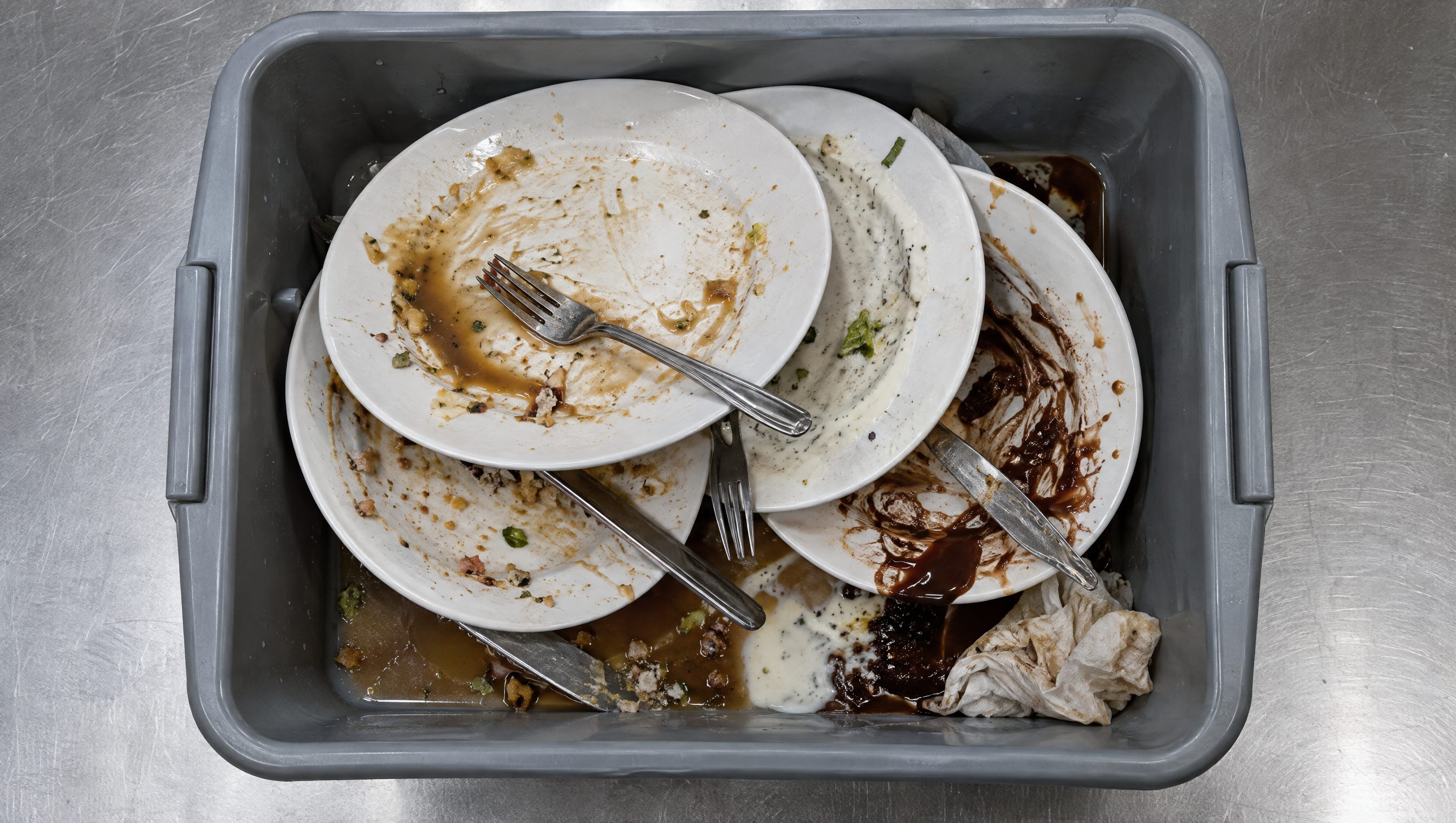
If food is cheap for a long enough time, you stop taking care of it. It becomes inevitable. Banal. That’s what the buffet is a microcosm of. And it follows us home. If a bag of spinach costs $3, you buy two and carelessly let one of them liquefy in the back of your fridge. Because who cares? It’s only $3. And you bought two because the idea of running out to get more is scarier than letting an extra bag rot.
This spinach thing happens at every scale in the food system. If it rains on a weekend and everyone stays home, then a restaurant that stocked up for a weekend rush scrambles to sell it all the following week or throws it out. A grocery store overstocks the produce wall and then has to toss a lot of it. A buffet diner takes three scoops of mashed potatoes and doesn’t touch them, because why not?
If you spent $500 at the grocery store then came home and lit it all on fire, everyone would think you lost your damn mind. But that is what happens every day in millions of pockets of the food system. Add it all up and it isn’t $500 of waste, it’s $325 billion of it, in 2024 alone. A lot of people bear that cost. And it’s a shame not only financially, but also for all the people that food could have fed and didn’t.
Cheap food has gravity. Because if food is cheap enough to waste, then the land it grows on needs to be cheap. The water needs to be cheap. The animals need to be cheap. And the people who harvest, handle, cook, and clean up after it have to be cheap too. I’ve written about this before, the human cost of our food system: when every other part of the food system has had the cost optimized out of it, the only place left to pull from is the people.
Yet after all that effort to make food cheap, we still haven’t fucking solved hunger.
The problem I don’t yet know how to solve is how we get more nutrient-dense, uniquely flavorful food into places that are as accessible as a Golden Corral. How might we rewrite the food system so that respect for quality, and for the people who create that quality, becomes its new center of gravity?
Maybe we first need to consider that “cheap” was never the endgame of the modern food system. And in a country that grows 4,000 calories for every man, woman, and child every day of their lives, we owe it to ourselves to spend a little more time caring about how good a few hundred of them are.
—
Mike Lee is a food futurist and innovation strategist, author of Mise: On the Future of Food, host of The Tomorrow Today Show podcast, creator of Mise Futures, and is on Instagram at The Book of Mise.
Thanks for this article! I'm with you on not being a fan of all you can eat buffets. Such spots definitely profited $ from my handful of visits, as excess intake of low-to-medium quality food isn't my cuppa tea. This is true, in part, because of my registered dietitian (RD) credential. Also, I eat slowly. Thanks for presenting the case on how America has "cheapened" food in many ways, with much broader consequences. :(