


Forty-two guests paid $1,500 each. Tickets sold out in sixty seconds. Outside the Paramour Estate in Silver Lake, on the opening night of Noma’s residency in Los Angeles, Jason Ignacio White stood with former employees and a demand letter signed by former Noma employees and One Fair Wage. He had spent five years running Noma’s fermentation lab. He had collected more than 56 testimonies. The letter called for settlement of legal claims, immediate reparation for prior harms, and changes to the company’s management and employee policies. It cited physical and emotional abuse, failure to pay wages, and described the restaurant industry’s wage structure as a direct legacy of slavery.
The New York Times had 35 interviews describing years of physical assault, body shaming, public humiliation, and threats to blacklist anyone who spoke up. American Express pulled its sponsorship. The pop-up continued, fully booked, through June.
That evening Redzepi posted a video on Instagram. Disheveled, perspiring. Staff crying behind him. Comments disabled. Multiple camera angles. A camera person working the room, hustling for coverage, finding the shot. The edit was clean. The whole thing was cinematic — cinema verité, but produced, the chaos carefully framed. At one point Redzepi spoke about his aspirations for what came next, and it tipped briefly into pitch territory.
Maybe for an organization where obsessive attention to detail had been drilled into everyone, this was genuinely their version of a hastily made emergency statement. But what landed was a production that felt more self-aware than empathetic, more interested in its own narrative than in the 35 people whose accounts had forced the moment. This had PR fingerprints all over it.
Then it ended. Redzepi led the team in their signature send-off — “have a good service” — followed by their collective clap in unison, cut to black. I’ll be honest: I got goosebumps. It was that crisp, that dramatic. The videos that followed on their Instagram account showed the remaining team running the pop-up, Redzepi nowhere in sight — a kind of welfare check proving that dad had actually moved out of the house. The brand pivoted forward, carried by the people he left behind, and if your only concern was protecting the Noma name, it was masterfully executed. It just never addressed the victims. To me, it didn’t feel like closure. It felt like a successful getaway.
Awards Are Power
Noma was the most celebrated restaurant on the planet for a while, ranked number one five times by the World’s 50 Best Restaurants. What I took from Redzepi’s work: he drew a hard line around Copenhagen and refused to cross it. Fermented berries, sea buckthorn, insects — made transcendent through technique, not imported prestige. You didn’t need French or Italian convention to be taken seriously at that level. I believed that then, and I still do. But I took that lesson a long time ago, and Redzepi kept accumulating power long after anyone needed to give him more.
The mythology that magazine editors, documentary producers, award voters, and culinary schools built around him concentrated authority in one person, and nobody thought to check it. Nobody in that machine ever asked what was happening inside the kitchen. What they built wasn’t just a reputation — it was a brand more exclusive than any luxury label. You can walk into a Mercedes dealership today. You can order Gucci from your phone. Noma you had to be chosen for, be lucky enough to reach. That allure was so bright that what was happening inside was easy to not see, or easier still, to not look for.
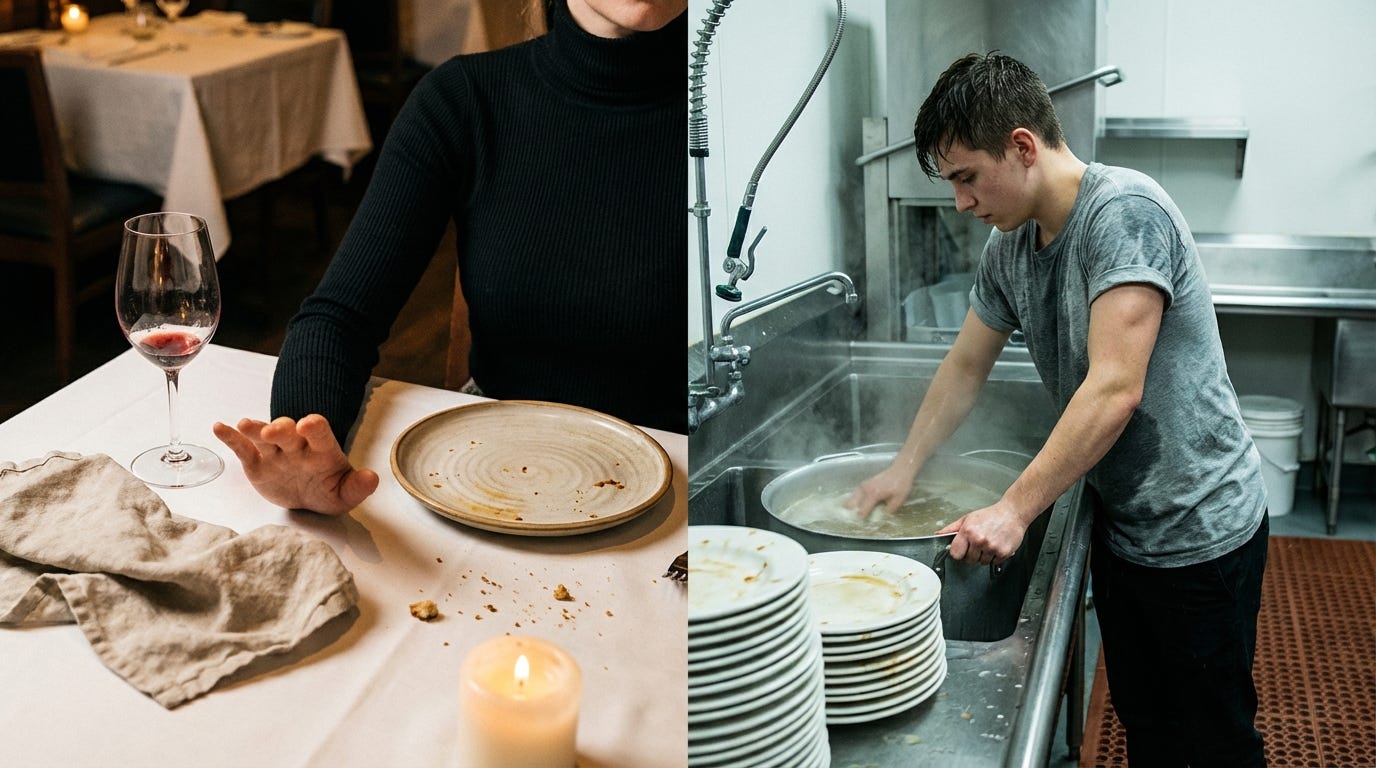
A Financial Times investigation found 30 unpaid interns alongside 34 paid chefs, working up to 70 hours a week. Contracts threatened to blacklist anyone who left early. That’s worth holding onto the next time someone asks why they didn’t just walk out.
Only the most insufferable chef nerds would compare a kitchen stage to being on the 1998 Yankees — but for a certain kind of young cook, it meant about that much. Walking away meant walking away from that. And the contract made sure you knew it would cost you your reputation in the only industry you’d trained for. The exit wasn’t free.
The restaurant extracted millions in owner dividends over several years while calling its model unsustainable. When it began paying interns in late 2022, Redzepi announced the closure within weeks. The business was only sustainable because nearly half the kitchen worked for free.
In 2015, Redzepi had written that he had been “a bully for a large part” of his career. The following year, the Danish government awarded him the Order of the Dannebrog for his contributions to Danish cuisine. The 35 accounts in the Times investigation describe conduct that continued after that essay. A public confession of harm, absorbed by the culture as evidence of growth, that changed almost nothing for the people inside the kitchen.
The apology became a credential. The story it told was entirely about him — his demons, his reckoning, his arc. The people he harmed were backdrop. Once you’ve cast yourself as the protagonist of your own redemption, anyone still being harmed becomes a problem with the timeline, not with the man.
Young cooks stayed anyway. Noma on a resume lasted forever — walk into any kitchen in the world afterward and the conversation changed. For many of them, nothing bad happened. Good for them. But for the ones being abused, the math was probably pretty clear and pretty brutal: three months of this, then your whole professional life shifts. How many of them ran that calculation over and over, trying to decide if they could last? How many decided they could, and did, and paid for it? The abuse was the price some people paid to get there.
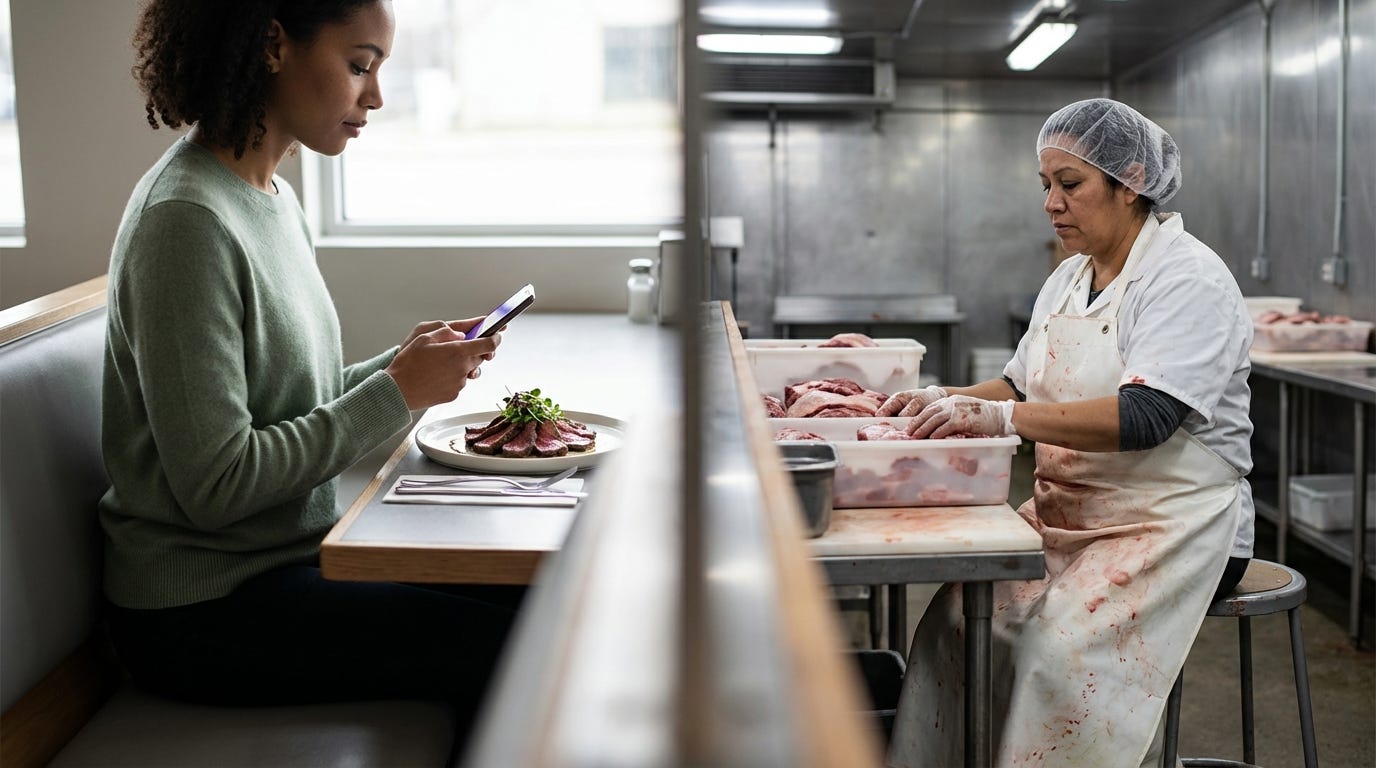
Noma made the news because a famous person was attached to it. Farms, meatpacking plants, and restaurant kitchens without famous people do and have done worse, but you never hear about it.
What the Receipt Doesn’t Show
According to the National Restaurant Association, the United States has roughly 1 million restaurants. The vast majority operate without celebrity chefs, documentary crews, or former employees with media platforms. The federal tipped minimum wage is $2.13 an hour, unchanged since 1991. McDonald’s settled a Michigan harassment case for $1.5 million. Chipotle paid $7.75 million for child labor violations in New Jersey. None of it generated a fraction of the coverage that one chef’s Instagram video produced in a single news cycle. The public pressure that briefly worked in Silver Lake almost never reaches the other 999,999 eateries in America.
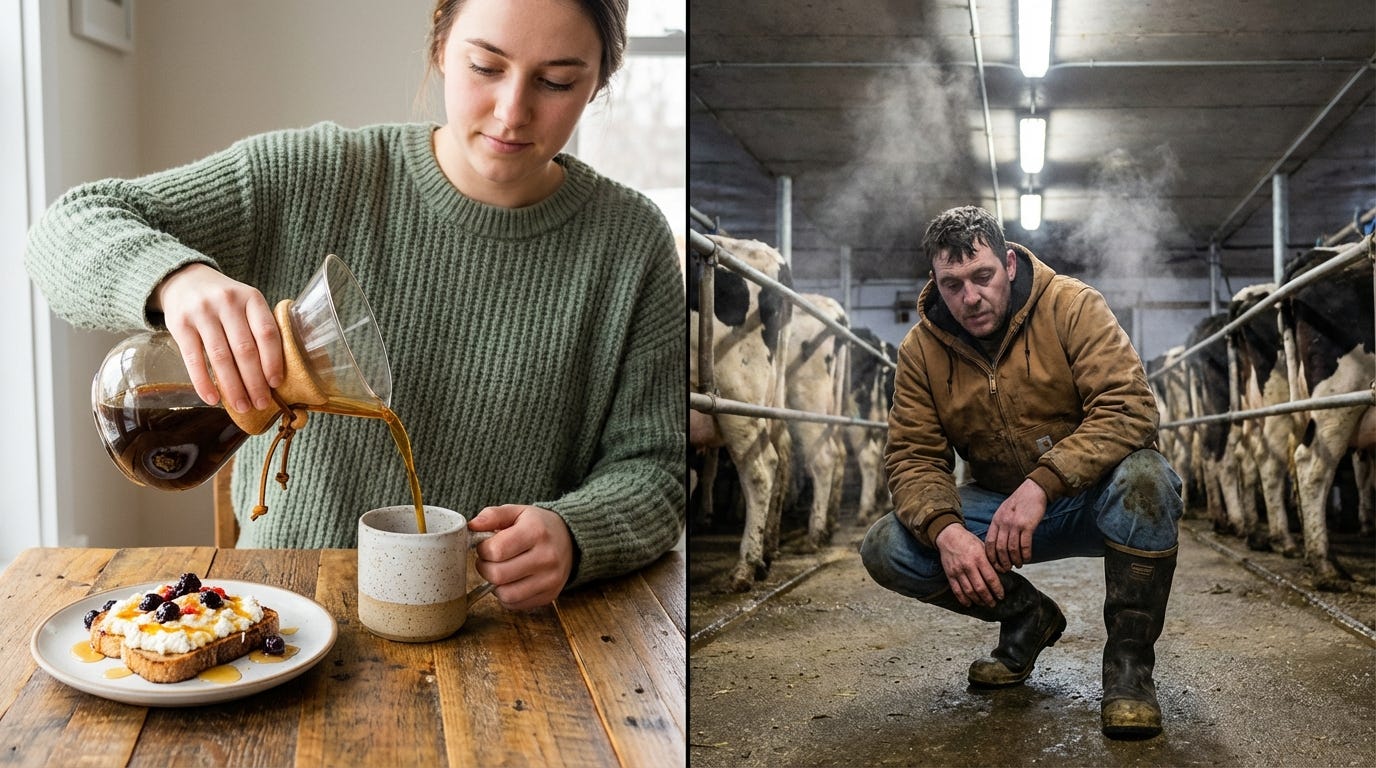
Go further back in the supply chain and the protections thin out fast. The Fair Labor Standards Act exempts farmwork from the overtime rules that cover every other American industry. Children as young as 12 can legally work the fields with parental consent. On small farms, there’s no minimum age at all. Farmworkers die of heat illness at rates far above the general workforce. The EPA estimates tens of thousands of pesticide poisonings among agricultural workers every year. Under the H-2A guest worker visa, laborers are legally tied to a single employer — the same person who controls their working conditions controls their ability to remain in the country. These aren’t oversights. They’re policy choices.
An hour east of Naples, Florida, tomato pickers in Immokalee worked for decades under what federal prosecutors called “ground zero for modern slavery.” Nine prosecutions. Over 1,200 workers freed from forced labor between 1997 and 2022. Locked in trucks. Some chained.
In meatpacking, the scale is industrial. At JBS’s plant in Greeley, Colorado, workers process hundreds of cattle an hour until their hands lock into permanent claw positions. In 2023, Packers Sanitation Services paid $1.5 million after the Department of Labor found 102 children cleaning equipment overnight with caustic chemicals at 13 plants across eight states. A 2016 Oxfam America report documented poultry workers wearing diapers on the line because bathroom breaks were denied. Line speeds: 140 birds per minute. A 2019 Human Rights Watch report on meatpacking carried a title that does the work: “When We’re Dead and Buried, Our Bones Will Keep Hurting.”
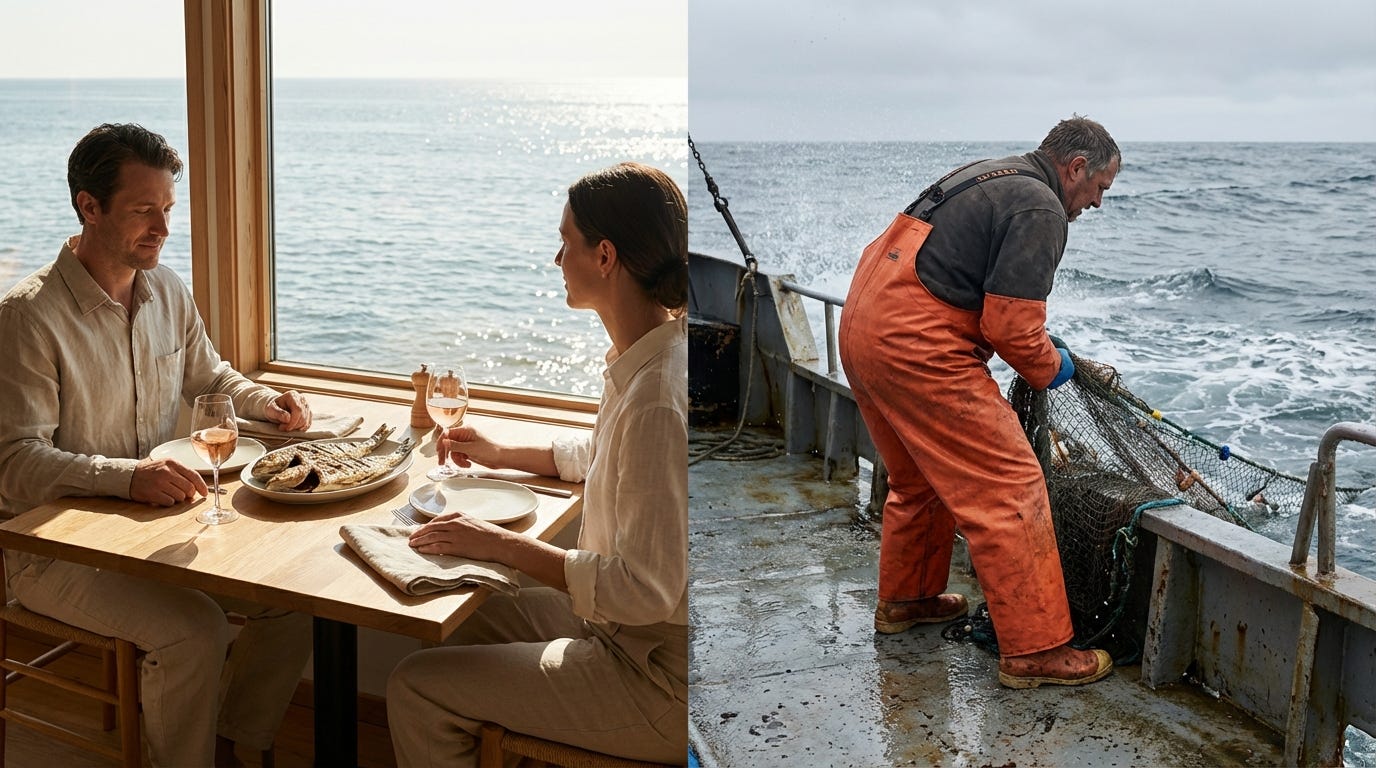
In 2015, an Associated Press investigation traced slave labor on Thai fishing vessels to shrimp sold at Walmart, Kroger, and Red Lobster. Workers held at sea for years. Some beaten. Some disappeared. The AP won a Pulitzer for Public Service. The supply chains were not dismantled.
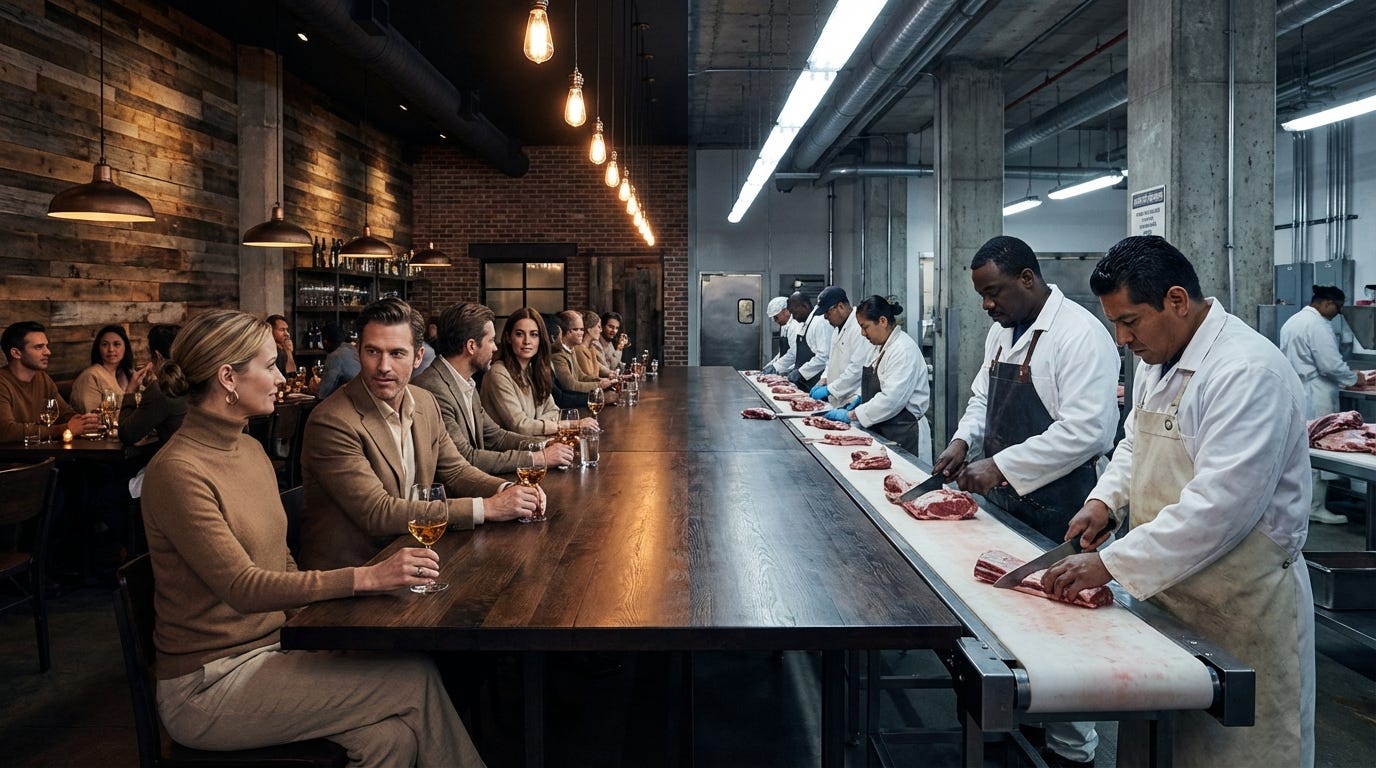
A $1,500 dinner produced by unpaid labor and a $4.99 rotisserie chicken produced by workers whose hands no longer work are the same contradiction at different price points. The abuses differ, but structure doesn’t: limited recourse for the workers, no way of knowing for the people buying the food.
What We Measure and What We Don’t
I’ve spent years watching the food and agriculture industry try to reckon with externalities, the costs that don’t show up on the receipt. Carbon emissions. Fertilizer runoff. Soil depletion. Deforestation. We have, in fits and starts, begun building infrastructure to account for some of these. Organic certification exists. The USDA’s regenerative label is taking shape. Michelin launched a Green Star in 2020 for environmental sustainability, proving that evaluation infrastructure could be built and deployed quickly when the Guide decided something mattered enough to measure.
For everything else, the environmental accounting is patchy, young, and easily gamed. “Carbon-neutral” on a package of beef can mean almost anything. “Regenerative” still has no single legal definition. Organic, the most established certification we have, accounts for roughly 6% of U.S. food sales after decades of growth.
And yet, even that limited, imperfect progress on environmental metrics vastly outpaces anything we’ve done for human worker treatment.
We have labels that tell you whether the chicken was cage-free or whether the cows were grass fed. We care, or we perform caring, about the life the animal lived and the condition the farm is in. We do not have a mainstream, consumer-facing label that tells you whether the person who picked the tomato was paid a living wage. We do not certify that the line worker at the meatpacking plant gets bathroom breaks. We have no widely recognized standard for whether cooks are allowed to work in a restaurant for 70-hours a week for free.
Consumer-facing environmental metrics, limited as they are, have gotten more institutional support in two decades than worker treatment has gotten in a long time. That gap reflects where the investment, market incentives, and consumer attention have pointed, and it suggests that the labor conversation won’t advance on its own.
The Work That Already Exists
There are people doing this work who deserve to be named.
Fair Trade certification guarantees minimum prices and labor standards for producers in developing countries, covering coffee, cocoa, bananas, sugar, and tea, but it applies primarily to imported commodities and doesn’t reach the restaurant kitchen in Chicago or the meatpacking plant in Greeley.
The Coalition of Immokalee Workers went directly to the buyers. The Fair Food Program requires participating retailers to pay a small premium, roughly a penny per pound of tomatoes, that flows down through the supply chain and shows up as a separate line item on workers’ paychecks. Farmers who refuse to comply with the worker-written code of conduct lose access to those buyers entirely.
Since 2011, that model has distributed more than $50 million in direct wage premiums to workers on participating farms. Take-home pay rose 50 to 70 percent. No documented cases of forced labor have occurred on a participating farm since the program launched. It now covers more than 20,000 workers in ten states across nine crops. McDonald’s, Walmart, Whole Foods, Trader Joe’s, and Subway are in. Kroger and Publix are not, and workers on their suppliers’ farms remain outside its protections.
The Equitable Food Initiative certifies farms on labor practices, food safety, and pest management simultaneously, with workers participating in the auditing process. Regenerative Organic Certified, developed by Rodale Institute, Patagonia, and Dr. Bronner’s, builds worker welfare directly into its soil-health framework. B Corp evaluates companies across governance, workers, community, and environment. These are different mechanisms with the same basic argument: purchasing power, aimed at labor conditions, changes them.
What all of these efforts share is proof that the model works when people decide to back it. Organic certification didn’t start big. Carbon labeling is still finding its footing. Someone decided those things were worth building, and institutions followed. The awards bodies, major retailers, and restaurant groups haven’t made the same call on worker treatment. They haven’t made it a condition of doing business the way they have with environmental standards. But they could.
Redzepi’s pop-up runs through June, fully booked. Former Noma employees and their supporters stood outside while every seat inside was already taken. The guests watched, said nothing, and kept eating.
We know what the chicken ate. We have no idea whether the person who processed it can walk off the floor at the end of a shift. That gap isn’t an accident. It’s a choice we keep making every time we hand over a menu, scan a label, or give out an award without asking who made the food and what it cost them to do it.
—
Mike Lee is a food futurist and innovation strategist, author of Mise: On the Future of Food, host of The Tomorrow Today Show podcast, creator of Mise Futures, and is on Instagram at The Book of Mise.