


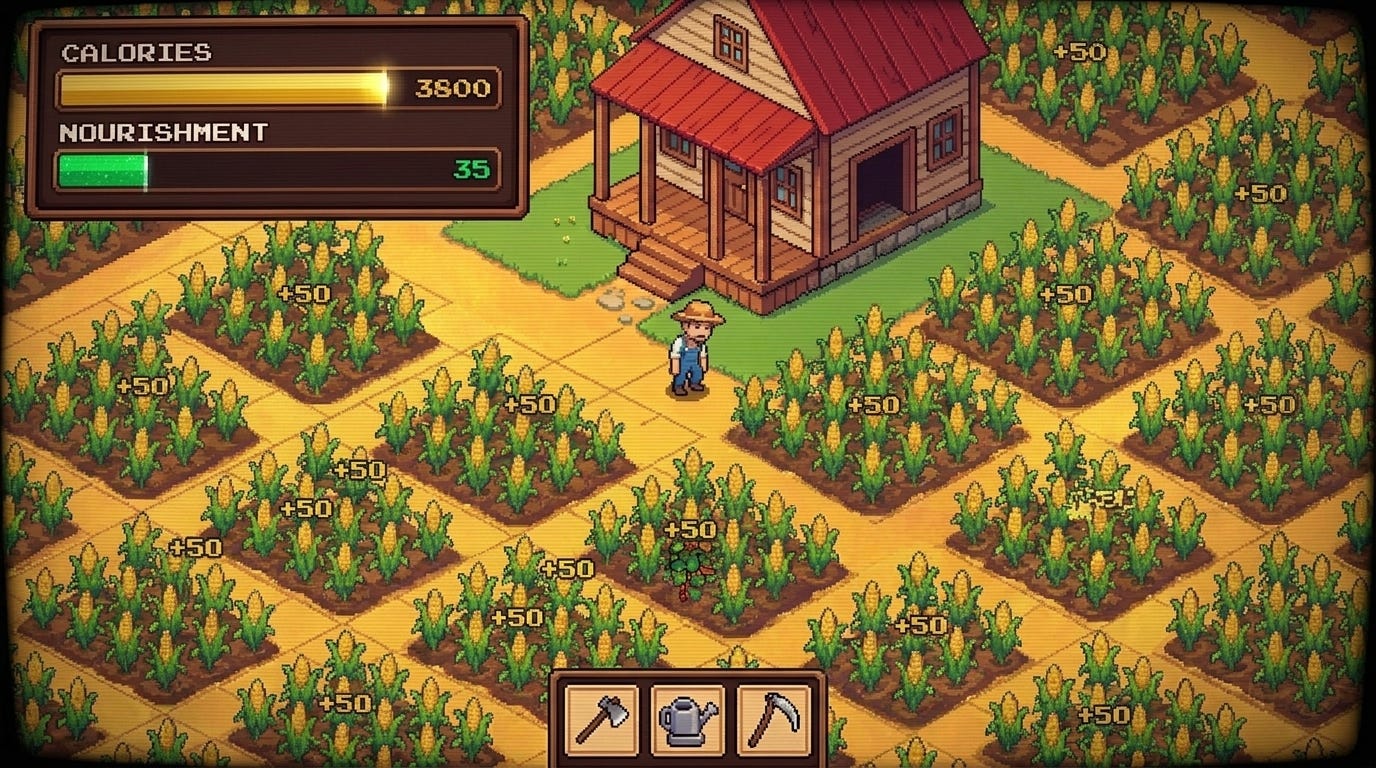
In 1946, Congress passed the School Lunch Act and justified it with a phrase that reads strangely for a program about cafeteria trays: “a measure of national security.” The logic came off the battlefield. Military examiners had rejected draftees by the hundreds of thousands during World War II, and General Lewis Hershey, who ran the Selective Service, blamed much of it on poor childhood nutrition. Feeding kids had become defense policy.
This spring, the House passed its version of the farm bill under a name that borrows the old language: the Farm, Food, and National Security Act of 2026. Same phrase, eighty years later, still on duty. The Senate is working through its own version now.
But the military’s food problem has flipped. The retired admirals and generals who publish under the banner Mission: Readiness have spent more than fifteen years warning that most young Americans can’t qualify to serve, and excess weight now sits near the top of the reasons. Recruits once couldn’t serve because they weighed too little. Now they can’t serve because they weigh too much.
The national-security language survived into the 2026 bill. The underfed recruit behind it did not. And because this bill will set American food policy for the next five years, now is the moment to ask whether “make more food” still deserves to be the central mission.
The Right Answer to a Different Question
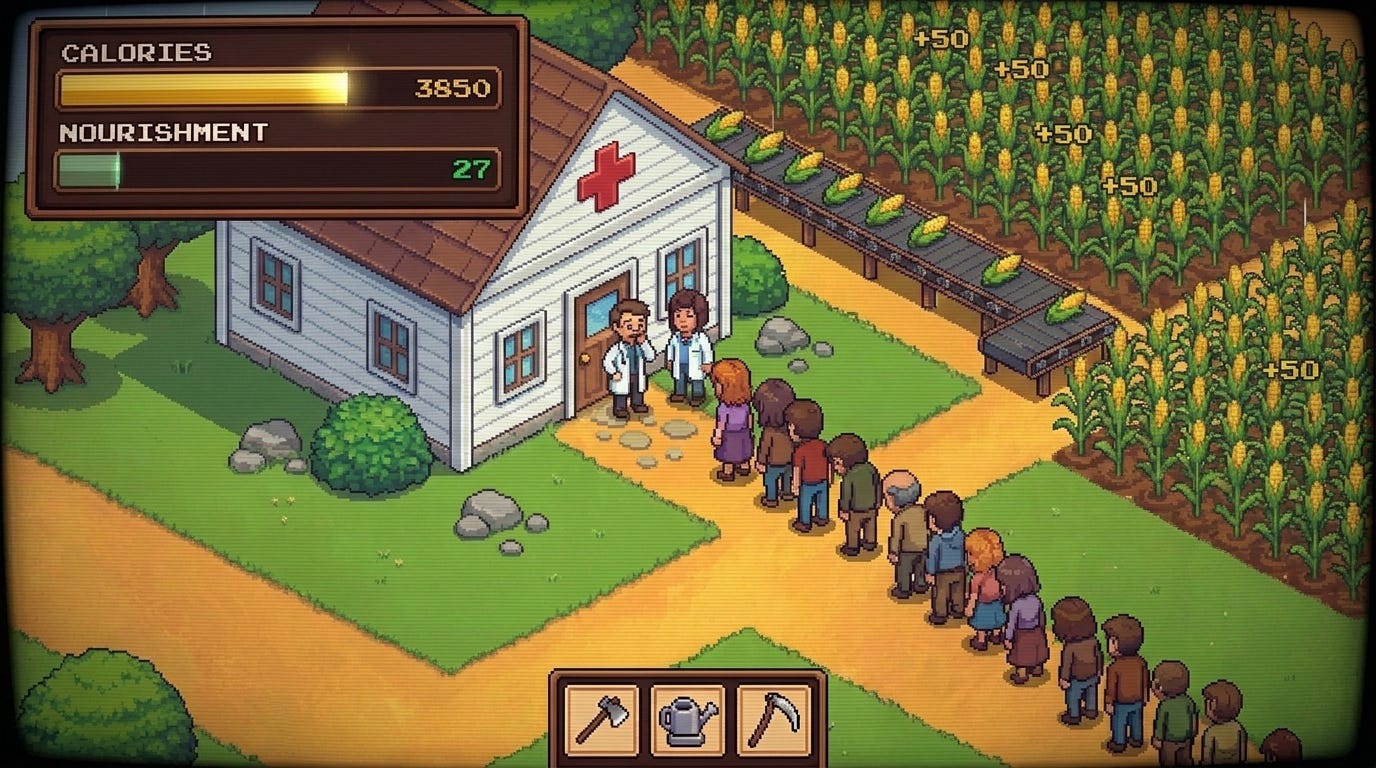
It helps to remember what the world was like back when “make more food” was the obvious mission. The people who built the Green Revolution had lived through the Dust Bowl and the Depression. They had lived under rationing. They read serious scholars insisting global famine had a date on the calendar. Paul Ehrlich’s The Population Bomb predicted in 1968 that hundreds of millions would starve within a decade, and William and Paul Paddock put the date in their book title: Famine 1975!
Against that backdrop, “make more food” was close to a moral obligation. If you believed the projections, every extra bushel was a life saved. Norman Borlaug went to Mexico in 1944 to breed high-yield wheat, and he and the other founders of the Green Revolution ran on that math. On their own terms they delivered: yields multiplied, and the scheduled famines mostly never arrived. I’ve written before about the tradeoffs bundled into those gains, so I’ll leave them aside.
That logic still holds across much of the world. Where a country can’t yet put enough calories in front of its people, “make more food” is the right mission, and only a well-fed country earns the luxury of contemplating the provenance and production of its own diet.
The trouble is that “make more food” worked so well it calcified into permanent policy. Every institution built to answer the quantity question kept optimizing for it long after the question was answered, which is what institutions do when nobody hands them a new question. Subsidies, research budgets, crop insurance, commodity markets: all of it still keeps score in volume.
By 1973, Agriculture Secretary Earl Butz could compress the whole mission into a slogan, telling farmers to plant “fencerow to fencerow” and to “get big or get out.” That was the last explicit mission statement American agriculture received, and fifty years on it is still the one taped to the wall.
Enough Food, Wrong Places
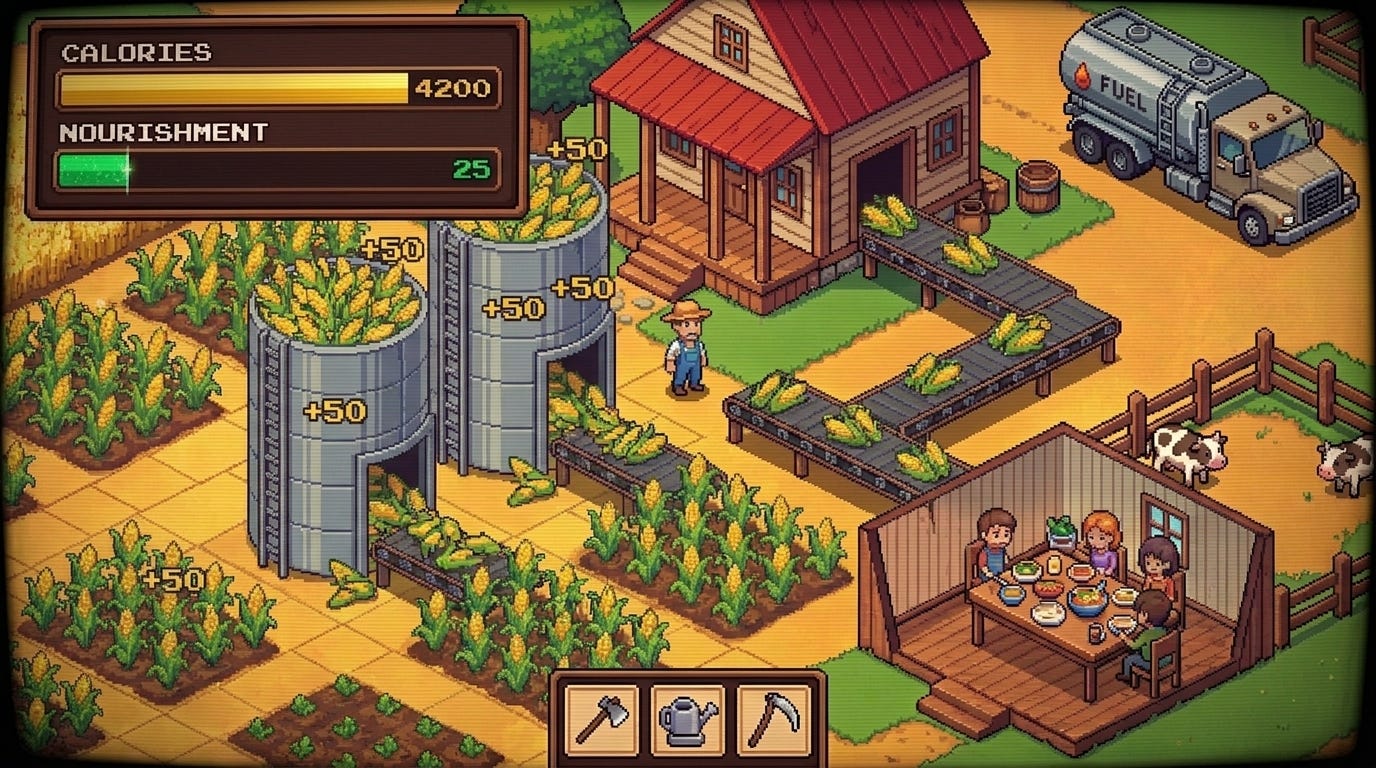
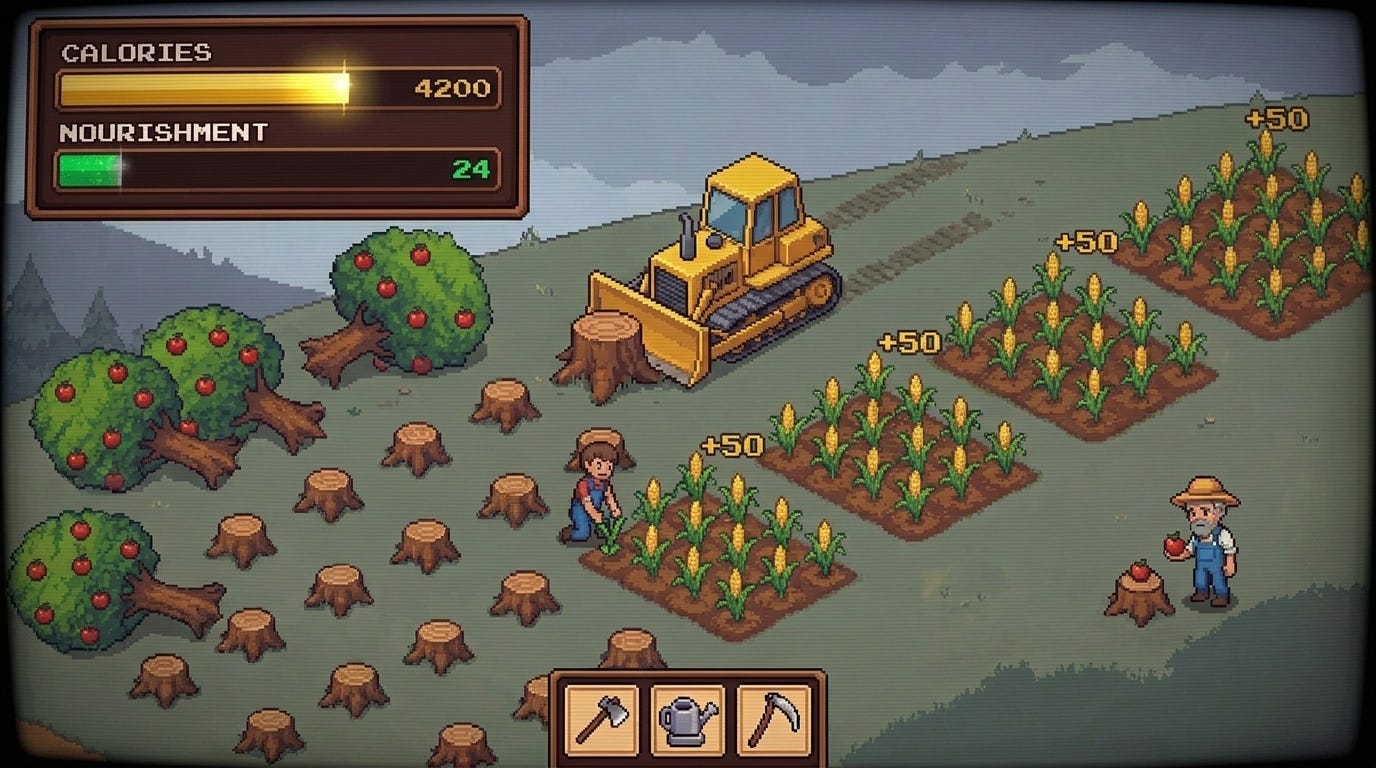
The American food supply now provides nearly 4,000 calories per person per day, by USDA’s food availability data. That is nearly double what a body needs, and roughly a third of it goes uneaten. The job of growing more food is finished, and has been for decades.
Yet USDA also counted 18.3 million food-insecure households in 2024, in the same country where about four in ten adults live with obesity. Those facts sit awkwardly together until you stop reading them as a supply story. A nation that grows twice the calories it needs and still has hungry citizens has a routing problem. The food exists. It travels to the wrong places, in the wrong forms, at the wrong prices. Obesity and hunger here are not opposite problems but the same routing failure seen from two sides, and they sometimes live in the same household.
The 2026 farm bill mostly declines to see it that way. You don’t need all 800 pages to catch the pattern. The money still flows to the big calorie crops, corn and soy and wheat. About a third of that corn goes into ethanol and roughly another third into livestock feed, so much of what we subsidize never reaches a plate as food. Fruits and vegetables, the foods every dietary guideline begs us to eat more of, sit under the heading “specialty crops.” And the food assistance that routes surplus toward hungry people got cut last year and stays cut in both versions. We keep feeding the production engine while pinching the valve that sends its output where it’s needed.
Congress seems to half-sense the mismatch, and the bill contains one tell. Tucked into the House version is a line saying food assistance exists to further the health of the people it feeds. Small as it is, that sentence carries a large mindset shift.
Calories and nourishment are not the same thing: you can fill someone with calories and still leave them undernourished. Cheetos contain calories, but no nourishment. For the first time, the law would say plainly that the point of the program is nourishment. It is the right question, sitting in the fine print of a bill whose headline still answers the old one.
No one here is quite a villain, but no one is off the hook either. A senator from a corn state defending crop subsidies is protecting her seat and the farmers who bankroll her campaigns. A food executive chasing volume is protecting his quarter and the numbers he was handed. Each one is guarding a corner, making the choice that keeps them in place for one more cycle.
But stack enough of those self-interested choices together, year over year, and the compounded result is a system tuned to the short term, one that shoves the hard problems past the next election and the next earnings call instead of solving them. The choices are defensible one at a time. The food system they add up to is one nobody would choose on purpose.
The Privilege of Asking
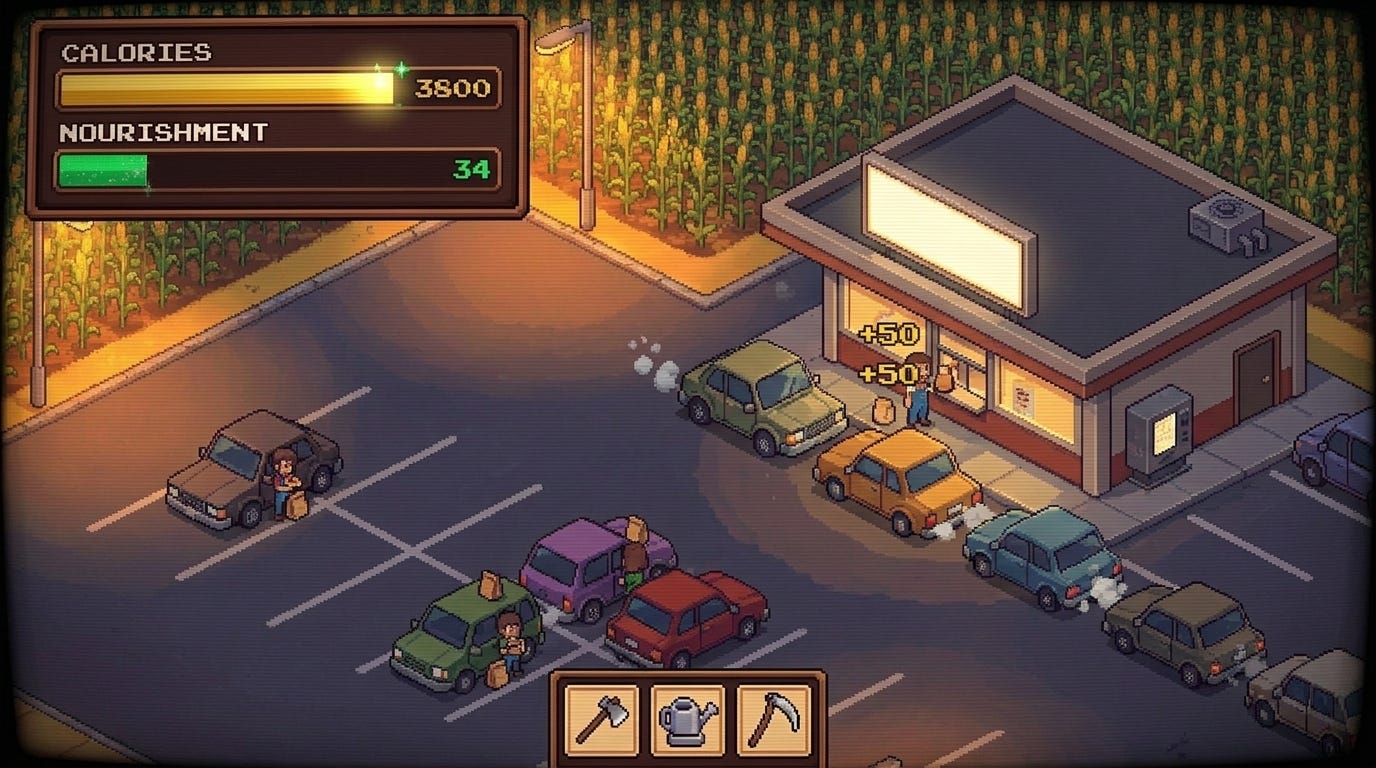
Questioning “make more food” is a luxury of the well-fed. Real hunger still runs deep across much of the world: Sudan and Yemen and the eastern Congo, the drought-stricken Horn of Africa, Haiti, Afghanistan, wherever conflict or crop failure has put famine back on the map.
Across much of sub-Saharan Africa, cereal yields run at a fraction of American levels, and a bad season still means empty plates. For an agronomist working in those places, “make more food” is still exactly the right instruction.
So I’m holding two ideas at once. Where a country can’t yet feed itself, the instinct to make more food stays correct. Money from richer countries can help, but that often locks the recipient of that support into a path toward a heavily industrialized, input-centric agriculture system like ours.
Paying for the calories and telling a country how to grow them are two different things, and they tend to arrive together. The industrial toolkit comes as a package: the seed that needs the fertilizer that needs the herbicide, most of it sold by the same few companies. A country facing empty plates is often in no position to argue, especially if the hunger problem is profoundly bad. This is how agribusiness turns an area stricken with famine into a customer forever.
The Alliance for a Green Revolution in Africa is the clearest recent case. Starting in 2006, the Gates Foundation and several donor governments put close to a billion dollars into spreading commercial seeds and chemical fertilizer across thirteen African countries, betting that Green Revolution yields would follow.
A donor-commissioned evaluation completed in 2021 found the program had missed its headline goal of higher incomes and food security, and in countries like Zambia and Tanzania, farmers who borrowed to buy the inputs couldn’t repay the loans after a weak harvest. Yields barely moved. The market for seed and fertilizer is what grew.
Run that same playbook in a country that has had a food surplus for decades and it stops helping and starts doing damage: waste, diet-driven disease, rural economies built around crops almost nobody eats directly.
American agriculture likes to borrow the moral weight of feeding the hungry to defend a business built on that surplus. “We feed the world” is the industry’s favorite sentence, an easy applause line that tries to end most criticism of the food system before it starts.
The more honest version, the one no one says out loud, is “we feed the world profitably,” and the profit comes from the inputs sold season after season, long after the emergency that justified them has passed.
The help is genuine at first. The seed and fertilizer show up when the plates are empty, and for a while they fill them, which is why a hungry country takes the deal. The long term cost is harder to see on the invoice. Once local seed stock and soil practice have been traded for a catalog of patented inputs, the country’s food sovereignty is gone, and it feeds itself only on terms a few foreign firms set. It is a Faustian bargain offered at the one moment it can’t be refused: eat now, and owe the seed and fertilizer companies for a generation.
We can sit here comfortably in our homes with full pantries and bellies and judge a nation’s leader who signs a deal to bring GM seeds and Roundup into their country. But imagine you’re that world leader and there are scores of children dying from malnutrition outside your door right now. What would you do? Would you say no to Monsanto?
We live in a world where being able to choose non-GMO, organic/regenerative food is a luxury. And I do think that if you have that luxury, you should choose food made that way if you can. But sadly, that luxury is precisely what places in the world who have hardcore hunger issues do not have. In America, many of us have the privilege to fight for the purity of our food. But in famine stricken places, they fight for any food at all.
Outcomes Per Calorie
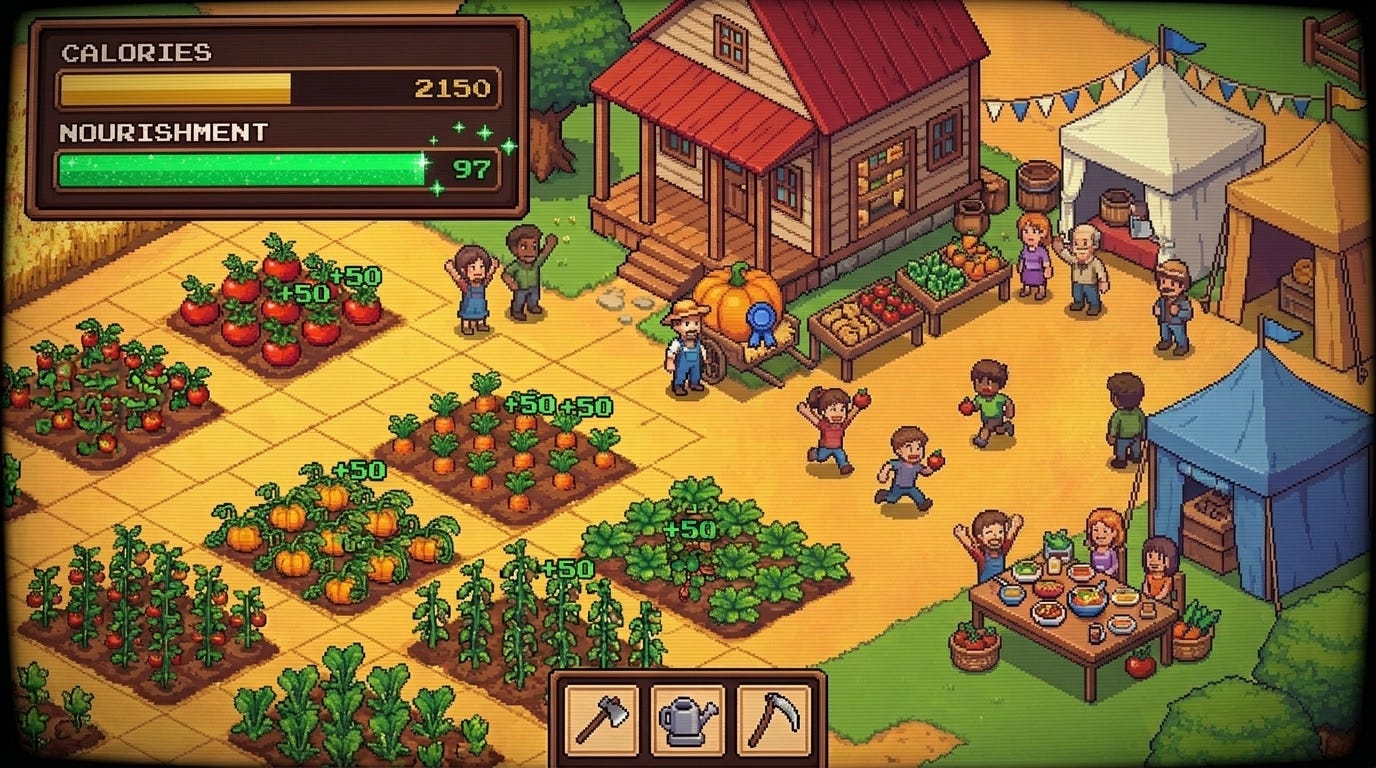
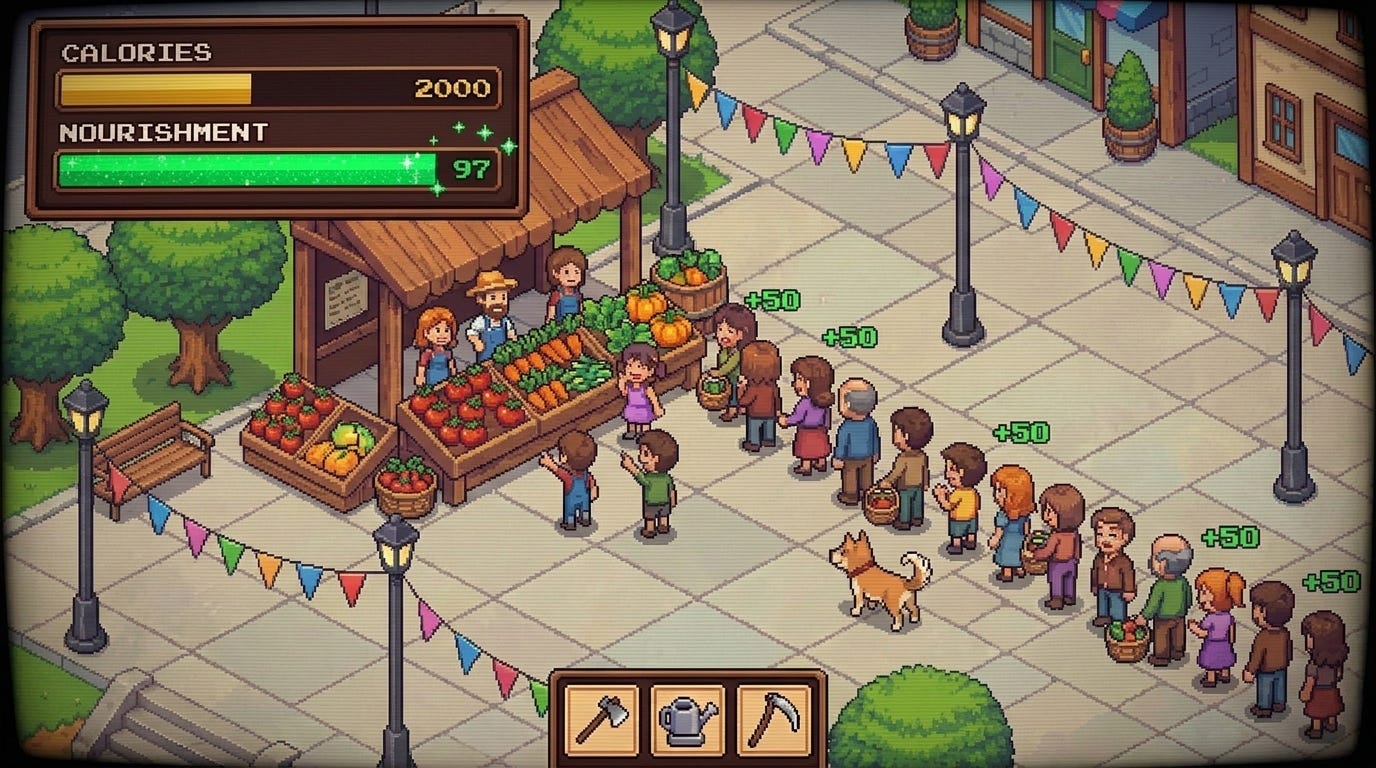
A country that has settled the quantity question should judge its farm policy on a different axis: outcomes per calorie rather than calories per acre. That means measuring nourishment (aka: better health and wellness outcomes) delivered and surplus routed to people instead of landfills. Getting a vegetable from a field to a low-income household, at a price and form that competes with a dollar cheeseburger, is an unsolved problem that would humble any yield fanboy.
It is also a different kind of problem. Doubling wheat yields was chemistry and genetics, work you could measure in a test plot. Routing nutrition is logistics and appetite at once: cold chains and last-mile economics on one side, the craft of making the nourishing option the one people want on the other. A carrot that arrives fresh but unloved has not been routed anywhere. The next generation of research has to treat desire as seriously as yield, and fund it the way the last century funded yield: cold chains for produce built like grain elevators, land-grant universities studying how to move nourishment as hard as they once studied how to grow it.
Pieces of that bill already sit in the margins of this one. USDA funds produce-prescription pilots, where doctors write scripts for fruits and vegetables the way they write statins. The health language in the House bill points the same way, and so, oddly enough, does the executive order on regenerative agriculture the White House issued in June. None of these is a new mission on its own. Together they read like a government sensing the old question is spent without quite saying or acting so.
I’m offering a general direction of change here, and I don’t want anyone to mistake it for a tactical blueprint. I don’t know what the headline metric of a nourishment-based farm bill should be, and whoever proposes one inherits a fight with every incentive now pointed at volume. Which is basically every single incentive we have now. We’re probably early, the way the yield pioneers were early in 1944. They didn’t have answers either, just a clear question they let organize everything they built.
Sometime after the midterms, the two versions will be merged and signed, and the mission of American food renewed for five more years, probably without anyone asking whether the mission changed. Set the two laws side by side: one written in 1946 for a country that couldn’t fill its recruits’ plates, one written in 2026 for a country that can’t stop overfilling them, both invoking national security, both sure the problem is getting enough.
How can you possibly prolong a 1946 policy that was written when no one knew what a “bliss point” was, into a 2026 world where the hottest thing on the market is an injectable to cure our own overproduction and overconsumption?
For eighty years we asked our food system a single question: how do we grow enough? And that question has been answered many times over. The next serious farm bill will ask what all this food is for, and whether it actually nourishes the people who need it.
—
Mike Lee is a food futurist and innovation strategist, author of Mise: On the Future of Food, host of The Tomorrow Today Show podcast, creator of Mise Futures, and is on Instagram at The Book of Mise.
—
Mise 2: The Restaurant Issue is now open for pre-orders! Ships 8/11/26. Over 200 pages of future scenarios exploring the future of restaurants.
This is such a great piece--thank you! The combination of history and thoughtful ideas for moving forward is so powerful. I love this idea: "A country that has settled the quantity question should judge its farm policy on a different axis: outcomes per calorie rather than calories per acre. That means measuring nourishment (aka: better health and wellness outcomes) delivered and surplus routed to people instead of landfills."
Really strong explanation of the challenges of Agricultural policy amongst Food Politics.