



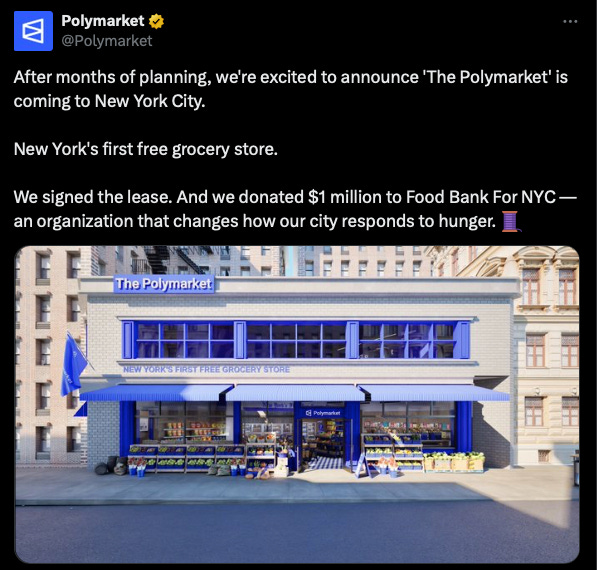
Two prediction market companies announced free grocery stunts in New York City this month. Kalshi set up outside a Manhattan grocery store offering shoppers up to $50 in free food. Their tweet: “F it. Free groceries for everyone.” Polymarket, its larger rival, went bigger—opening what it calls “New York’s first free grocery store” for five days, along with a $1 million donation to the Food Bank for New York City.
“F it” is what you say before buying last-minute concert tickets or booking a spontaneous flight to Paris. It’s the language of carefree impulse, of throwing caution to the wind on something fun. Applying it to feeding people who can’t afford groceries tells you everything about how this was framed—not as a response to a crisis, but as a vibe.
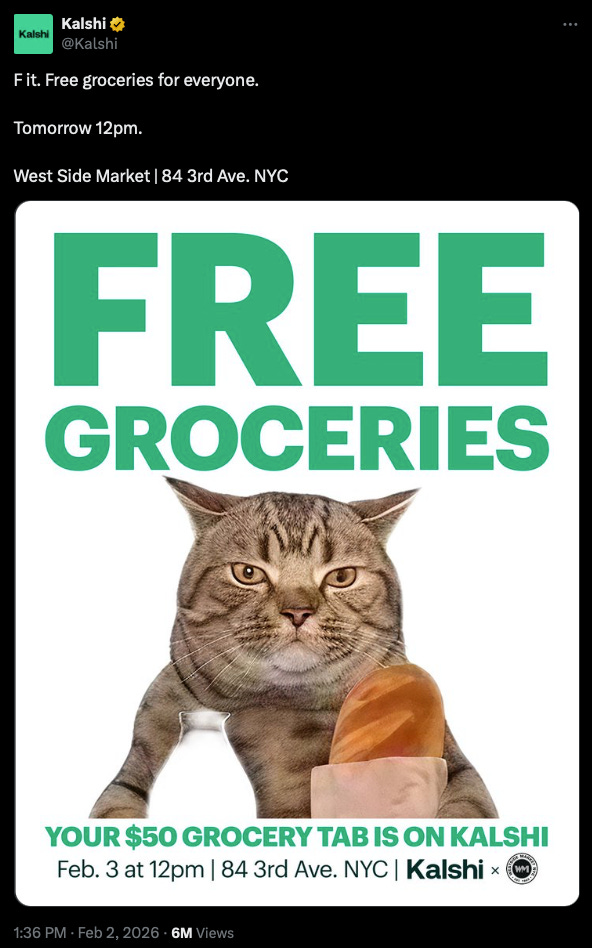
My first reaction should have been simple—free food is free food. But I kept wondering who was actually in that line, and whether a grocery giveaway that functions as a photo op gives off a different vibe than one that functions as a lifeline. There’s something about turning hunger into a brand activation—someone else’s need becoming your marketing moment—that makes generosity feel like it’s performing for the wrong audience.
I know this isn’t entirely rational. When a food bank receives a major donation, they hold a press conference. They put out a press release. Someone poses with an oversized check. That’s also turning food assistance into PR, and it doesn’t bother me. Maybe the difference is that a food bank’s entire reason for existing is feeding people, so the PR is in service of the mission. When a gambling company sets up a pop-up grocery store, the mission is in service of the PR.
It’s a bit like when the mob builds a playground in a neighborhood they’ve been shaking down for protection money. The playground is real. The kids will use it. But everyone knows who paid for it and why, and that knowledge changes the gesture.
Where the Money Comes From
And the gambling part matters. Since the Supreme Court opened the door to legal sports betting in 2018, Americans have wagered over $142 billion in a single year. Problem gambling hits hardest in low-income communities—the World Health Organization explicitly identifies the diversion of household spending on gambling as a driver of food insecurity.
The people most likely to lose money they can’t afford to lose on these platforms are the same people most likely to need help buying groceries. A gambling company handing out free food to families that gambling may have helped put in financial distress is a loop that should make everyone uncomfortable, even if the food itself is welcome.
Prediction markets are gambling platforms dressed up in the language of information markets and probability. Both Kalshi and Polymarket face existential regulatory threats in New York—the ORACLE Act would classify them as unlicensed gambling with fines up to $1 million per day, and Attorney General Letitia James issued a consumer alert the day before Kalshi’s giveaway. The free groceries arrived alongside all of this, which makes the generosity read less like philanthropy and more like lobbying with better optics.
But once I started pulling on that thread—hunger, charity, who gets to play hero—I kept running into the same dynamics I’d been aware of for years, just wearing different costumes.

47.9 Million Americans
The most recent USDA data found that 47.9 million Americans are food insecure—roughly one in seven of us, in the wealthiest country in the history of the world. More than fourteen million of those are children.
The United States produces far more food than it needs. We throw away 40 percent of our food supply every year. Hunger in America is not a scarcity problem. It’s a distribution problem, a wage problem, a policy problem—the accumulated result of decisions about who gets help and who doesn’t. As the Food Research & Action Center puts it: “Hunger and food insecurity in the United States are symptoms of policy choices and an economic system that prioritizes the needs of corporations and the wealthy over those of the general population.”
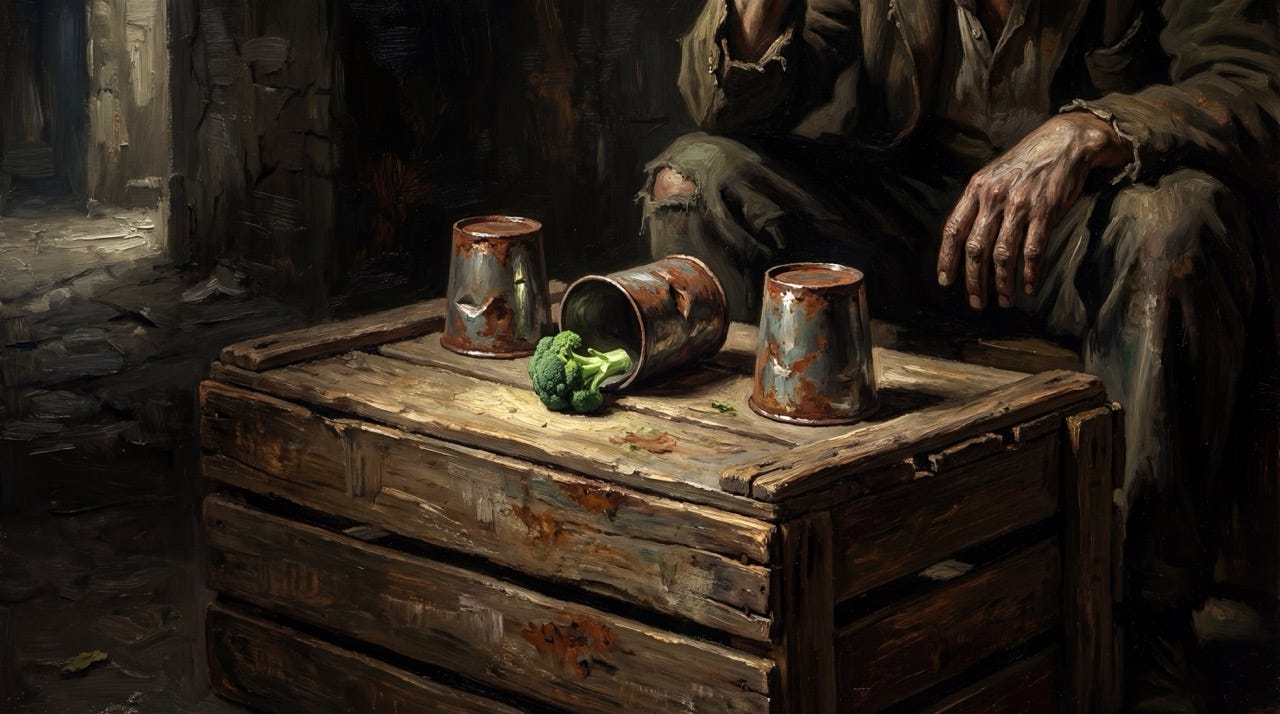
SNAP benefits—the federal government’s primary tool for fighting hunger—are pegged to the USDA’s “Thrifty Food Plan,” which works out to roughly $3.31 per meal. Agriculture Secretary Brooke Rollins made that vivid in January when she announced what $3 can buy. After running “over 1,000 simulations,” the USDA’s conclusion: a piece of chicken, a piece of broccoli, a corn tortilla, and “one other thing.” One piece of broccoli. One unspecified item. This is what the federal government considers a meal for Americans who can’t afford to feed themselves.
Set that against the current landscape of wealth. The world’s twelve richest billionaires now hold more wealth than the poorest half of humanity—more than four billion people. Billionaire wealth surged by $2.5 trillion in 2025 alone—not through labor or invention, but through stock appreciation and compound returns.
The twelve richest men on Earth could fund the entire SNAP program out of last year’s gains and still have $2 trillion left over. Average weekly food spending runs about 18 percent higher than what the Thrifty Plan allows. The benchmark isn’t a safety net. It’s a policy choice about how little help is acceptable.
What Feeding People Actually Takes
Many years ago, I served on the board of the West Side Campaign Against Hunger (WSCAH) in New York City. Founded in 1979 in the basement of a Methodist church, WSCAH became one of the most innovative food pantries in the country by rethinking what emergency food assistance could be.
In 1993, they pioneered the first customer-choice supermarket-style pantry in the country — letting guests select their own produce, proteins, and grains instead of handing them a pre-packed bag. When COVID made that indoor model impossible, they didn’t close. They asked a harder question: should people have to come to the food, or should the food come to people? They rebuilt — community distribution sites across Northern Manhattan and the South Bronx, a digital ordering system, a 13,000-square-foot warehouse. SNAP enrollment, job training, financial counseling. WSCAH now serves more than 100,000 customers a year, distributing over five million pounds of food, operating on donations and grants, never quite having enough.
Polymarket’s million-dollar donation will feed people. But a single donation isn’t a commitment. Have they shown any interest in the policy work or root-cause infrastructure that organizations like WSCAH have spent decades building? Will they give again next year? I challenge them to.
Or did feeding the hungry just happen to be great optics at the exact moment they needed New York to see them as good neighbors? This is what happens when generosity is discretionary — when feeding people isn’t a commitment but a gesture, available when the incentives align and gone when they don’t. Gambling companies do it at the neighborhood scale. Billionaires do it on a global stage.

The Billionaire Question
In October 2021, Elon Musk had just been named the world’s richest person. David Beasley, head of the UN World Food Programme, challenged him to help save 42 million people from starvation for $6.6 billion. Musk responded publicly: “If WFP can describe on this Twitter thread exactly how $6 billion will solve world hunger, I will sell Tesla stock right now and do it.”
The WFP called his bluff. They published a detailed spending plan and tweeted it directly to Musk. He never responded. SEC filings later revealed he donated $5.7 billion to his own foundation around that time. The World Food Programme never saw a dime. A year later, he bought Twitter for $44 billion. A global institution responsible for feeding millions of starving people, forced to make its case in a Twitter thread because the richest man on the planet turned famine relief into a social media dare. World hunger is not something you solve by tweet.
The $6.6 billion request represented roughly 2.2 percent of Musk’s fortune. For a fifty-year-old American with the median household net worth of $200,000, that’s about $4,400—what you’d pay for a used Honda Civic with 120,000 miles on it. Musk was being asked to do the proportional equivalent of buying a beat up used car to help prevent the starvation of 42 million people. He said no, then spent twenty times that amount on a social media platform.
I’m not arguing that people shouldn’t be allowed to get rich. But no one’s quality of life changes between $250 billion and $300 billion. You don’t sleep better. Your kids aren’t safer. You don’t eat differently. Every human need was met a million times over long before you got there. If we can tolerate that kind of wealth concentration at the top—and I think we can—then we can also afford to guarantee that the floor isn’t starvation. That 47.9 million Americans don’t know where their next meal is coming from isn’t a scarcity problem. It’s a distribution problem.
But this isn’t a story about Musk specifically. It’s about what billionaire philanthropy actually is: discretionary, whimsical, shaped by the preferences of people who have never experienced hunger. The money to eliminate food insecurity exists. The will doesn’t.
Generosity as Performance
You could argue I’m just being a big downer. And you might be right. Money is money. Food Bank for New York City will use that million dollars to feed people, and that matters. Should we really reject help based on where it comes from?
Maybe not. But we should reject the idea that giving absolves the giver. A donation doesn’t neutralize the business model that made it necessary. The tobacco companies made this case for decades—funding arts programs and universities while buying silence about harm. The WHO eventually recommended banning tobacco industry philanthropy altogether through its Framework Convention on Tobacco Control, because the gesture of giving was inseparable from the strategy of influence.
Gambling companies aren’t tobacco companies. But when hunger relief depends on industries that profit from human weakness and even causes people to need emergency food assistance in the first place, the philanthropy isn’t offsetting the harm. It’s laundering it.
And this is the deeper problem with charity as spectacle: it lets everyone off the hook. The company gets its headline. The public gets to feel good about sharing the post. The politicians get to point to private generosity as proof that the system works. And the structural question—why are 47.9 million Americans food insecure in a country that throws away 40 percent of its food supply—never gets asked in this news cycle, because someone showed up with free groceries and a camera crew.
We know what actually reduces food insecurity. SNAP works. Universal free school meals work. When the expanded Child Tax Credit was active, food insufficiency among families with children dropped by 25 percent—then the credit expired and millions of families slid back. These are policy choices, not PR charity—and they don’t depend on the whims of billionaires or the reputation needs of gambling companies. No one should have to be grateful to the right benefactor at the right moment to eat dinner.
Polymarket’s pop-up opens tomorrow and closes Sunday. The million-dollar donation will feed people for a while. But then the pop-up closes. And the need continues—1.3 million food-insecure New Yorkers, still hungry, still waiting for a system that actually works.
The groceries matter. The discomfort matters too. And the distance between a five-day stunt and a forty-year-old food pantry—between a Twitter dare and a detailed spending plan—between a piece of broccoli and a functioning safety net—is the distance between performing generosity and practicing it.
The next time someone can’t feed their kids in New York City, Polymarket will not be there. Neither will Kalshi. The pop-up will be gone. The tweets will be forgotten. And the hunger will still be exactly where they left it.
—
Mike Lee is a food futurist and innovation strategist, author of Mise: On the Future of Food, host of The Tomorrow Today Show podcast, creator of Mise Futures, and is on Instagram at The Book of Mise.
As always, amazing writing. thoughtful and well researched, Thanks Mike. Also, this is so messed up on so many levels.
It reveals painfully how corrupt and broken the market is. We have too much food. Almost none of it is priced accurately to its value. The reasons people are hungry have nothing to do with the availability of food.