


Before the algorithm, before the broadcast signal, before the printing press—hunger chose your next meal. You ate what was available. What you could grow, hunt, or afford. The question wasn’t “what do I feel like eating?” It was “what can I get?”
Industrialized agriculture changed this equation for much of the world. The ability to produce, process, and distribute food at massive scale made calories abundant and accessible in ways previous generations couldn’t imagine. Hunger still exists, but the dominant challenge in wealthy nations shifted from scarcity to choice. And with abundant choice came a new vulnerability: our appetites became increasingly receptive to outside influence, if for no other reason than to help us navigate the sea of food choices now before us.
Food media works like surround sound. A new item enters the conversation—Dubai chocolate, a viral baked feta pasta, a celebrity tequila—and suddenly it’s everywhere. TikTok videos, Instagram stories, podcast mentions, friend recommendations. The repetition doesn’t feel like advertising. It feels like culture.
And eventually the noise gets loud enough that you find yourself craving something you’d never heard of a month ago, or ordering George Clooney’s tequila at the bar without remembering when you first learned about it. This dynamic isn’t new. Breakfast cereals embedded themselves into children’s minds through cartoon mascots and catchy jingles for decades. What’s changed is the speed, the volume, and the number of voices competing for the same mental real estate.
The Invisible Fork
Call it the invisible fork—communication technology guiding food to our mouths before we’ve consciously decided we’re hungry for it. Someone is always holding the handle. The question is whether you can see them.
This is worth understanding, because whoever influences attention influences the food system—what gets funded, what gets farmed, what ends up on shelves and in stomachs. And the people shaping that attention don’t need a message with substance, or even truth. They just need to be loud enough, long enough.
In December 2023, a video appeared on TikTok: a woman biting into a pistachio-studded chocolate bar (originally made by FIX Dessert Chocolatier), the inside oozing with a green tahini-like filling called knafeh. The ASMR crunch. The theatrical stretch of the filling. The creator’s expression of exaggerated bliss. The video hit millions of views within days and as of today has over 142 million views.
What followed was the attention machine doing what it does. Reaction videos: people hunting down the bar, taste-testing dupes, ranking knockoffs. Commentary videos: food critics debating whether it was actually good. Outrage videos: the original bar cost $20 and sold out everywhere. Recipe videos: home cooks attempting DIY versions. Reaction videos: people who literally watch all the other videos and react to them.
Each piece of content created another data point telling the algorithm that people cared about this thing. And to the algorithm, this “thing” is just a “thing,” because the algorithm doesn’t really understand the thing it’s promoting. Yet, the algorithm helped manifest it. More people saw it. More creators made content about it. Which just feeds the algorithm even more.
Within weeks, Dubai chocolate wasn’t a product. It was a phenomenon. Lindt launched a version. Grocery stores stocked imitations. There was a pistachio shortage. The hashtag accumulated billions of views. And the cycle kept feeding itself—even the backlash content, the “is Dubai chocolate overrated?” takes (which paradoxically gives the fad more life, not less), the trend pieces analyzing why everyone was talking about it, and the endless river of LinkedIn posters throwing their twigs into the conversational inferno.
All of it added fuel. Industry insiders mentioned it at conferences, on webinars, in trend reports and Substacks (like this one), which generated more content, which reinforced the perception that this was what consumers wanted.
But was it really what consumers wanted? How does anything that no one ever asked for, suddenly become something that everyone longs for?
I genuinely don’t know. It becomes impossible to distinguish organic demand from manufactured consensus once the cultural flywheel starts spinning. The chocolate might be amazing. It might be horrendous. It doesn’t really fucking matter. The attention machine doesn’t care. It just keeps feeding on whatever people are staring at right now.
From Gutenberg to General Mills
This dynamic isn’t new. The technology changes; the pattern repeats.
The printing press enabled mass distribution of ideas for the first time—religious, political, scientific, and eventually culinary. Cookbooks and household manuals began codifying what proper families should eat. Regional traditions that had evolved over centuries now competed with printed authority. Some foods became respectable. Others became peasant fare. Ideas about eating could suddenly travel faster than the food itself.
Radio added something new: the ability to associate specific brands with trust and entertainment. The Jell-O Program Starring Jack Benny. The Kraft Music Hall. Betty Crocker, a fictional character invented by the Washburn Crosby Company (which later became General Mills), answered listeners’ letters on air, modeling what a modern homemaker should serve. She wasn’t real, but her influence was. Millions of Americans absorbed her guidance without questioning whether a publicly traded, for-profit food company might have multiple motives.
Television added the visual dimension: the snap, crackle, pop; the condensation on a Coke bottle; the giggle of the Doughboy; the “BAM!” from Emeril. Americans learned to desire moving images of food almost as much as food itself. I once saw someone at the gym running on a treadmill for an hour while watching the Food Network. Yes, burning calories while watching them.
The economics of television broadcasting concentrated power in fewer hands. Television advertising was expensive—prohibitively so for anyone without scale. Only large corporations could compete for attention at the national level. Only large corporations could build national brands.
General Mills, Kraft, PepsiCo, Nestlé—these companies weren’t neccesarily built on making the best food. They were built on making the most accessible food, and on the ability to purchase attention in bulk. Their genius was economies of scale on two fronts: standardized production that could churn out millions of identical units, and mass marketing that could reach millions of identical eyeballs. The model demanded lowest-common-denominator products—things inoffensive enough for everyone, optimized for no one in particular.
Then came the internet, and the rules of attention changed.
Oops! All Influencers
For most of the twentieth century, Big Food’s playbook was simple: make a product, then spend enormous sums to capture people’s attention. Success required two things—a passable product and a massive media budget. The product didn’t need to be extraordinary; it needed to be cheap to produce, shelf-stable, and available everywhere. The job of making it desirable fell to marketing.
You didn’t “earn” attention; you bought it. You took your budget to your agency of record over sushi or steak, they carved it up into GRPs and CPMs, then wired it into the veins of the TV ecosystem—network upfronts, primetime slots, and Sunday football. Broadcasters converted that money into airtime, and whoever could afford the most impressions won the largest share of mind and, eventually, stomach.
This model rewarded scale above all else. If you could manufacture millions of units, you spread production costs thin. If you could advertise nationally, you spread media costs thin. Small brands couldn’t match either advantage, so the system naturally consolidated around a handful of giants who effectively rented America’s attention and, in the process, shaped what most people ate.
Social media disrupted this arrangement by making reach theoretically available to anyone. A single person with a phone could potentially command the same audience as a corporation spending millions on advertising. This shift coincided with—and likely accelerated—an explosion of indie food and beverage brands over the past two decades.
Food entrepreneurs from the Bay to Boulder to Boston and beyond discovered they could build audiences directly, bypassing the traditional gatekeepers of retail placement and national advertising. Food tribes emerged around specific values and aesthetics—vegan, keto, paleo, clean label, regenerative—and indie brands learned to speak their language. Meanwhile, Big Food started to feel outdated, its one-size-fits-all products struggling to resonate with consumers who now had alternatives that felt more personal and aligned with their identities.
Big Food’s response has been acquisition. Not because they couldn’t reverse-engineer the recipes—any competent food scientist can reformulate a kombucha or an organic snack bar. What they couldn’t manufacture was trust. Consumers who wouldn’t give a legacy brand the time of day had genuine relationships with the indie brands they loved. So Big Food bought those relationships, hoping the trust would transfer along with the trademark.
The new model inverts the old logic entirely. MrBeast didn’t build a chocolate brand and then try to find an audience. He built an audience of 425 million YouTube subscribers and then launched Feastables, which generated over $400 million last year. Attention attracts money and money builds chocolate companies.
The Algorithm’s Palate
Whether these creator-led products are any good is almost beside the point. The attention economy doesn’t select for quality. It selects for reach. And reach, in the algorithmic era, depends less on what you say than how you say it. The algorithm has no opinions about nutrition science. It measures what holds attention. And what holds attention is almost never “here are the seventeen factors you should consider before deciding if this food is right for you.”
Nuance is attentionally expensive. And like anything expensive, most people have learned to live without it. We’ve become bargain shoppers of ideas—grabbing whatever’s cheap, fast, and clearly labeled. Complexity is a luxury good we can’t afford on a Tuesday afternoon, so we reach for the cognitive equivalent of dollar menu thinking: takes that fit in a headline, opinions that require no research, certainty that costs nothing to maintain.
We learn to like what we’re exposed to, and we don’t miss what we’ve never had. A steady diet of 15-second absolutist content reshapes our intellectual palate the same way a childhood of chain restaurant food makes unfamiliar cuisines seem strange.
Look at the nutrition influencers who’ve built massive audiences: Carnivore evangelists, Raw Vegans, Glucose Hackers, Seed Oil Skeptics. These camps can hold fundamentally incompatible views on what humans should eat. Yet they all succeed using the exact same playbook: absolute certainty, shock-based hooks, emotional punch. The algorithm amplifies whatever generates engagement, regardless of whether the underlying message is true.
Food, nutrition, health, sustainability—these aren’t trivial topics. They affect whether people get sick or stay healthy, whether farmland regenerates or degrades, whether we address climate change or accelerate it. Yet the information environment systematically favors the loudest voice over the most accurate one.
Explaining regenerative agriculture means talking about soil biology, carbon cycles, grazing patterns, the economics of transition. The complexity is the point—these systems work because they account for relationships that industrial agriculture dismisses. But “it’s complicated” doesn’t stop anyone’s doomscroll. The nuanced truth about why soil health matters is competing with a gameshow contestant guessing whether a shoe is candy. Absurdity wins.
The Most Precious Resource
Here’s the asymmetry you’re up against: a food system with enormous inertia, billions in profit motive, algorithmic reinforcement loops that feed on themselves—and I’m about to tell you that learning to cook matters. That sounds like bringing a vegetable peeler to a nuclear submarine fight.
Maybe it is. I’m not certain individual action solves this. The system won’t reform itself. Regulation moves slower than trends cycle. But there’s one resource at the center of this machine that you actually control: your attention.
Your scroll. Your craving. Your purchase. That’s what they’re all competing for—the food giants, the creators, the algorithm itself. You. Are. The. Fuel.
Every time someone develops their own palate and stops needing the feed to tell them what to want, that’s one fewer data point. One fewer view. One fewer like. This isn’t about solving the problem—it’s about declining to participate in it. The people most susceptible to food marketing are those who haven’t thought much about food beyond what tastes good and what’s easy. That’s not a flaw; it’s the default in a busy life. But that default is exactly what the system relies on. Developing food literacy disrupts it—the quiet act of starving the feed.
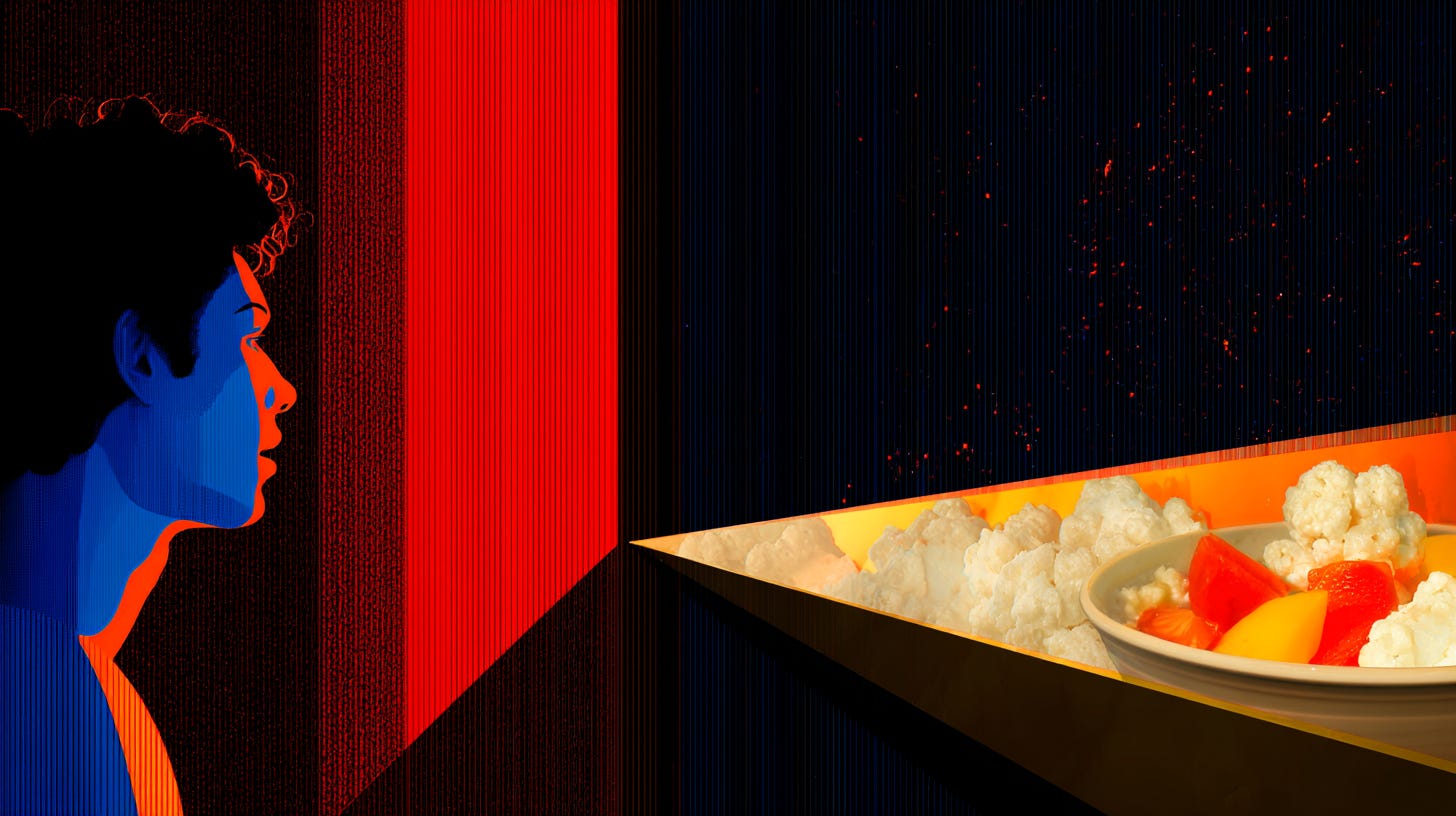
Literacy as Withdrawal
Food literacy is pattern recognition. In our current information environment, it means glancing at a fear-mongering headline or “miracle cure” video and instantly spotting the manipulation. You don’t need to research every claim; you’ve seen enough nonsense that the patterns are obvious. This efficiency is the core of its power.
Cooking is the physical practice of this literacy. Starting can feel daunting—modern life has optimized cooking out of most routines. But building the skill to feed yourself isn’t about declaring war on the industrial food system. It’s about ensuring you aren’t dependent on it. There’s a vast difference between enjoying a fast-food burger with your eyes wide open, as a conscious indulgence, and relying on it as your only option.
Cooking restores your agency. It lets you treat corporate convenience as an occasional utility rather than a nutritional default. It’s the satisfaction of putting something on the table that your kid actually eats, or nailing a dish you’ve failed at three times before, or realizing you just made something better than takeout for a fraction of the price. These aren’t precious foodie flex moments—they’re small competencies that compound. You start to trust your own judgment. You develop an internal compass for what good food actually tastes like, built from experience rather than downloaded from an algorithm.
The feed will keep manufacturing cravings. The algorithm will keep rewarding whatever captures attention. But food literacy lets you see the invisible fork. And once you see it, you can take it back.
—
My Book - Mise: On the Future of Food
My Podcast - The Tomorrow Today Show
My Instagram - The Book of Mise
My Consultancy - Mise Futures
Love this breakdown of the Dubai chocolate frenzy as a case study in attention economics. The bit about impossibility to distinguish organic demand from manufactured consensus once the flywheel starts really nails why those viral food moments feel so strange in retrospect. Building personal food literacy as a withdrawal stratgey makes way more sense than trying to out-compete industrial marketing budgets. The algorith doesn't care about nutrition or taste, it just amplifies whatever holds eyeballs longest.
Excellent, I love the image of a vegetable peeler in a nuclear showdown. And now I know Better Crocker was a myth - we had Alison Holst in NZ, who was real.
I’m also interested how personality plays as much a role as exposure - my brother and I grew up in the same house, eating meals cooked by Mum which included produce grown by Dad. We went out for dinner once a year, on Mothers’ Day! Today, I grow a lot of vegetables, fruit and have chickens - our eating patterns are highly influenced by what is available in the garden. My brother loves Uber eats and I don’t know when I last saw him cook a meal.