


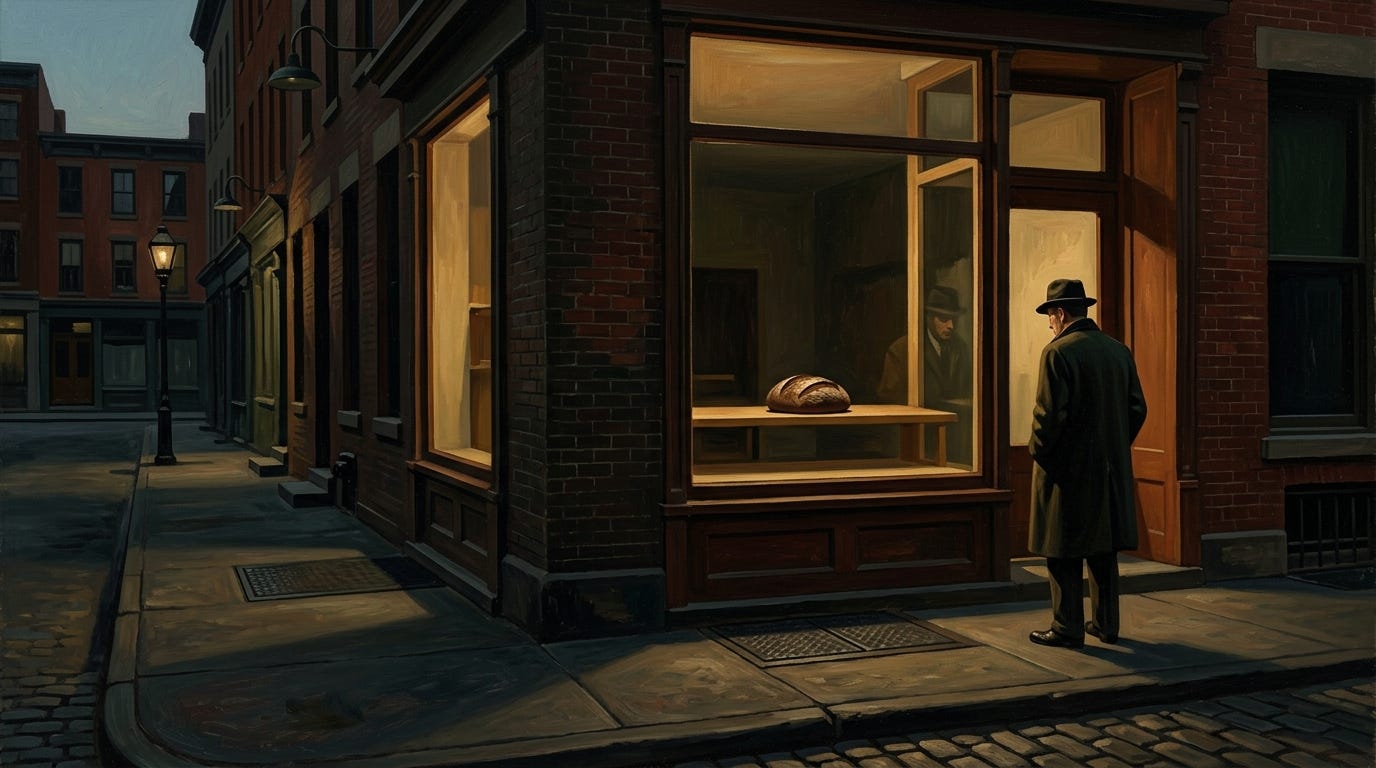
Recently, a bakery called RYE by Martin Auer opened up in NYC and instantly became infamous for selling a loaf of sourdough rye bread for $60. The loaf was all over social media, with people calling it out of touch. Discount grocer Lidl even parked a truck near the bakery advertising its bread for $3.99.
The RYE loaf is big: 3.3 lbs. Martin Auer’s son, Tim, says the price covers the handmade nature of the loaf, the organic flour shipped in from Austria, and the cost of doing business in NYC, where wages and SoHo rent are steep.
But Bien Cuit, the venerable Brooklyn-based bakery, sells a similarly sized loaf for $18. Back in Austria, the Auers sell the same $60 loaf for about $16.
Martin Auer has compared his bread to designer handbags. So the $60 isn’t just about the cost of the labor, ingredients, and rent. It’s about serving how a person feels about bread and how they want the world to see them.
In 1899, the economist Thorstein Veblen wrote about this in his book, The Theory of the Leisure Class, which made famous a term he coined, “conspicuous consumption,” for the way people buy things partly to show other people they can afford them. That book is 127 years old, but the habit he pointed out feels so obvious and persistent that one must wonder if there’s something hard-coded in humanity to flaunt wealth. People throughout history have shown off with feasts, the same way we do now with the three-Michelin-star restaurant we brag about on our Instagram feeds.
And food has always been one of the main ways to do this, because everyone understands food intimately. Not everyone can parse the difference between a Rothko and a Newman painting, but everyone can tell a luxe plate of food from one that’s not. Nobody needs a $60 loaf, but virtually everyone has eaten bread, so it becomes a miniature lightning rod for discussion.
I don’t think RYE is doing anything bad per se. No one has to buy it. But to me, it raises an interesting question about how eaters interact with the prices of food and how we as a whole understand, or misunderstand, the economics of food.
Sticker Shock
Most of us know food from the demand side, but not the supply side. It’s easy to look at a $40 chicken dish on a restaurant menu and think, “I could make that at home for cheaper,” because we don’t bear the burden of paying staff, rent, insurance, credit card fees, and so on. We just noticed that the half chicken on the menu costs $40 and a whole raw one at the grocery store costs $12. And while we’re academically capable of understanding that not all $40 of that dish goes into the ingredients, the ingredients are what’s visible on the plate, so it can still feel like we’re being bamboozled somehow.
But typically, food costs only account for about a third of the sticker price of a restaurant dish. The other two-thirds covers the people who cook and serve it, along with the rent and infrastructure of the restaurant itself. Restaurants typically keep only a paltry three cents of every dollar as profit margin, according to the National Restaurant Association.
A lot of the biases we bring into looking at restaurant menus come from grocery prices, which can invisibly set the bar for what we think it’s acceptable for a restaurant to charge, and the industrial food system has set that bar very low.
Instant ramen costs about a dollar per pack and a two-liter bottle of soda costs just a few dollars. So next to the grocery store, most mid-range restaurants can feel expensive.
The bigger problem to me isn’t that someone is charging rich people in SoHo $60 for a loaf of bread. It’s that the rest of the food system is made of food that’s too cheap. We made food cheap, which has done a lot of good to feed more people, but the costs of concentrated animal farms and highly industrialized farming have passed on the costs of that food to our personal and planetary health. Once you count all those costs, the impact of the American food system actually costs about three times more than we spend on food, as the Rockefeller Foundation estimated in 2021.
And when you look at it like that, the $40 restaurant chicken is more honest. It pays the cook you can see, the rent for the room you’re sitting in, the farmer whose name is on the menu, and a portion of the wages for your server, as opposed to the $12 supermarket chicken, whose real costs are externalized to the environment and sometimes our health, neither of which appears on the receipt.
The Supply Side
Dina Daniel immigrated to the United States from Egypt and started a food truck in Arlington, Virginia, called Fava Pot. She now runs three Egyptian restaurants in the Washington, D.C., area. This spring, her food costs spiked, like they did for many other restaurateurs. The case of tomatoes that used to cost just under $18 the year before now cost nearly $77, as The Washington Post reported. And many of her other key ingredients, like halal lamb, had gotten pricier too.
So, she raised her prices on most of her menu. About 70% of it. She worried about losing customers, but had to do it anyway to keep the business afloat.
I know what that worry looks like. My dad had a Chinese American restaurant in suburban Detroit, and I remember how anxious he got about raising the price of a dish by a quarter. He, like Dina, was afraid his customers would go somewhere else. As a kid, I’d watch him at the restaurant in between the lunch and dinner rush with his menu on the table, crossing off prices with his pencil and writing in new ones. Sometimes crossing them off multiple times until he got a number he felt he could live with. My mother would chastise him for not being more aggressive in raising prices, and I could see the stress in his face.
Whether or not his customers would actually abandon him was almost incidental. The worry that they might was enough to affect our family. I’m grateful he’s not in the business anymore today, as I don’t know how he would handle his produce costs jumping from $18 to $77. I get stressed just thinking about that for him.
What Happens to the Middle?
RYE is a meme-worthy stand-in for the high end of our restaurant industry, where the price is part of what people buy. After the flour, rent, and wages are paid for, RYE is charging for attention and status. And the customers in that high end will keep paying, and all the other luxury places that serve them will be just fine too.
On the other end of the affordability scale, you’ve got the big chains like McDonald’s. They face the same rising costs and the same cash-strapped consumers. But the McDonald’s corporation has the finances to change the math of their business model. McDonald’s is now sinking $8.5 billion into yet another digital transformation where AI chatbots will be a big part of the experience. That’s a huge sum of money, but they probably feel strongly that they’ll make that money back many times over from the cost savings they’ll accrue in the coming years. None of this is guaranteed to work. But regardless, if you’re a giant like McDonald’s, you at least have the option of throwing money at the problem in order to literally change how your business model works.
That leaves the place where my dad’s restaurant and Fava Pot sit: in the middle. They are the kinds of restaurants that can’t charge for status like RYE, but can’t afford to automate themselves into a fundamentally different cost structure like McDonald’s. These are the restaurants where the owner loses sleep over adding a dollar to the price of a popular dish.
Restaurants like these are where regular people eat on a weeknight. Where immigrant families like mine and Dina’s get a foothold for a new life. Where plenty of working families make a middle-class living. I don’t know what happens to that middle if this pressure continues. And if the middle fails, we lose its impact on culture and our communities. All that’ll presumably be left is the drive-thru convenience chain, the $60 loaf of bread, or a wax-lined paper container from the prepared-food aisle at your local grocery store, eaten alone at home, which isn’t even a restaurant at all.
—
Read more about the future of restaurants in MISE 02: The Restaurant Issue, out now.
—
Mike Lee is a food futurist and innovation strategist, author of Mise: On the Future of Food, host of The Tomorrow Today Show podcast, creator of Mise Futures, and is on Instagram at The Book of Mise.