


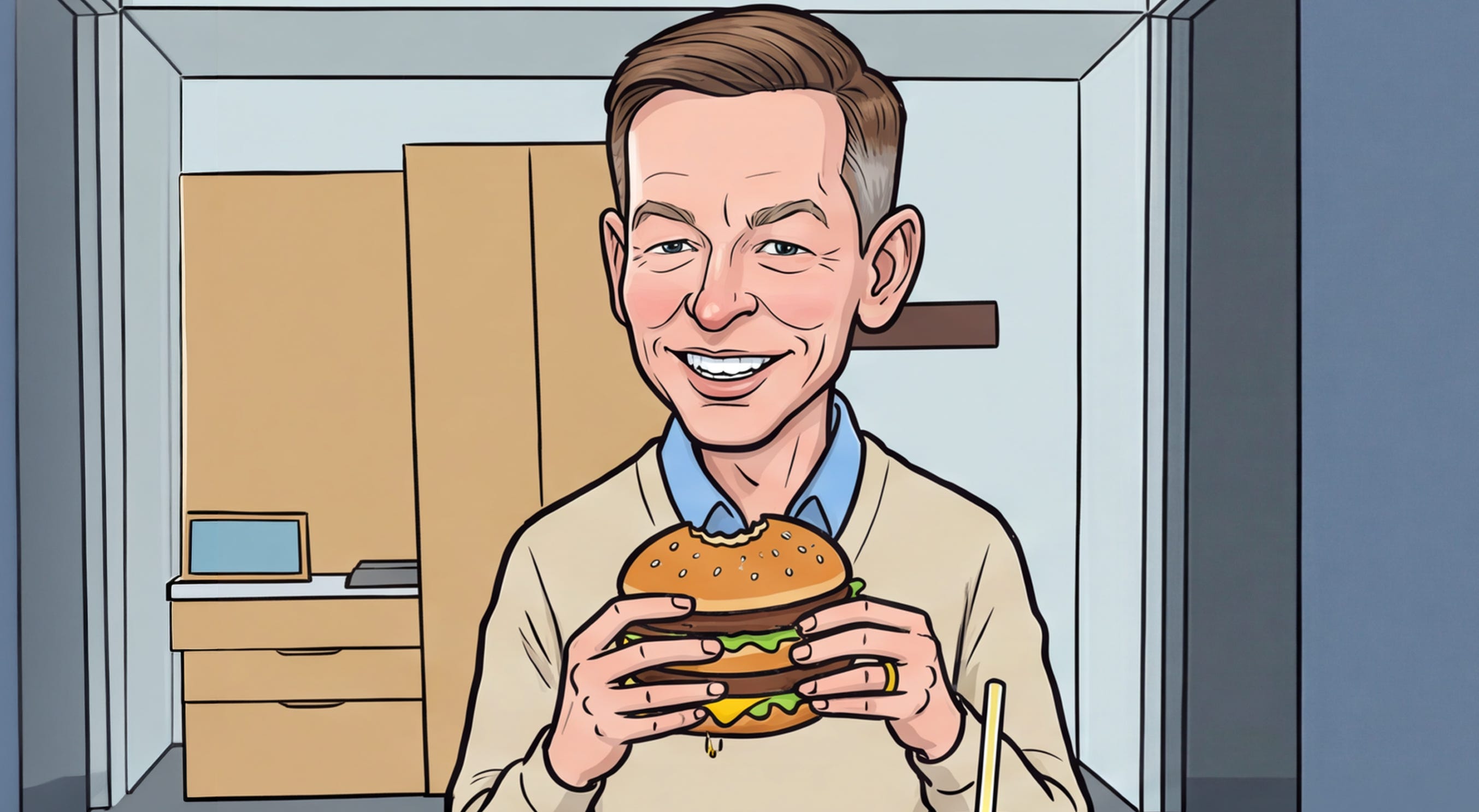
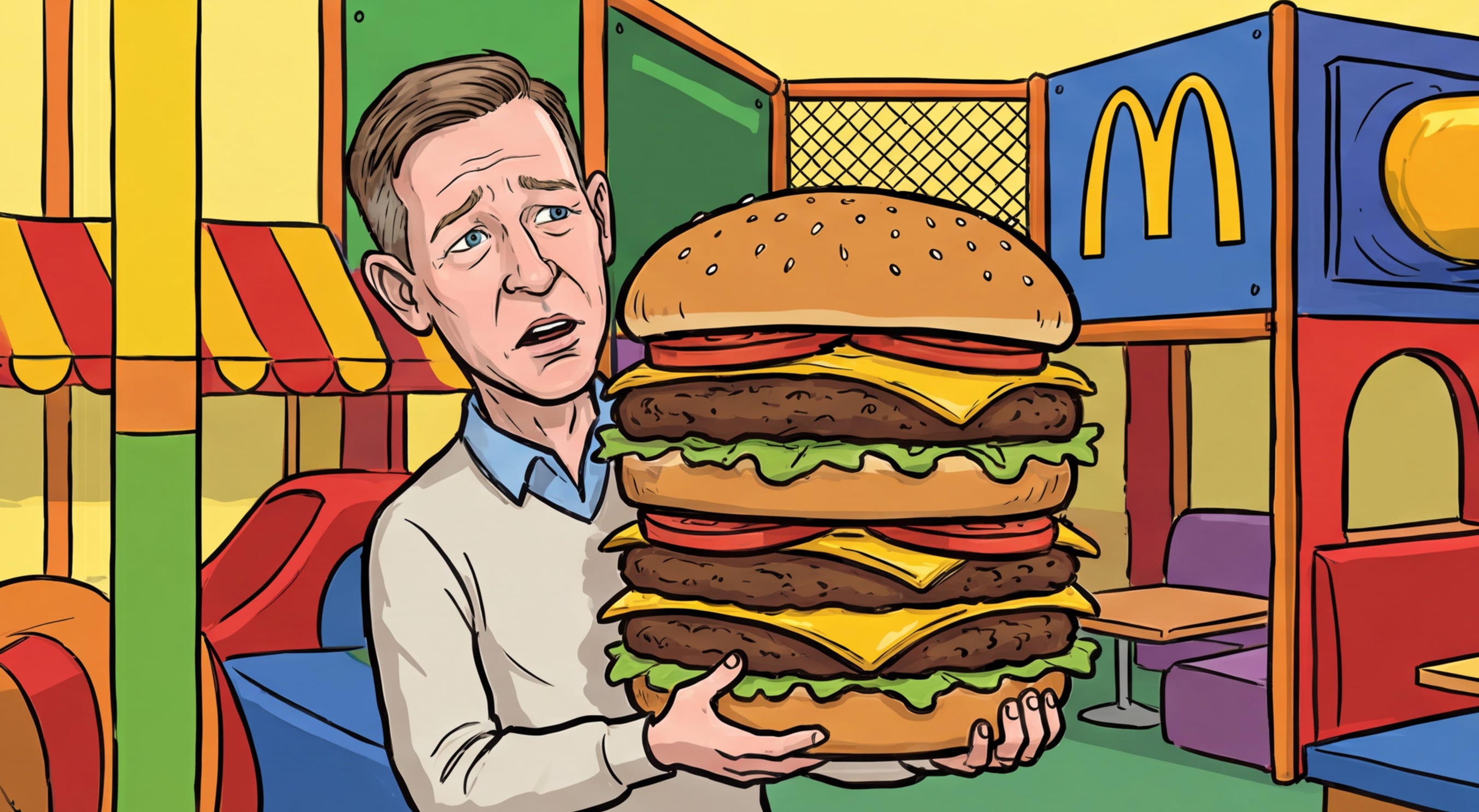
Unless you’ve been living under a digital rock, on February 3rd, McDonald’s CEO Chris Kempczinski posted a video to Instagram introducing the chain’s new Big Arch burger. He was trim and scrubbed in a beige sweater, oxford collar visible, the kind of man whose aura, as one commenter observed, “screams kale salad.” He held the burger toward the camera like Exhibit A.
He called it a “product.” He took a bite so small the burger looked essentially untouched, then declared it “so good” with the conviction of someone confirming the parachute had, in fact, opened.
“That’s a big bite for a Big Arch,” he said. It was not.
Then came the pile-on. Burger King’s president posted himself biting a Whopper with genuine commitment, mayonnaise running down his chin (ew). Wendy’s president ate a Baconator on camera and dipped fries in a Frosty. Jack in the Box wagged a finger: “Small bites? We don’t do that here.” A&W Canada posted their CEO tearing into a “teen burger” with two hands.
McDonald’s leaned in. They posted a photo of the Big Arch captioned “Take a bite of our new product,” with the note “can’t believe this got approved.” One marketing firm estimated that the meme added $18.4 million of brand value to McDonald’s, whatever that means.
Why We Laughed
The video was funny because it confirmed what most of us already suspected: the man who runs McDonald’s does not seem like he actually eats McDonald’s. He earns $20 million a year selling a combo meal that costs $11, and in 81 seconds of unguarded footage, the distance between those two numbers became visible.
As Mark Ritson observed in Adweek: “You know your product intimately as a concept, its market share, its brand equity, its net promoter score, but you stop knowing it as a thing you shove in your mouth on Tuesday when you’re shitfaced.”
Fast food occupies a strange position in American life: we eat it constantly and trust it almost not at all. We know the photo on the menu board was styled by someone whose job is to make a $6 sandwich look like it has self-respect. We know the “freshness” means it arrived frozen on a truck. We know the person at the window was trained to say “my pleasure” whether they feel any or not. We eat it anyway, because on a Tuesday at 6pm or Saturday at 2am when the day (or night) has already won, fast and cheap counts for a lot.
The whole thing runs on a quiet agreement to not look too closely. Kempczinski’s tentative nibble and clinical vocabulary tore that up. He made the synthetic visible, let the machinery show. We recognized it instantly, because we’d always known it was there.
The best observational comedy works exactly like this. The comedian doesn’t tell you anything you didn’t already know. They just say it out loud, and the laugh comes from the relief of finally hearing it confirmed.
One Word
“Product.” Kempczinski called the Big Arch a product, and the internet treated it like a confession.
It wasn’t a confession. It was vocabulary. When you run a $220 billion company with 40,000 locations, the burger on your desk is, in fact, a product first and food second. It has a positioning statement, a margin target, a launch date, and a customer segmentation strategy. Kempczinski gets paid $20 million a year to make the Big Arch a successful product. Nobody’s cutting him a check to make it a wholesome food. He used the word because it’s the word everyone in his office uses every day.
But when you call your own burger a “product” on camera while holding the thing fourteen inches from your face, the internet notices. When a CEO holds up a burger and calls it a product, he’s telling you, without meaning to, how the people who create your food refer to your food most of the day.
The word “product” and the word “food” don’t describe the same object differently. They put you in completely different headspaces. One is about customer acquisition and margins. The other is about taste, hunger, the body. The soul. Food feeds people. Products feed corporations.
The best food companies learn to hold both at once. What made the Kempczinski video so arresting was catching a CEO who runs a food company talking about food like he’d never once thought of it as food. It felt like we saw something we weren’t supposed to see. Like running into your eccentric high school English teacher at a restaurant in your hometown on a Saturday, drunk on margaritas. Some things you just assume without proof. Then the proof arrives and you're somehow still caught off guard.
Food crosses a line that most other products don’t. You take it into your body. Every culture on earth has rituals around eating, not because nutrition requires ceremony, but because ingestion is an act of trust. When you’re placing that trust in a system rather than a person, the bet is that regulation and corporate incentives align, at least roughly, with your interest in not being harmed.
That bet has gotten harder to feel good about. The 21-ingredient bun. The patty engineered to hit a specific fat-to-lean ratio not for flavor but for cook-time consistency across 40,000 griddles worldwide. The “natural flavors” that are natural only in the sense that a chemist probably derived them from something that once grew in soil. Each choice is rational from a business standpoint and widens the distance between the words food and product.
And when everything is a product, everything gets optimized. The ingredients, the cooking time, the portion size, the packaging. And once you’ve standardized all of that, the last remaining variable is the person handing it to you. Burger King is currently rolling out an AI system named Patty across 500 U.S. restaurants, listening through headsets and generating friendliness scores for workers based on keyword detection. This is literally a Black Mirror episode come alive for BK employees.
The goal is consistency: sand down the variables that humans naturally introduce, the bad days and distracted moments and accents that don’t quite parse, until the transaction runs as smoothly as the supply chain that produced the food. The worker becomes another input to standardize. The hospitality isn’t there to make you feel like a person. It’s there to confirm the product arrived correctly.
At some point you have to ask: if you automate all the humanity out of the experience, is it still a restaurant? Or is it just a vending machine with seats?
McDonald’s killed its own AI ordering pilot in 2024 after the system kept adding items nobody ordered. Taco Bell paused its version after a memorable glitch: the system asked a customer what they’d like to drink with their drink. Each failure reveals the same gap the Kempczinski video did: the machinery behind the curtain becomes visible at the exact moment it’s supposed to be invisible.
The Escape
I watched the original video more times than I’m comfortable putting in writing. I even renamed a group chat I’m a part of to “Products,” since that was all we talked about for over a week. I still see new parodies spawning every day, more than a month after the original video was posted. Yeah, I’m in deep, and writing this essay will either get it out of my system or send me further down the hole.
The world since January 1st has been a lot. Our phones have made it possible to witness every atrocity happening everywhere on earth, in real time, all day. What’s happening to people out there right now is genuinely horrible. And our brains were not built for this. The caveman brains we all have evolved to process the immediate dangers of a small tribe, not a live feed of a planet in crisis. And yet here we are, doom-scrolling through wars and political dysfunction and injustice before we’ve finished our morning coffee.
Then a CEO in a beige sweater takes a comically small bite of a burger, and for a few days, the entire internet agrees on something that costs nothing to care about. No body count. No villain. No position required. Looking away from the hard stuff for a minute doesn’t make you a bad person or an indifferent one. Sometimes it makes you a functioning one. The hard stuff will still be there when you look back. It needs us paying attention.
But you can’t pay attention to everything, all the time, without occasionally looking away. The Chris K video was that. An innocent gaffe that gave millions of people a low-stakes place to gather and laugh at the same thing before diving back in to face reality.
We’ve always known the product frame, the fiction on the menu board, the manufactured smile at the window, the CEO who doesn’t eat his own burger. Most days we’d rather not think about it. And that’s exactly how McDonald’s likes it.
The break is the product. The distraction is the point. Keep us coming back for the comfort, not the nutrition, because if we actually stopped long enough to think about the nutrition, we might not come back at all. Kempczinski accidentally told us how they talk about the food. What he didn’t say, and didn’t need to, is that they’ve always been selling something else entirely.
Maybe that’s the real product McDonald’s has always sold. Not the burger. The escape.
—
Mike Lee is a food futurist and innovation strategist, author of Mise: On the Future of Food, host of The Tomorrow Today Show podcast, creator of Mise Futures, and is on Instagram at The Book of Mise.
Great reflection!
Loved the piece!