


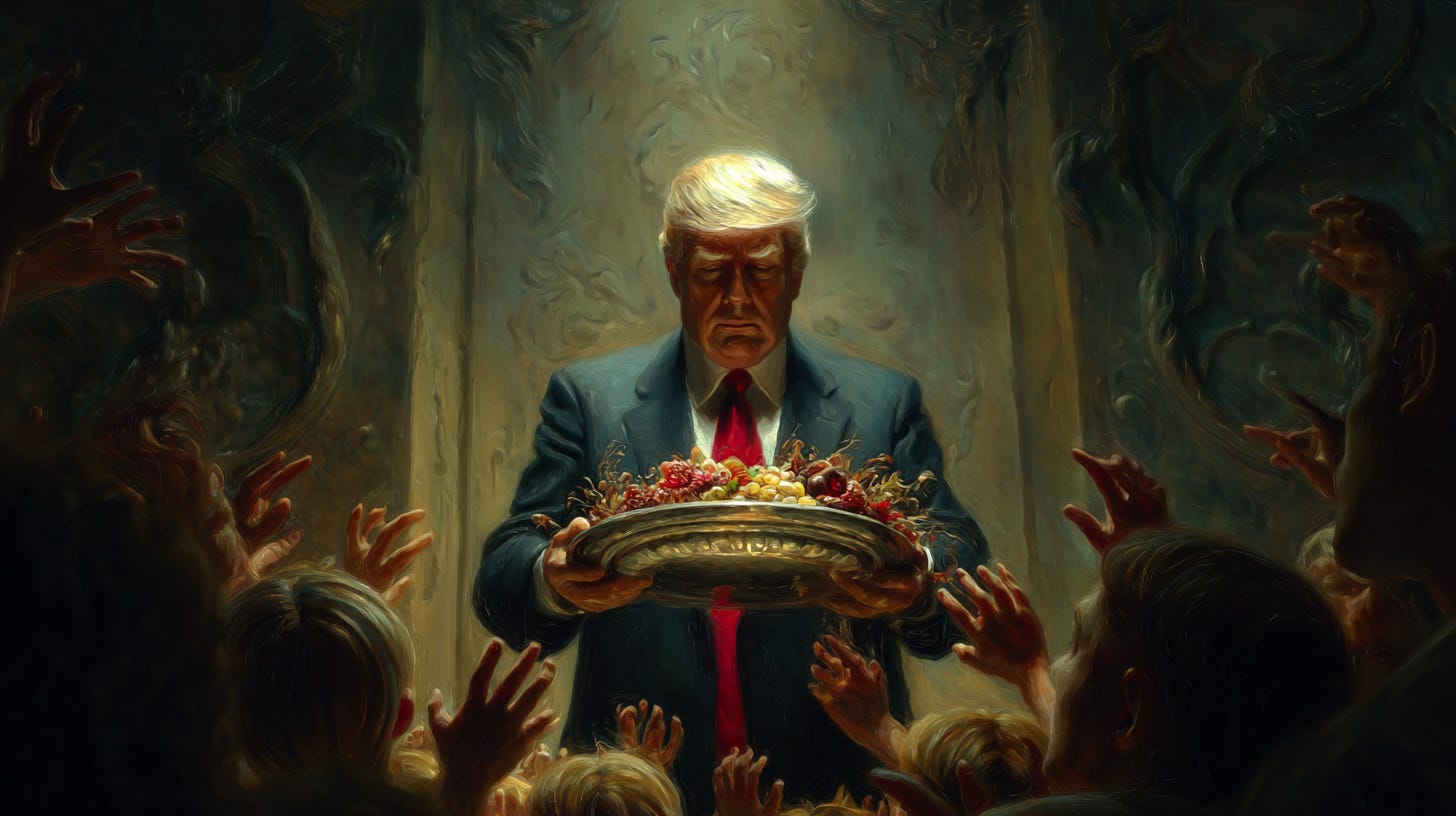
After 40 days of government shutdown, the Senate voted 60-40 late Sunday night to advance a deal that would restore food assistance to 42 million Americans. Eight Democrats broke ranks, surrendering their demands for healthcare subsidies to secure SNAP funding. The administration’s strategy worked: they weaponized hunger and won.
This is the story of how we got here. While Donald Trump builds a $300 million ballroom at the White House—a structure modeled after Versailles, funded by corporate donors with business before the federal government—his administration waged that 40-day war against food assistance.
This was warfare conducted through Congress and the courts. When federal judges ordered them to use emergency contingency funds, they appealed to the Supreme Court. When some states managed to issue full benefits, the administration demanded they “undo” those payments—literally trying to claw back food assistance that families were counting on. Even as political pressure mounted to end the shutdown, the legal strategy remained: appeal, block, delay. Fighting through every available court to prevent food from reaching hungry families.
The most depraved part? They did this while fighting over the ACA. The shutdown was driven by disputes over Affordable Care Act subsidies. The administration used SNAP—food assistance for 42 million Americans—as a bargaining chip in a healthcare funding fight. They withheld one basic human need to fight another basic human need. Not food or healthcare. Just neither, unless they got their way.
And it worked. Democrats gave up their ACA demands—subsidies that keep healthcare premiums affordable for millions—to secure SNAP funding. The administration got exactly what it wanted: food as leverage to kill healthcare protections. They starved families for 40 days and won the political fight they started.
At every turn, when presented with the legal authority and financial means to feed hungry families, this administration chose litigation over nutrition. Meanwhile, the ballroom continued rising on schedule. Historic magnolia trees planted for Warren Harding and Franklin Roosevelt were bulldozed. The East Wing demolished. All without federal approval from the National Capital Planning Commission, which remained closed during the shutdown that prevented SNAP payments.
When a society wants to build something, it finds the money. It finds the workers. It bypasses the regulations. But when that same society is asked to feed hungry children, suddenly there are endless obstacles. This isn’t incompetence—it’s calculated cruelty dressed as strategy.
Competing Visions
Tesla shareholders just approved a compensation package that could make Elon Musk the first trillionaire in history. Two days earlier, New York voters elected Zohran Mamdani as NYC mayor, a democratic socialist who campaigned on taxing New Yorkers earning $1 million and above 2% more to fund programs like free universal child care and fare-free buses.
The split screen highlights humanity’s biggest moral question: how much should an individual keep and how much should they share? Food brings this into sharp relief. If you don’t eat today, you feel it today. When SNAP gets cut off, families don’t experience some abstract future hardship—they experience it at the grocery store checkout, at the dinner table, in their children’s faces that night.
In our society today, individual need requires constant justification while corporate accumulation gets permanent protection. We’ve designed systems where a parent has to re-prove their children are hungry every six months, while tax structures that enable trillion-dollar fortunes persist across administrations without question. Where food assistance gets appealed through multiple courts while construction projects for the powerful bypass federal oversight entirely.
What War Looks Like
The administration claimed it couldn’t tap additional funds for SNAP because doing so would “endanger” child nutrition programs. Yet $300 million appeared for a party space. Resources materialized for demolition crews working around the clock. Federal law requiring approval was bypassed for monuments to power, but emergency food assistance required endless litigation.
They treated basic human needs like poker chips, betting that families would suffer enough to force political concessions. And they bet correctly. After 40 days, Democrats broke. Eight senators—Shaheen, Hassan, King, Kaine, Durbin, Cortez Masto, Rosen, Fetterman—voted to advance a deal that secured SNAP funding by abandoning healthcare protections. Senate Minority Leader Chuck Schumer called it a betrayal, but the moderates argued they had no choice: millions of families were being held hostage.
This was concentrated wealth deployed as a weapon—through court filings to prevent food assistance, through appeals to block emergency payments, through legal strategies to claw back benefits already distributed. The strategy worked. Hunger proved to be effective leverage.
Historical Precedent
The French have seen this before. When harvest failures in 1788 and 1789 drove bread prices to 88% of daily wages, the king—nicknamed “the first baker of the kingdom”—was held accountable for the starvation of his subjects. When officers at Versailles hosted a lavish banquet while families starved in Paris, thousands of women marched to the palace to demand food. Starving women storming Versailles to demand food from a monarch living in opulence became the defining symbol that sparked revolution.
We’re watching the same contrast: a $300 million ballroom versus food assistance for 42 million people. When you can find $852 billion for defense spending but can’t find funds for emergency food assistance, you’re revealing priorities. When corporate tax cuts pass without debate while food assistance requires 40 days of shutdown and a political surrender, you’re showing whose needs matter.
An economy runs on transactions, not accumulated wealth. When working families have resources, they spend them immediately on groceries, rent, car repairs—the actual transactions that keep businesses running. When billions pile up in the hands of a few, that capital gets deployed as a weapon: court filings to prevent others from accessing the resources they need to survive.
What We Just Chose
The Musk-Mamdani split screen showed competing visions. Sunday night, we chose. We chose the vision that protects unlimited accumulation while using food assistance as a hostage. We validated the strategy: withhold food long enough, and the opposition will surrender anything to make it stop.
The difference between these visions isn’t the ceiling—it’s the floor. When you raise the floor so that even the most destitute can simply get food, you give them a chance at fighting their way upward. Hunger keeps people trapped in an endless cycle where they can’t think past their next meal. Food assistance isn’t charity—it’s the baseline that makes mobility possible.
But we just watched that baseline get weaponized. We watched families feel the visceral stress of going hungry (or fearing that they would) for 40 days while their representatives fought over whether they deserved food AND healthcare or just one. And when the compromise came, it came on the administration’s terms: families get food, but millions lose affordable healthcare access. Choose which basic human need you want to protect, because you can’t have both.
What kind of morals do we subscribe to as a society? Have we actually evolved past our basest instincts—the lion hoarding its kill, attacking any member of the pride who dares approach? Or are we just sophisticated animals, justifying the destruction of our own species to preserve individual prosperity? Sunday night answered that question through a Senate vote.
Right now, we’re a country where the Trump administration fought harder to prevent food assistance than to provide it—and won. Where appeal after appeal got filed to block SNAP payments while tax cuts for the wealthy pass without debate. Where the legal strategy was to starve families into submission, using hunger as leverage to block healthcare access. Where millions of children waited 40 days for food while lawyers argued in multiple courts about whether emergency funds could be used to feed them. Where Democrats finally broke and gave up healthcare protections to secure food assistance.
This isn’t governance. This is barbarism dressed in legal briefs. This is cruelty as policy, starvation as strategy, hunger as a weapon that proved devastatingly effective. The Trump administration made a choice—explicit, documented, appealed through multiple courts, litigated for 40 days—that protecting concentrated wealth matters more than feeding children OR providing healthcare to the poor.
The obscenity isn’t just the palace construction or the tax cuts. It’s that they used food—the most fundamental human need—as a hostage to prevent healthcare access, and it worked. They decided that the best way to fight medical care for the poor was to starve them into political submission. This is the logic of a failed state. This is the morality of warlords, not leaders. This is what happens when a society decides that basic human needs are bargaining chips, that survival is negotiable, that hunger is just another form of political leverage.
And when that strategy succeeds—when food assistance as a weapon actually forces the opposition to surrender—we reveal exactly who we are as a society. The ballroom will open on schedule. The families got their SNAP benefits back, but millions lost healthcare protections in the trade. The administration proved that starving families works as political strategy.
That’s the lesson from these 40 days: if you’re willing to weaponize hunger, if you’re prepared to let children go without food long enough, you can win any fight. The question for me is: what kind of society learns that lesson and calls it victory?
—
My Book - Mise: On the Future of Food
My Podcast - The Tomorrow Today Show
My Instagram - The Book of Mise
My Other Instagram - Mike Lee
My Consultancy - Mise Futures
That it’s run by a demagogue?
This is another case of the world watching the USA in disbelief. Does any other country have this system of approving budgets? In NZ we have an annual budget announced by the government each May which allocates funds for the year to the various Government departments for spending.