



In 1968, a doctor wrote to the New England Journal of Medicine speculating that MSG caused his symptoms at Chinese restaurants. The letter was anecdotal and speculative, published in a correspondence section—not peer-reviewed research. But MSG had an unfamiliar, chemical-sounding name. It was associated with “foreign” food. The story felt true, and it stuck.
Never mind that MSG is just glutamate—the same compound that creates umami flavor in tomatoes, parmesan, and mushrooms. Never mind that fifty years of controlled studies failed to confirm the claimed effects. Chinese restaurants—like my mom and dad’s—were targeted, while American food companies quietly used MSG in processed foods for decades, labeled as “natural flavors.”
Then fat was vilified in the 1980s. Carbs were out in the 1990s. Gluten got the boot in the 2010s. Now it’s seed oils and acetaminophen. The ingredient changes. The pattern doesn’t.
The Pattern
I’ve been fascinated for a long time by how food trends rise and fall. My recent posts (here, here, here, and here) are current evidence of that fascination. And one core piece of the story of food trends is the ingredient villains. How do they emerge? Why do they stick around? Why is there always one?
Sometimes ingredients really do deserve to be avoided. Cigarettes cause lung cancer. Lead exposure damages developing brains. Trans fats increase cardiovascular disease risk. These conclusions rest on decades of overwhelming, consistent evidence. Real harms reveal themselves through mountains of data, not through anecdotes and mechanistic speculation.
Now consider seed oils—canola, soybean, corn oil. They’re blamed for everything from inflammation to infertility. The concern centers on oxidation: when oils break down under heat, they form compounds that can damage cells and contribute to inflammation. That’s a real mechanism. The question is whether it happens at levels that actually harm people.
Seed oils are high in omega-6 fatty acids—polyunsaturated fats that are essential nutrients but (as all sources agree) are far more prone to oxidation than other fats. Deep frying keeps oil at that temperature for extended periods, through repeated cycles. If you’re consistently eating food covered in that degraded oil—think regular fast food consumption—that’s a legitimate concern.
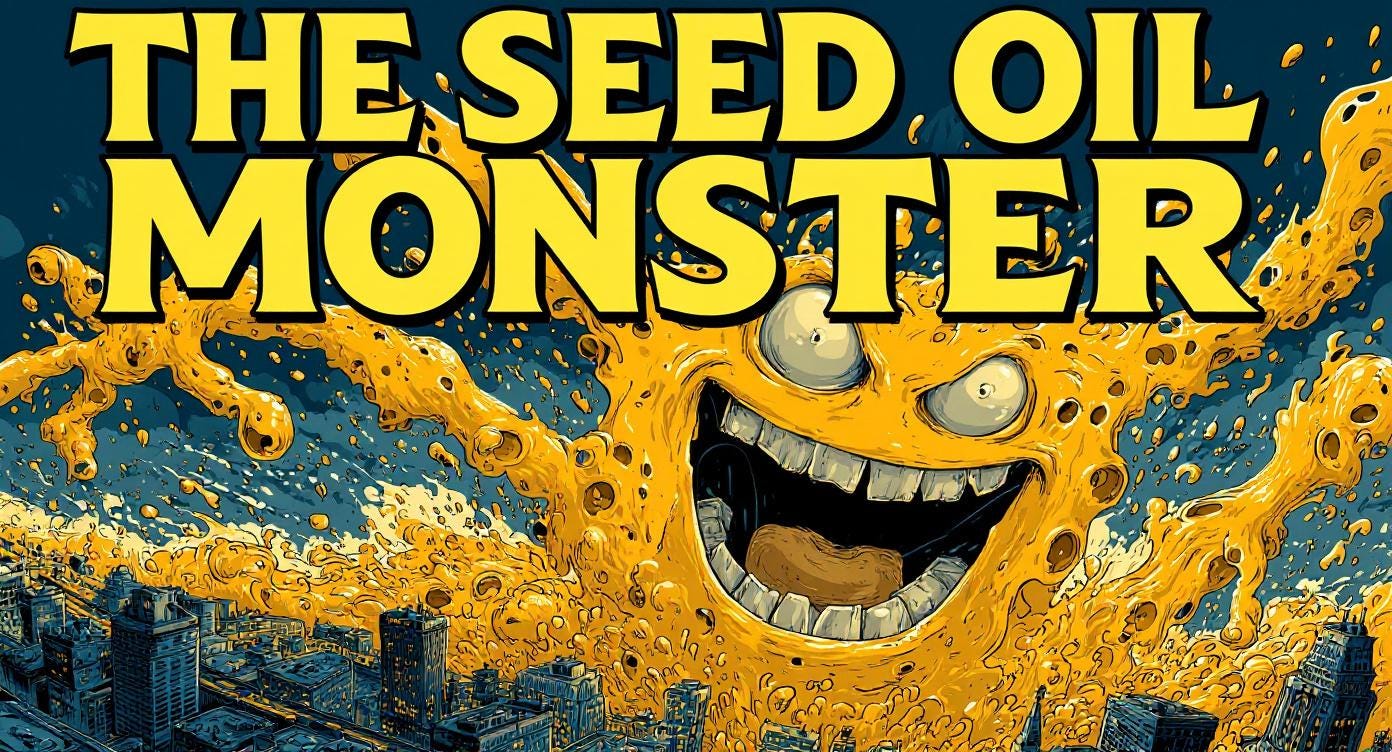
But most home cooks aren’t deep frying with any consistency. And when you’re sautéing vegetables in a tablespoon of seed oil, you’re simply not creating the same level of degradation. While the debate is fierce, large-scale population evidence tracking hundreds of thousands of people for years shows no harm—and often a modest benefit—from omega-6 fatty acids at typical intakes.
The problem happens when a narrow industrial concern becomes a blanket condemnation. Restaurant fryers running constantly at high heat with reused oil create harmful compounds. That specific context becomes “all seed oils are poison everywhere.”
Seed oils make up 8–10% of total energy intake in Western diets, and about 34% of U.S. packaged foods contain them. They’re in chips, crackers, baked goods, salad dressings, frozen meals, fast food. The dose question becomes trickier when the ingredient is ubiquitous in ultraprocessed food—the same food that’s engineered for overconsumption and drives chronic disease through multiple mechanisms.
Drinking one glass of wine differs from drinking a whole bottle of vodka. Some substances harm at any exposure. But others show harm only at extreme doses or specific contexts. Seed oils might be the same—harmful when degraded and consumed constantly, benign in typical home cooking amounts.
Does industrial-scale seed oil production raise legitimate questions about processing methods, environmental impact, or metabolic effects worth studying? Absolutely. But those are different questions than putting out a blanket statement that “all seed oils are poison.”
Many people cut out seed oils and feel better. Real relief, real improvement. But did they feel better because they eliminated seed oils specifically? Or because eliminating seed oils meant eliminating fast food, fried food, and ultraprocessed junk? It’s hard to isolate which ingredient was actually the problem when people’s diets are this complicated. When you remove seed oils, you’re not making a surgical change—you’re dismantling an entire eating pattern. That’s where correlation can get mistaken for causation.

To me, the conversation around seed oils is a fascinating exhibition of how scientific evidence, cultural bias, commercial interests, and social influence create consensus around ingredient villains—often with weaker evidence than we’d like to admit. And the act of villainization serves a need. Not just nutritional, but psychological and economic.
Single-ingredient villains offer clarity. “Avoid seed oils” is actionable. “The industrialized food system requires coordinated regulatory reform” is overwhelming. We’re wired to prefer clear causes and simple solutions, even when reality is messier.
Wellness influencers build audiences by offering specific threats and solutions. They can’t be the hero without casting a villain and can’t sell the cure without identifying the poison. “Seed oils destroy your mitochondria” gets more engagement than “the evidence is mixed and context-dependent.” These creators link to premium alternatives that they often have financial interest in—ghee, beef tallow, “ancestral” cooking oils commanding 3–5× the price. Social platforms reward extreme claims over nuanced analysis.
Frustrated people seek alternative authorities after mainstream nutrition got fat wrong, then carbs wrong, then other things wrong. That skepticism is legitimate. But it creates vulnerability to claims that sound scientific without meeting scientific standards.
Yesterday, Kimberly-Clark announced they’re acquiring Kenvue—the company that makes Tylenol—for $40 billion. This wasn’t a normal acquisition of a struggling business. Kenvue’s problems compounded when Trump and RFK Jr. claimed acetaminophen causes autism in children.
The assertion spread rapidly despite lacking solid evidence—studies showing associations but no causal proof, confounding factors left unaddressed, the kind of preliminary research that normally warrants further investigation, not public alarm. But parents heard “Tylenol causes autism” and stopped buying. Because, “What if Trump was right?” So Tylenol sales took a dive and so did Kenvue’s market value.

RFK Jr. later admitted there wasn’t “sufficient” evidence for the claim. The retraction didn’t matter. Companies now operate in an environment where political pronouncements move billions in market capitalization faster than scientific research establishes facts. “Seed oil free” becomes a marketing advantage regardless of evidence.
If you’re a food brand and seed oils become cultural poison, your scientific opinion is kind of irrelevant—you either reformulate or lose market share. And the gravity of the seed oil–free trend grows. Truth and profitability rarely align. These ingredient villains don’t just shape consumer purchases—they reshape entire markets based on fear rather than data.
What to Watch For
When the next villain ingredient emerges—and it will—remember that most villain ingredients are just places to direct anxiety about a food system optimized for everything except health. That anxiety is valid. Villainizing lets us feel like we’re taking action while avoiding harder questions about why chronic disease rates keep climbing, why healthy food costs more and takes more effort, why our food system prioritizes shelf stability and profit margins over nutrition.
But for most people, those systemic questions feel too big and too distant to act on. And most people don’t have the bandwidth to start a movement. That’s understandable. So instead, they take seed oils out of their diets. It feels like doing something. And honestly, that’s understandable too.

Still, there’s value in developing pattern recognition. Not to dismiss people’s concerns, but to distinguish warranted caution from manufactured panic.
Look out for one ingredient blamed for multiple complex health problems—that’s usually a red flag. Watch for claims built on lab studies rather than real-world outcomes. Lab research generates interesting hypotheses, but population studies tracking thousands of people over years tell you what actually matters. Notice when elimination sounds costless—real dietary changes involve tradeoffs. And follow the money to whatever premium alternative is being sold.
Compare the evidence to established harms: does it look like cigarettes—overwhelming data across decades? Or MSG—plausible story, weak evidence, cultural anxiety doing the work?
Somewhere right now, someone is building the case against the next ingredient. The pattern keeps repeating because it serves too many needs. Politicians gain attention. Influencers build audiences. Companies sell products. People get simple answers to complex problems.
The question isn’t whether you should avoid the next villain ingredient. The question is why we keep looking for nutritional smoking guns when the evidence doesn’t warrant it—and why we’re so quick to accept simple explanations for complex problems.
Some ingredients deserve their reputation. Most are just convenient targets. Learn to tell the difference. We don’t need new villains. We need new systems.
—
More ingredients…
My Book - Mise: On the Future of Food
My Podcast - The Tomorrow Today Show
My Instagram - The Book of Mise
My Other Instagram - Mike Lee
My Consultancy - Mise Futures
Great synthesis. Eggs were another maligned food that ‘turned around’ though not blamed for multiple health woes.
It's happening in real time..."Any amount of alcohol is bad for your health".