


About this piece…
In my recent piece, “What Maduro’s Capture Has to Do With Your Groceries,” I argued that clean energy wouldn’t eliminate resource competition—it would just redraw the map. Whoever corners the market on batteries and fusion inherits the leverage that oil producers hold today.
This is a speculative scenario I wrote about that future. “The People’s Green Republic” and its companion story “The Tian Gao Integrated Pork Cultivation Facility” are from my book Mise: On the Future of Food. But if you read the Venezuela piece and wanted to sit with the implications longer, this long read might scratch that itch. Enjoy.
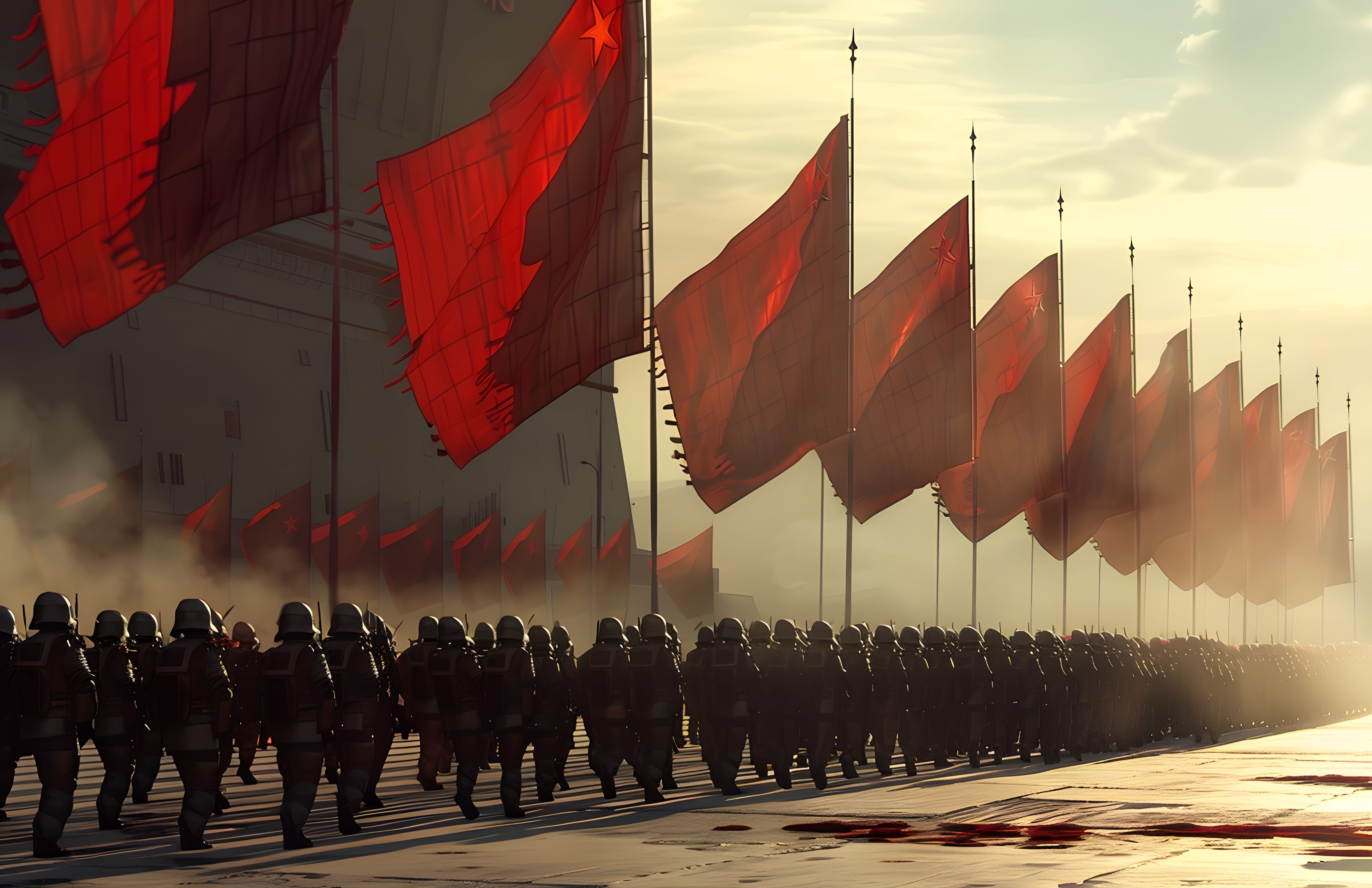
Zhong Cai’s first landmark initiative after ascending to power as the Chinese Communist Party’s General Secretary was the Jade Renewal Movement, a sweeping 35-year vision for China to become the world’s top superpower through green energy. Introduced in 2030, one year after Xi Jinping’s death, the Movement doubled down on China’s leadership in renewable energy technology and manufacturing, especially in solar and wind power generation and best-in-class battery technology.
While this development seemed laudable from an environmental standpoint, Zhong was more interested in its potential to make China the world’s largest economy by cornering the renewable energy market. While the rest of the world fought over the dwindling global oil supply and was bumbling the transition to clean energy, Zhong’s China would become the next sole superpower. Zhong’s vision for a clean, green China may have differed dramatically from his predecessor’s economic strategy. Still, he deployed it with the same autocratic rule, with all the propaganda, political purging, and human rights violations for which Xi was infamous.
Xi Jinping died suddenly of a stroke in March 2029. An emergency session of the Chinese Communist Party Congress was called, and after five days of closely held proceedings, Zhong Cai emerged as the party’s new leader. By design, little is known about the conversations during the plenary. Foreign affairs experts suspect that Zhong rose to power after years of covertly forming a coalition of dissent after Xi’s disastrous Zero Covid policies that contributed heavily to civil unrest and economic stagnation.
Zhong was born and raised in Shanghai and was involved in the communist party from a young age. He actively participated in the Communist Youth League of China from age five. He was educated at the Huazhong University of Science & Technology in Wuhan and then at Stanford University for his MBA. Upon returning home, he held various staff positions in the National People’s Congress before joining the notorious Central Commission for Discipline Inspection (CCDI), where he investigated and ousted several high-profile Politburo members on corruption charges. Zhong was a relentless and effective investigator and eventually led the CCDI as its secretary while also holding a position on the Politburo Standing Committee of the Chinese Communist Party. As the leader of the CCDI, he greatly expanded its influence and scope beyond investigating government officials. The Zhong-era CCDI acted more like the Red Guards of the Chinese Cultural Revolution, able to investigate, arrest, and punish citizens with impunity. Zhong had cultivated an intimidating presence in the Chinese government and was seen as one of Xi’s most trusted advisors.
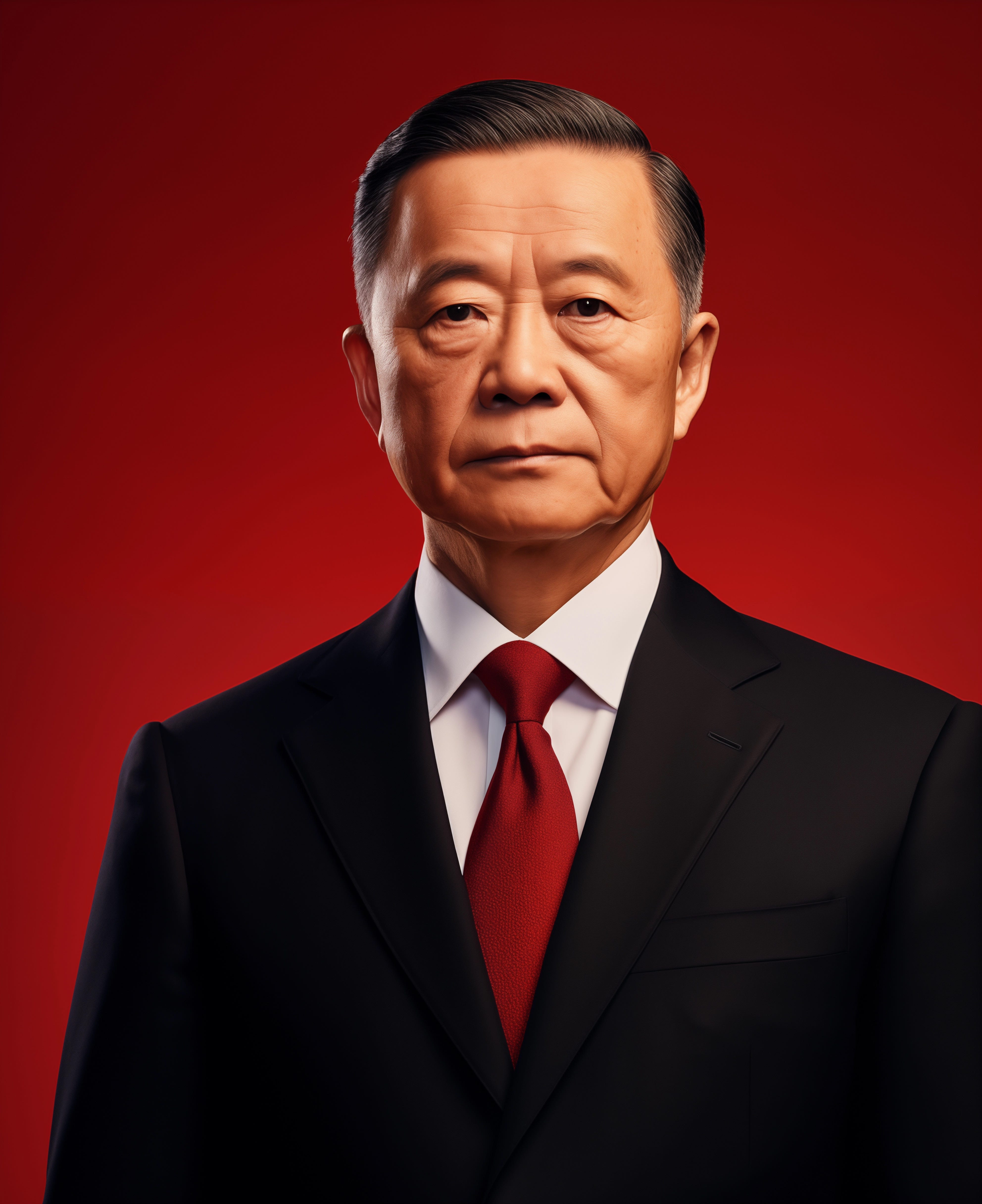
But while Zhong’s outward loyalty to Xi never seemed to waiver, internally, he had become increasingly agitated with Xi’s handling of the Covid-19 lockdowns and the real estate crisis that followed. Zhong never dared to speak these concerns out in public, but discreetly started meeting with other CCP leaders to discuss how China might steer itself out of economic stagnation and off-the-charts unemployment. In these conversations, Zhong began to socialize his vision for China to become the world’s top superpower by focusing harder on green energy. This quiet coalition building cemented his opportunistic rise to power after Xi’s untimely death.
Zhong’s Jade Renewal Movement was staggeringly complex and arguably could have only been accomplished within a government like China’s. Market forces in capitalist countries had not created enough incentives to switch to renewable energy at a sufficient pace to avoid the 2072 deadline when the world’s obtainable oil was predicted to run out. This was not for lack of an ideological fight, as the issue of phasing out fossil fuels had gained more support than ever. Still, the allure of near-term profits in the oil and gas industry would ultimately limit the amount of serious investment in clean energy infrastructure. With his near-limitless power to enact legislation and provide cheap capital for green projects, Zhong knew he could make change happen far faster than any other country. In China, there was no debate about whether or not to go green like there was in more pluralistic societies. You either fell in line with the agenda, or you’d disappear.

Phase 1: Green As Jade
Targeted Completion Year: 2045
The Jade Renewal Movement had three phases stretching over the next 35 years and would transform China into the world’s leading energy producer, military force, and largest economy. The first objective was to accelerate the transition toward solar, wind, and hydroelectric power while aggressively dialing down its fossil fuel consumption. China had already been ahead of the rest of the world in solar power generation for nearly a decade before Zhong’s rise to Supreme Leader, which gave it a considerable head start in building green infrastructure. 98% of the world’s solar panel manufacturing now happens in China, and Zhong enacted new reforms to advance that lead even further.
Chinese companies were forced to begin measuring and assigning valuations to the positive and negative externalities it created for the ecosystem and society. True socialism meant company profits were socialized across society, but so were the costs. In 2017, air pollution contributed to about 21% of deaths in China. Major Chinese cities had long been blanketed in smog, contributing to countless health issues for its citizens, but the carbon-emitting companies never bore those costs. This and other pollution from industrial and agricultural industries burden the country’s socialized healthcare system. With measurement systems and valuation methods now in place, polluting companies would be billed for that damage.
On the other hand, if companies could demonstrate that they created beneficial outcomes that regenerated ecosystems and enriched human health, the government would reward them for those services. Combining the quantified externality program with considerable tax credits and R&D funding grants to hasten the transition to green energy would make it economically difficult to continue burning fossil fuels at pre-Jade Renewal Movement levels.
Under these economic conditions, Chinese food and agriculture companies had little choice but to transform themselves. Being punished or rewarded for their role in ecosystem harm or healing drove many farmers to transition toward regenerative agriculture practices. Chinese crops became heavily rotated, with ryegrass-sweet sorghum to winter wheat–summer maize rotations or soybean to winter wheat-summer maize rotations happening in Northern China.
Regenerative farming would create positive ecosystem services and help China achieve food sovereignty. It would also reduce the amount of fertilizer and other synthetic inputs they import from abroad. Not having to depend on other countries for agricultural inputs would greatly simplify their foreign policy, especially when dealing with democratic countries disapproving of their lackluster human rights record. The added labor from farming more regeneratively was offset by solar-powered farm robotics, which were more easily attainable due to China’s highly efficient manufacturing processes. Clean, green food sovereignty was just as important as renewable energy independence.
On the other end of the technological spectrum, having access to cheap, renewable, clean energy also changed the economic viability of food technologies like indoor farming, cellular agriculture, and precision fermentation. These food-tech operations could produce higher-value food products closer to large city centers with solid demand from affluent urbanites. Previously taboo or rare ingredients revered in Chinese culture, like shark fins and abalone, could be fabricated ethically and more affordably in bioreactors, often in the same building as the grocery store or restaurant that sold them. Health-conscious citizens also appreciated that lab-grown proteins could be manipulated to boost certain nutrients like Omega-3s or protein levels to suit their nutritional goals. The blend of regeneratively grown and high-tech fabricated food choices gave citizens many options to access affordable, safe, and nutrient-dense foods that ultimately increased their well-being and ability to contribute to China’s economy.
Phase 2: Make All The Batteries
Targeted Completion Year: 2055
One of the most significant technologies that enabled all these changes was the superiority of Chinese battery technology. The global rise in electric car production thirty years prior incentivized Chinese firms to manufacture them. Decades of manufacturing experience, along with significant R&D funding and the fact that many of the raw materials for high-performance batteries were found at home, made China the leading battery producer by a long shot.
Transporting significant amounts of energy from often remote areas where wind, hydro, and solar power generation occurred to the point of energy consumption—without losing much power along the way—was a game changer. It was becoming more common to see cargo vessels being loaded with thousands of fully charged, industrial-sized batteries where oil barrels used to sit.
Their prowess with batteries would also open doors for clean energy export to other countries seeking to reduce their carbon footprint without the infrastructure to do so. The United States was especially behind in creating a significant amount of clean energy capacity and still used a lot of fossil fuels. They became one of China’s biggest customers for batteries charged with cleanly generated energy to meet their carbon offset goals. Renewable energy infrastructure doesn’t get built overnight, so buying Chinese-made green battery energy was a convenient band-aid for powering homes and businesses without expanding their carbon emissions.
Zhong knew that food and energy independence were two big keys to becoming a global superpower. Economic and military might required prodigious amounts of fuel to build and maintain infrastructure and innovation. Oil wouldn’t flow freely from the ground forever, so he made sure that when the wells dried up, China would still be running on a never ending supply of renewable power.
Microchips and missiles were still crucial for national security, but energy was needed for them to be produced and operated. Much like the Americans had historically limited China’s access to their cutting-edge semiconductors and weapons, China was in control of how much energy it would let the United States buy from them and refused to give them access to their best green energy generation technology. America was far behind schedule in preparing for the end of oil in 2068, and China had the patience to wait for their fuel tanks to run empty.
Phase 3: The Fusion Dynasty
Targeted Completion Year: 2065
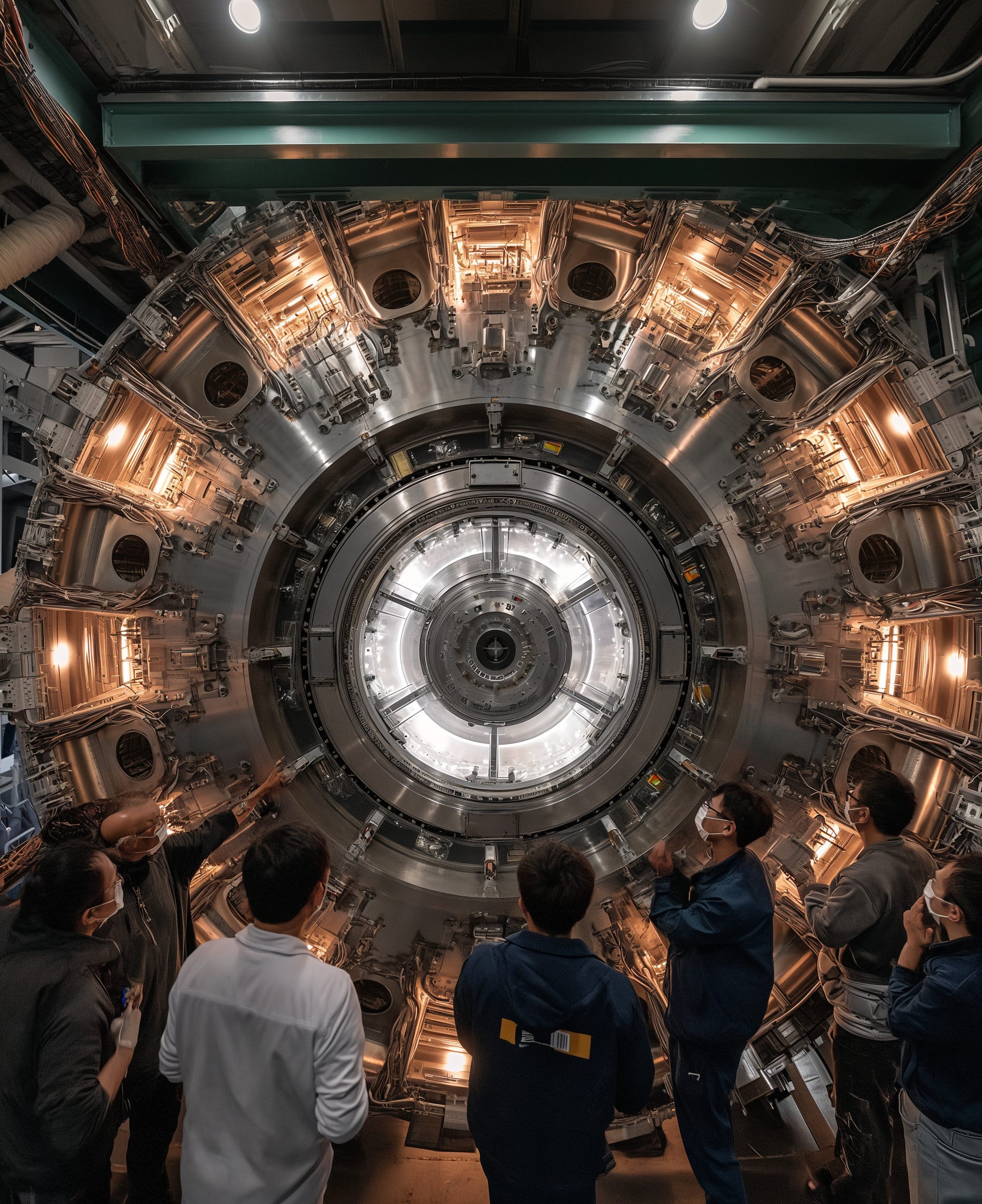
The final piece of Zhong’s vision was to achieve nuclear fusion and retrofit the entire Chinese energy grid with fusion-driven power plants. China had invested in nuclear fusion research since the 2020s, and its commercial-scale fusion grid had been expanding since 2050.
This coincided with China’s top semiconductor fab, SMIC, being able to consistently manufacture significant amounts of 7 and 5-nanometer chips by the mid-2020s. These chips were still a few generations behind chips made in other countries but were powerful enough to run supercomputer simulations of fusion plasma that would accelerate their R&D. Best of all, no nation could deprive China of these advanced chips, as SMIC had painstakingly built its supply chain and local fabs outside the reach of American sanctions. By the mid-2030s, SMIC had caught up to the world’s best chip fabs, and they were making 1 nanometer chips that could run the most sophisticated software, which was a crucial component in understanding how to crack the code on nuclear fusion.
In 2042, Zhong attended a ribbon-cutting ceremony in Shandong for China’s first fully operational, pilot-scale nuclear fusion plant. The Americans wouldn’t have this capability for another ten years. By the time a pilot plant like this would first go live in the States, China had already opened up a 1-gigawatt fusion power plant that was supplying power to parts of Beijing, with at least a dozen more plants like it under construction.
By 2065, China provided 40% of its energy needs via nuclear fusion, with the remainder coming from solar, wind, and hydroelectric power. OPEC had fallen to its knees, with oil stores nearly empty after over two decades of unsuccessful exploration efforts. Oil and gas supplies in Russia, Venezuela, the United States, and other non-OPEC countries were dwindling. Many countries had appropriately planned for this day and built their green energy infrastructure or forged longstanding trade relationships with China to buy their green batteries.
Zhong Cai was now 95 years old and in poor health. China had entered the 21st century as an indispensable component of the world’s manufacturing economy and was now the world’s most important energy producer—Zhong’s dream of overtaking the United States as the world’s superpower had come true. The Chinese history books would immortalize his achievements in turning China into the biggest economy in the world with the highest per capita GDP and almost non-existent levels of poverty.
Even his critics would concede that he did more than anyone else did to help the world reach net zero emissions by the middle of the century. But it was hard to forget the trail of carnage he left behind. Repeated attempts from dissidents within China to derail his Jade Renewal project were met with ruthless displays of violence not seen since the Cultural Revolution. Anyone who dared push back on the feasibility of his plans would be arrested and sent to re-education or labor camps to manufacture battery and fusion reactor components, never to be seen again. The lucky ones would be executed immediately after a show trial. Their families would meet similar fates to send a lesson that no one was above the CCP’s rule of law.
China was economically and militarily powerful, but the daily lives of its citizens were tightly constrained. Zhong’s propaganda machine had been ingrained in Chinese culture, and this level of government control was necessary for its citizens to have such prosperity. As their military might grew, this arrangement was extended to the many colonies worldwide that China had taken over. Submit to our way of life, and you’ll be rewarded with clean food, water, air, and shelter. Otherwise, you won’t live long enough to experience those things ever again.
The Jade Renewal Movement has been great for the planet, but what about its people? The victors write history, and the Chinese propaganda machine would ensure the collateral damage Zhong caused would fade away in the rearview mirror. World leaders would not dare protest China’s methods because, in the end, they needed China for its energy. That was the deal other countries had to make with the world’s most ruthless superpower. They didn’t move fast enough to do what China had done. While the West was wringing its hands on what to do about energy policy and climate change, China was busy jamming the Jade Renewal down its people’s throats.
The Tian Gao Integrated Pork Cultivation Facility
Year: 2067
6:54 PM. The nurse jabs the long cotton swab up my right nostril and spins it rapidly clockwise, then counterclockwise. My eyes tear up, and I feel a burn in my sinuses as she switches to the left and repeats the motion. She removes it, and I instinctively cough. She gestures toward the pale green door behind her that leads to the decontamination room where I undress, and a bathroom attendant squeezes a large dollop of shampoo-body wash onto the top of my head before I enter the communal showers. The attendant observes me as I thoroughly scrub every inch of my body with a coarse, single-use scrub brush.
The attendant gives me a thumbs-up, signifying that I’ve sufficiently cleaned my entire body. I walk through another pale green door into an 18°C room with six rows of metal benches evenly distributed across the space. The walls are white and sterile. The cold is bracing. I endure. Still naked and dripping wet, I take a seat on one of the benches and close my eyes for twenty minutes while the results of my swine flu test are processed.
My test results return negative. I am now allowed to walk through a red door with two rows of twelve bathtubs. Workers in waterproof, clean suits walk around with power washers shooting disinfectant-laden water into the tubs that had just been used. One worker looks at me and gestures toward a tub she just finished cleaning and filling with hot water and a blend of disinfectant soap. I dip my toe into the hot water, which feels welcoming after chill drying, and sit submerged in it for another twenty minutes. After that, I get out and move to the next room where a technician hands me a sealed, clear plastic bag containing a pair of sweatpants, tank top, underwear, bra, v-neck t-shirt, sweatshirt, and pair of rubber slippers all in the same pale pink shade. I break the sterility seal and put the clothes on. Finally, I am allowed to enter the women’s dormitory, where I walk down the long hallway and into the fifth door on the right of my room.
Seven other women share the room. There are eight single-sized beds with gray metal frames and all-white sheets. Next to each bed is a locker where we are permitted to keep our pre-approved and sanitized personal items secure. I checked my company-issued phone and saw a message from my husband, Hao: “did you make it ok?” I reply, “yes,” and “i love you, my bao bei. going to sleep now. chat later.” My bed is the third on the right, and I pull the covers halfway down, sit on the side of my bed, remove my slippers, swivel under the blankets, and lay my still-damp hair on the pillow. I close my eyes and take deep breaths to calm my mind. It will be a long day tomorrow, and I’m tired from the long train ride back home after the New Year celebration. Tomorrow, the pigs need me. I fell asleep almost instantly.
SQUUUUUUUUUUUUEEEEEEEEEEEEAAAAAAAK
1:12 AM. I hear the sound of old bed springs shifting. Someone is rolling over heavily. I see the clock on the wall with half-open eyes. It’s the middle of the night. My eyes adjust to the dark, and I look at the sound. It’s Jie. She’s back. And awake. I open my eyes fully and gaze at her, trying to make eye contact. She sees me. We lock eyes. Like me, Jie was here to earn as much money as possible and quit the skyscraper farm one day. She was the only girl in our dorm to work in the bioreactor section of the building. Like me, Jie grew up in a rural village, and we had similar experiences growing up, which bonded us as much as you can bond with a colleague. Outside of my supervisor and the night shift tech on floor 55, Jie was the only person I talked to. The girls here liked to gossip, so keeping your private life to yourself before rumors got out was best.
Jie looks stressed. Neither of us says anything to avoid waking the other girls. I reach into my bedside locker and grab my pack of cigarettes and lighter. I open it and put one in my mouth. I grab my pen and a small scrap of paper from the locker and write a message to Jie. I fold the note, shove it into the red pack of Chunghwas, and toss it over to her. Jie opens the pack, grabs a smoke, and reads my note: “Can you talk?”
She nods, and I carefully get out of bed and lead her to the end of the room and into the bathroom. Jie follows, shuts the door, and we sit on the floor between the window and one of the showers. I crack the window and light her cigarette, then mine. We take deep pulls, the orange embered ends illuminating our bathroom corner as the smoke fills the air. Head tilted back against the wall, Jie pauses for a moment, eyes fixated on one of the shower heads, and then begins to speak softly.
Jie tells me about the two days before the Chinese New Year holiday when she managed what she believed was a contamination event on the 32nd-floor bioreactor farm. Contaminations were rare but not unheard of. Protocol directed a technician to flush out the contaminated tank, order cleaner bots to sterilize the tank then refill it with growth factors and start over. It was never fun to have one, but it was merely a mild inconvenience.
But this time, her supervisor had her flush out eight 350,000-liter bioreactor tanks as a precaution. It was a grotesque amount of protein slurry and the smell was horrendous. Management suspected the contamination had spread farther than usual and put Jie in quarantine as an extended precaution.
The quarantine ward was actually pretty relaxing, consisting of decently appointed and clean single-occupancy rooms with private bathrooms. You get an entertainment and communication console, and your meals are brought to you. It’s like a hotel where you can get some privacy and escape without being accountable to anyone for a week.
They tested Jie for any traces of infection but she thankfully didn’t contract whatever had contaminated her floor. The day before her discharge date, a man from the Central Commission for Discipline Inspection visited her. The CCDI was the notorious national police and investigation unit that operated with impunity across China. As a kid, my Auntie and Uncle would sometimes tell me stories about the Red Guards of the Cultural Revolution and the Gestapo of Nazi Germany, both of which inspired the modern-day CCDI. They didn’t think youth should insulate you from the world’s harsh realities. I got their message that the CCDI were not to be messed with. It wasn’t until my teenage years that I realized how risky it was for them to share that information with me. But they believed that knowing the truth was worth the risk.
The man never identified himself but wore a red Tristar lapel pin on his all-black suit that was unmistakably CCDI. The man reminded Jie of her national duty to remain silent about what she had witnessed during the contamination. All employees had to sign strict confidentiality agreements to work at Tian Gao. Still, he offered her a chance to sign a reaffirmation of silence oath in exchange for a substantial hush money package, paid immediately in cash. The CCDI only did this if something significant was at stake and found that using the carrot before the stick yielded greater loyalty. What an odd request for what seemed to be a garden variety contamination.
He then produced three photos from his briefcase. They were satellite surveillance images of her husband and parents. Without anyone saying a word, Jie knew what it would mean to refuse the cash. The CCDI didn’t keep surveillance photos of people to keep them safe. Jie signed and took the money. The man collected the documents and left the room. The next day, she was discharged from quarantine and was free to leave Tian Gao for the New Year holiday.
She spent quality time with her husband, Wing, and parents at home. She got through the quarantine experience unscathed despite the unnerving visit from CCDI, which she chose not to share with her family. The holiday could not have come at a better time. She would get a chance to recharge at home and then return to Tian Gao with a fresh start on the year. After their New Year’s Day dinner, she sat in bed mindlessly, scrolling through her phone as her husband was in the shower. A message came through from an unfamiliar name written in English. She clicked the translate button and read the message from a British reporter who tracked her name down from leaked Tian Gao documents he had obtained from an anonymous source. His name was Jamie, and he had been observing satellite footage of Tian Gao for the past nine months.
Jamie noticed the smokestacks running unusually high before the holidays and wondered if she’d be willing to speak to him. Jie sat up in bed and gazed at the message, feeling a rush of anxiety wash over her. Did he know about the contamination? How would he have known? Was he shooting in the dark? Regardless, it was jarring, and she suspected the CCDI might have intercepted this message. The fear from her CCDI visit crept back into her head, undoing what was a lovely, quiet week at home. She processed her options for a minute as she could hear her husband turn off the shower.
Images of what happened to whistleblowers nearly 50 years ago during the COVID-19 pandemic flashed through her mind. She was an idealist, but was she ready to put everything on the line for truth? Besides, she was kept in the dark about the full extent of the contamination and didn’t have much to offer Jamie, aside from her visit from the CCDI. Jie archived the message and turned off her phone as Wing returned to the bedroom in a towel. She quickly placed her phone on the nightstand and pulled the covers over her, rolling away from him into a fetal position to hide her nerves. She pretended to be asleep, not wanting him to see her in this state, which would inevitably lead to questions. She didn’t want to lie to him.
Jie and I finish our cigarettes, extinguishing them on the damp shower drain and flicking the butts out the window before returning to bed. I put my arm around her as we walked back to bed, reassuring her things would be ok and that she probably did the right thing. Jie looked relieved to talk about the situation with someone who would understand. I hugged her and tucked her into bed before climbing back into mine. Within minutes, I could hear her gentle snoring. I fall asleep shortly after she does, appreciative that I have a friend in this harsh place.
BZZZT BZZZT BZZZT BZZZT BZZZT
5:30 AM. The alarm buzzes loudly through the distorted overhead speakers in my dorm room. My eyes open immediately, and I can see the rest of the ladies still in their beds, beginning to move. I see Jie lying on her stomach, eyes still closed as the alarm wails. I sit up and put on my slippers to head to the bathroom. I tap her on the shoulder as I pass by to wake her. We wash up and head to breakfast.
After our typical morning meal of congee and tea, I send Hao a good morning message and wish him well. We’ve been dating for five years and married for two. He’s a loving and reliable husband but couldn’t pass the technical exams to work at Tian Gao. He stays in our village and works as a handyman, doing odd jobs around town. He checks in on my parents daily and takes care of his aging parents. We miss each other dearly, but both agreed that the money I was earning at Tian Gao would fund our future. Besides, being a quasi-bachelor most of the year gives him plenty of time to hang out with his friends after work. He’s a good man and understands the need for sacrifice to support the greater good. I love him.
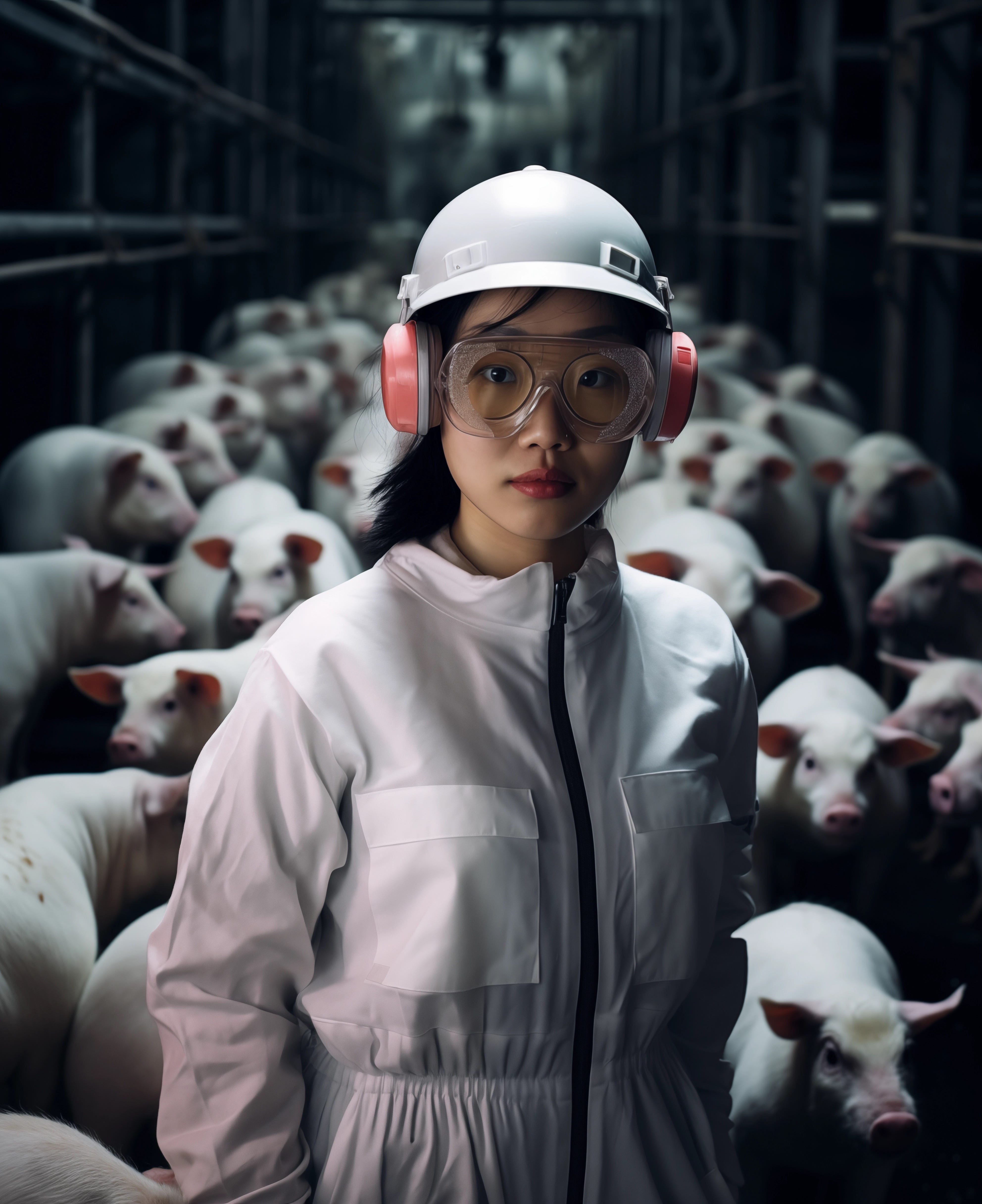
I return to the disinfecting shower room and disrobe, placing my dorm clothes in my locker. The attendant squeezes the shampoo-body wash onto my head again, and I enter the communal showers. I use the single-use scrub brush again to scour my body and get the thumbs up. An attendant handed me a bigger sealed plastic bag that contained my clean suit. I crack the sterility seal and put it on. She hands me a clean pair of white rubber boots, green gloves, a white hard hat, clear safety glasses, and red sound dampeners. I take the lanyard with my ID card from my locker and place it around my neck. I adjust it so my ID photo and name, Shao Min, face outward. I close the locker and direct my eyes toward the door, where I enter the elevator on floor 55. I scan my eyes to access the control room.
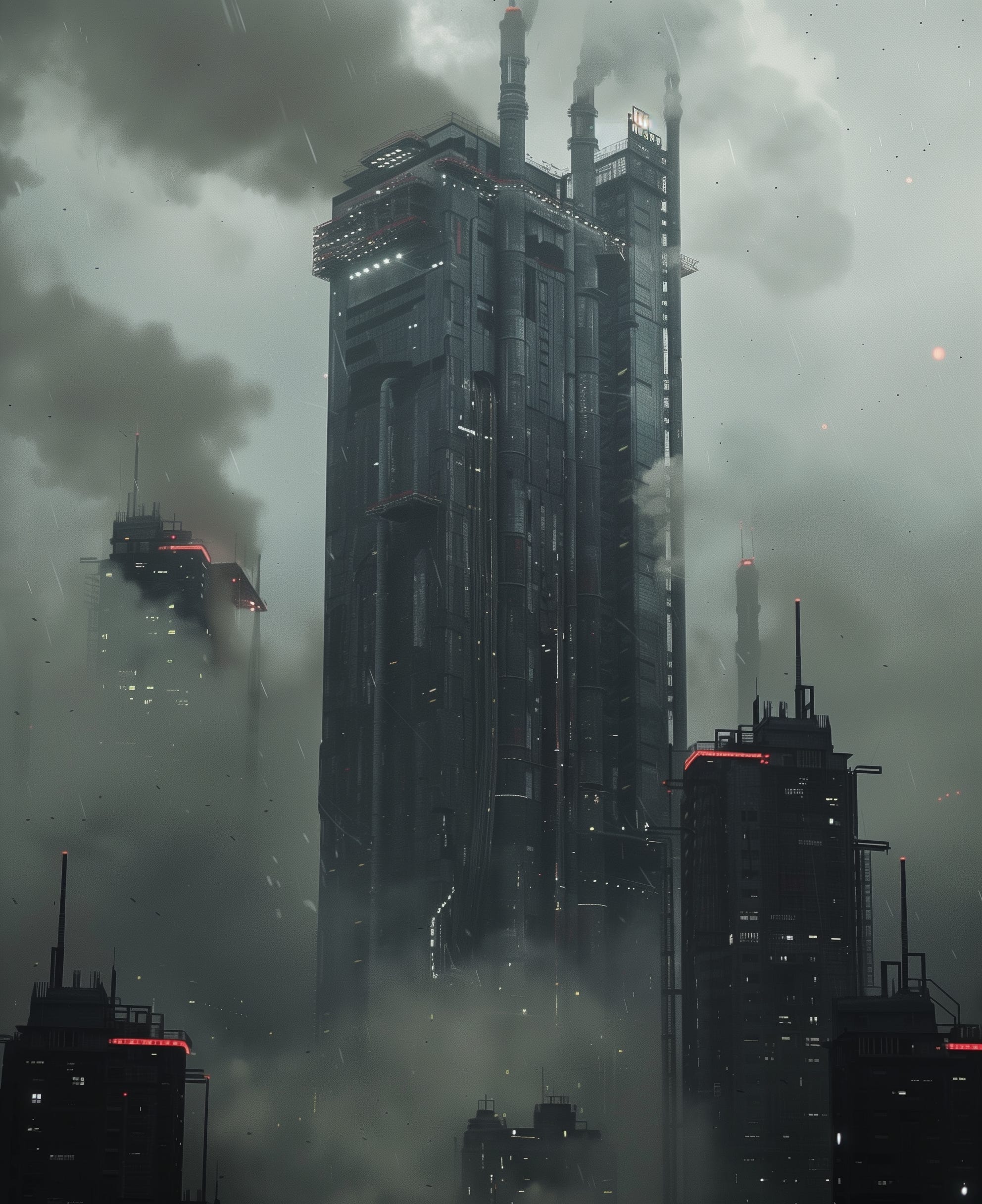
The Tian Gao Integrated Pork Cultivation Facility is an 88-story concrete building with no windows above the 8th floor where the human living quarters end and the pork production floors begin. The facility is owned by the Tian Gao Industrial Concrete Concern, the largest concrete maker in China, and was built in 2055. It towers over the edge of the city. Next to it is a 68-story building constructed initially for affordable housing but was converted to an indoor controlled environment corn and soy farm before it ever became apartments. A sky bridge on the 9th floor connected the two buildings so the corn and soy feed could be easily transferred to the pigs in our facility.
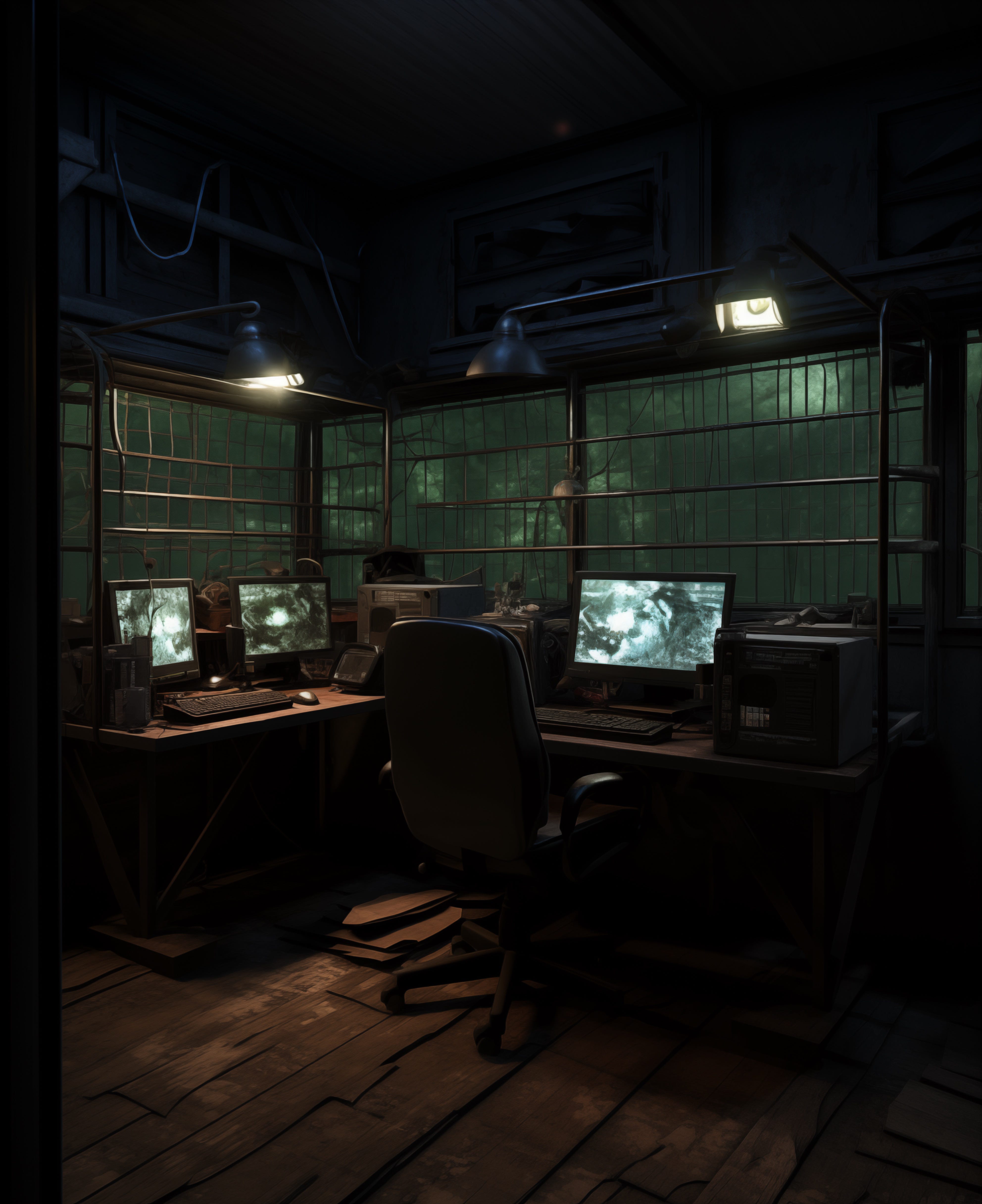
I manage 5,000 pigs on floor 55. The 32 floors above me house the fermented pork protein production floors where Jie works. Despite the size of my floor, I am the only technician on 55, just like all the other floors. I rarely need to walk on the production floor and spend most of my shift inside a clean control room in the center of the floor. My dimly lit control room space is four by 4 meters large with a small restroom and countertop with a microwave oven and hot water kettle. The control console and screens run along the edge of the room with large shatterproof windows where I can look out onto the floor without getting up from my chair.
I control the robotics, climate system, lighting, feeding, artificial scenery, and watering systems from my console. My floor is one of the finishing floors where my primary goal is to fatten pigs for slaughter. At around 12 weeks of age, pigs enter my floor from a pale green freight elevator door at the southeast corner and are routed to one of the many feeding pens by robotic wranglers. Our AI control systems automatically dispense 2.72 kg of feed to each pig from the central feed processing floors via an intricate system of pressurized tubes running through the entire building. My pigs are fed six times daily until they reach a target weight of 150 kg, give or take 2%. My daily quota is to achieve an average of 2 kg of weight gain per pig, measured by the floor sensors in each pen. I mainly feed them our proprietary blend of feed that consists of 76% corn, 12% skim milk powder, 6% soybean meal, 6% calcium-protein supplement, and 0.2% salt. Once the target weight is achieved, the pigs enter a red steel freight elevator door at the northwest corner, taking them to one of our automated slaughtering floors. New pigs arrive at the southeast freight elevator shortly after.
Our skyscraper farm has a dedicated mega-scale fusion reactor on the ground floor, providing a virtually endless supply of cheap, clean power. The reactor heats water for a series of steam engines that provide electricity and hot water for heating, drinking, and bathing for the pigs. There are no windows to the outside on the pig floors, so high-definition OLED panels mounted on the wall and ceiling display outdoor landscape scenery and artificial sky and sunlight above. Air ventilation grates line the ceiling to bring in cold air during summer and pull out harmful gas concentrations. We have been taught since new technician training that our controlled indoor environments provide pigs with optimal living conditions, free from the variables and discomfort that come from living on legacy outdoor farms. I fully control the floor’s artificial climate system and can simulate seasons and weather events, such as rainstorms, to bathe the pigs. The floors are angled at a precise pitch so that artificial rainwater will flow toward drainage gates, bringing highly valued pig feces with it.
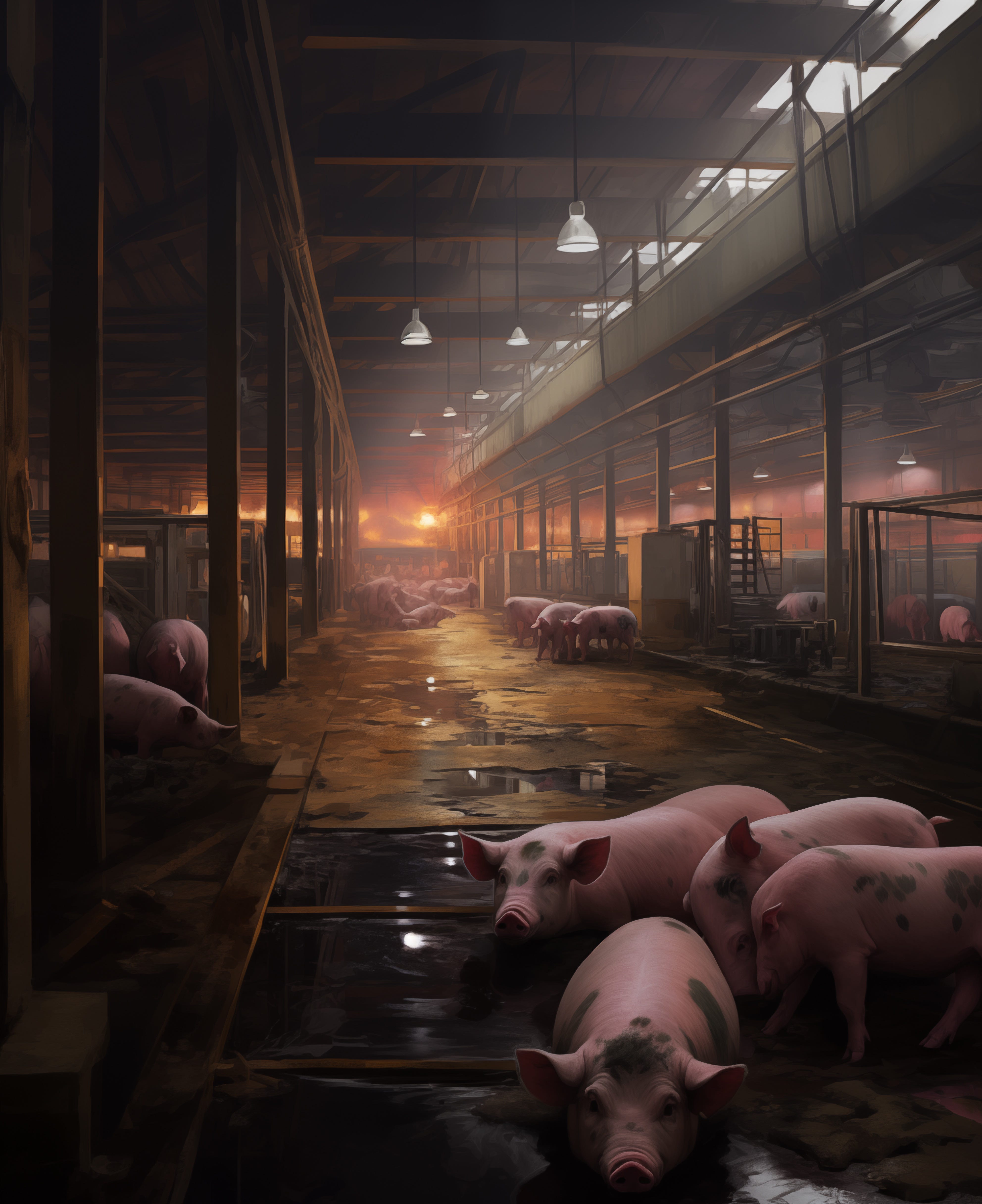
The Jade Renewal Movement had forced agricultural operations to become regenerative. However, with little arable land in China, the Zhong Cai administration invested aggressively in building skyscraper farms like this one. The Ministry of Green Agriculture certified farms like ours as regenerative because of the massive amounts of manure that are recovered and donated to conventional Chinese land farms or sold abroad to foreign farms looking to enrich their soil. Despite not having a single grain of soil on-premises, our skyscraper farm indirectly regenerates and enriches millions of acres of soil worldwide with a net positive carbon footprint. At least, that’s what the Chinese government told the world. And with most of the planet depending on China for their energy, no one was in a position to call bullshit.
I take over the controls from my night shift counterpart. I look at the overnight numbers–everything looks in order. I will almost certainly meet my weight gain quota today. I then proceed to accomplish my first task of the day: maintaining the induced sedation levels of my pigs. I guide my sedation robot from pen to pen, its long arm automatically reaching over the gate and using computer vision to target and inject each pig with a precise mixture of the sedative Azaperone (40 mg/ml injection dispensed at 2 ml per 20 kg of body weight) and a synthetic Psilocybin derived psychoactive designed to keep them in a perpetual, calm state. I monitor the process to ensure it goes smoothly with cameras in the pens and on the robot. Just in case, I pull up a pretty sunset scene on the walls to calm them. The gray concrete slabs magically turn into a photorealistic scene of a blazing red sunset above endless rolling hills. The pigs respond favorably and don’t fight the sedation bot.
The pigs receive these injections four times per 24-hour period, and I can always tell when the dosage begins to wear off. The telltale sign is when they start to root, pushing their snouts against each other and on the floor, a vestigial behavior that has not yet been bred out of these pigs. In the wild, rooting is a core activity that pigs naturally perform as a form of stress relief and stimulation. Because our pigs live in concrete and steel environments, the rooting can cause damage to the snout meat, which lowers their value on the market. Geneticists were unsuccessful in trying to breed rooting instincts out, so the sedative-psychoactive injections were introduced to skyscraper farms to keep them docile and probably mentally vacant. In some countries, animal welfare is a crucial component of being regeneratively certified but China’s Minister of Agriculture adjusted the rules to allow for sedation as a way around those kinds of welfare requirements.
If an animal doesn’t feel anything, is it actually suffering? Am I taking care of sentient beings or protein-generation machines? These are the kinds of questions that will get you placed in a vocational re-education center for years. I cannot afford to think like that. In one month, I can earn more money than my aunt and uncle were able to earn in a year on their farm. I briefly tried to make their farm work after they died four years ago, but it was simply too difficult, and I sold it for a pittance before I got a job here.
I didn’t know my parents growing up. Auntie and Uncle raised me after my Ma and Ba went away to a re-education center when I was three years old, and they didn’t graduate until I turned 18. I only got to visit them once a year during the New Year, so our relationship never took hold. My Auntie and Uncle were everything to me. They were rice farmers, and I observed, then later helped out in the paddies. We didn’t live extravagantly, but our needs were met, and I saw what honest work in a noble profession looked like. They had great self-respect and reverence for what they did to help feed people, which rubbed off on me.
They never told me why my parents were sent to the re-education center, and I dared not ask. Anytime our conversations hover near that topic, they’d change the subject and get this anxious look. I didn’t understand when I was younger, but I started to learn that it was probably for fear of retribution from the CCDI, who visited our home once a month to ensure there were no “irregularities” in Auntie and Uncle’s mood. Relatives of those undergoing re-education were expected to be grateful for their relative’s opportunity to reform themselves. Any sign of sadness about their absence could be interpreted as an insult to the government, which would also send them away for re-education. I had to learn how to save face early and maintain an upbeat demeanor, even when things were anything but.
Ma and Ba have been back for eight years and live next door to Hao and me. We often see each other but don’t interact much beyond small talk. They live with a persistent, sullen energy, too afraid to live but not yet old enough to die. We don’t communicate much verbally, but their general demeanor says more than words could ever. I’m grateful they can at least live the rest of their days in relative peace.
Truthfully, I came to work at Tian Gao to earn enough to smuggle Hao and me out of China and into the United States. Neither of us can bear the oppression, and holding up a constant facade to avoid re-education is exhausting. I hated that the government took my parents away. Hao and I want kids one day but worry that the CCDI could pluck us away from them for any reason as they did to my parents. This was no place to bring children into. I hate what I do at the skyscraper farm, but it’s the highest-paying job I can get. My Auntie used to say that sometimes you had to ride atop a donkey to find your horse, making me a three-year, full-time donkey rider.
If I play my cards right, I can ride this donkey out of China in another two years. By then, we’ll have enough savings to pay the smuggler to arrange for passage out of China via plane to Turkey, then to Ecuador, where a guide will escort us through the treacherous Darien Gap, up through Mexico to the American border, where we’ll surrender and apply for asylum. Refugees from South America have traveled this dangerous route for over a century. Chinese nationals tend to have better luck receiving asylum since China rarely agrees to take its fleeing citizens back. Hao and I love to daydream about using our savings to buy a small farm I can manage while he gets a job as an auto mechanic working on classic American cars. On hard days, I close my eyes and conjure this dream, fixating on every small detail I can to make it feel as accurate as possible. It’s just a fantasy, but it keeps me motivated and optimistic.
In the real world, the rest of my day goes by quickly without incident. The pigs are calm and fed, and I’ve hit my daily weight gain quota. My night shift counterpart returns, and we exchange pleasantries before I hand over the controls to him and return to the dormitories. I disrobed and repeated the disinfecting shower process as I had done early this morning. I return to my dorm and close my eyes to catch a quick fifteen-minute nap before dinner is served.
HEYYYYYYYYY MINNNNNNNNN!!!
I awake to Jie’s jostling. Her mood is lighter now, which is great to see. We walk to the cafeteria for dinner, hoping for something other than pork. It’s beef noodle soup tonight, which is music to our ears. The dining hall quickly fills with the cacophony of everyone slurping their noodles down. Dinner is quite delicious tonight. But the slurping is punctuated with the heavy clang of the double steel entrance doors slamming shut. Jie and I instinctively lower our chopsticks and raise our heads to find the cause of the noise.
Jie drops her spoon into her soup as we both make eyes on three CCDI officials who have just entered the hall, flanked by the four most senior Tian Gao bosses. They walk to the center of the room, and the man who looks like the lead CCDI officer shouts for everyone’s attention. The slurping abruptly stops. Everyone is fixated on him in stunned silence. The official pulls a folded piece of paper from his breast pocket, opens it, and loudly reads it.
“XIANG JIE! With the approval of the Supreme People’s Procuratorate of the People’s Republic of China, you are formally under arrest on the charge of political treason for providing a foreign agent with confidential state secrets.”
The color from Jie’s face immediately disappears and she freezes, chopsticks still limp in her hand. I nudge her with my arm and silently mouth the word “breathe” to her. The two other CCDI officials approach and take her by each arm, pulling her to the center of the room. The lead CCDI man shouts orders for all one hundred of us to get up from our chairs and form a circle around Jie and the two officers next to her.
“XIANG JIE! You have betrayed the People’s Republic of China. Digital forensics has traced your communications with an enemy of the state! The severity of this violation cannot be understated. In sharing state secrets with foreign agents who wish us harm, you have undermined the peace and prosperity that the People’s Republic of China has long struggled to cultivate. Let it be a lesson to all of you that while you have betrayed the love and trust of our great Republic, the Republic is forgiving and will grant you mercy and the opportunity to re-educate yourself to see the error of your ways. But mercy does not come without struggle, and today you shall struggle as an initiation to your 21-year vocational re-education curriculum…”
The words track in my brain in slow motion. 21 years. I know this is happening, but I feel like my body is frozen in time. I feel a sharp pain in my abdomen as the stomach acid floods my belly, triggered by nerves. I want to keel over onto the floor but do not dare move. The CCDI official unfastens the wooden baton from his utility belt and raises it high in the air.
“DEAR LOYAL WORKERS OF TIAN GAO. We live, work, and die as one Republic. Treachery by one of us is a crime against all of us. Let us all join in this struggle session to help re-educate our sister Xiang Jie so that she may be enlightened. Who shall be first to contribute a lesson?”
Everyone stared off into space, not knowing what to do next. One of the Tian Gao bosses pulls a technician into the circle and jostles him toward the CCDI official. The official whispers something into his ear as tears begin to visibly emerge from his eyes, slowly trailing down his cheeks. His bottom lip quivers as the barbarity of the instructions sinks into his psyche. He is handed the wooden baton and gestures to approach Jie. He moves to face her about a meter away. The CCDI official gently urges him to move closer until he’s only centimeters away from Jie’s face.
“XIANG JIE! You have betrayed the People’s Republic of China and must be re-educated. I give you this gift of enlightenment so you may begin your journey with my support!” exclaims the technician in a forced, faltering yell. Jie’s eyes wince as spit flies from his lips onto her face.
The technician pauses for a beat. He takes a step backward, raises the baton, and swiftly strikes Jie in the left thigh, right above her knee. Jie instantly screams out in pain and collapses toward the blow. The CCDI officials shift their feet to maintain their balance as they hoist Jie upright again. She is crying uncontrollably between screams, writhing and pleading for mercy. The next technician is ushered to the center of the circle to deliver the next blow.
I mentally black out. Too afraid to look but even more terrified to look away. I unfocus my eyes as best I can, trying to blur the image of Jie being beaten and berated by technician after technician. “XIANG JIE! You have betrayed the People’s Republic of China and must be re-educated. I give you this gift of enlightenment so you may begin your journey with my support!” This is repeated over and over again, giving each technician a chance to deliver punishment to Jie as her body grows weaker with the accumulating blows. How is she going to survive 100 baton strikes?
Amidst my disassociation, the fact that it will soon be my turn to deliver a blow cuts through like a knife, and I am jolted back to reality with this terrifying realization. I look to my right and see that the tech three people away from me is handed the baton. He delivers a blow to her right shin. The next tech hits Jie in the ribs. The next tech hits her in the stomach. Oh my god. I’m next.
I am handed the baton and slowly approach Jie, using all my energy to keep a straight face. I deliver the line I’m supposed to, my voice trembling as I choke back tears. Jie is exhausted at this point, and her head and body are limp as the CCDI officials bear most of her weight. I don’t know if she sees me or knows where she is anymore. I raise the baton above my head and look for the thickest part of her thigh, hoping to avoid striking any bone. As I thrust my arm downward to deliver the hit, I release my grip on the baton ever so slightly, careful not to let go but providing some give in my grip to cushion the impact. I don’t want to hurt her any more than I have to, but I also don’t want to be next in line for a struggle session by not doing what I’m told. The baton makes contact, and her body reflexively recoils again from the pain. I hand the baton back to the officer and return to my place in the circle, tears uncontrollably rushing down my face.
I stand at attention as everyone else has had a turn. Jie is unconscious at this point, as her wailing has settled to a murmur, and the CCDI officials are wholly supporting her body now. The CCDI reminds us again that silence is of utmost importance, and we shall never discuss this event from this point onward. They say nothing about the outbreak that Jie witnessed. There is nothing about the interaction with the British journalist. Jie told me she archived the message and didn’t respond. Did she lie to me? I suppressed the thought in my mind as I knew that having this information would send me to a similarly brutal fate.
The heavy steel doors creak open as two Tian Gao medics enter with a stretcher to take Jie away. She is bloody, bruised, and limp on the stretcher, but I can see her chest rising and falling slowly, so thankfully, she’s still alive for now. We are ushered out of the dining hall and back to our dormitories. The mood is tense and silent. I return to my room, passing two more CCDI officials in the hall, holding a box that presumably contains Jie’s personal locker items. I see her bed has already been stripped. I change into my sleep clothes and curl up under the covers, hoping in vain to get a good night’s sleep. I want to call Hao and talk to him about what I just witnessed, but that’s an impossible fantasy. I have to soldier on and keep moving forward. The lights go off. I close my eyes, feeling lost in the darkness.
10 months later.
BZZZT BZZZT BZZZT BZZZT BZZZT
5:30 AM. The alarm. I go through my usual morning routine. Bathroom. Breakfast. Disinfect. Dress. Control room. Everything looks good as usual. It’s been almost a year since Jie was taken away. A new girl, Mei, has taken her bed and station on the 32nd floor. She’s quiet. I’m reluctant to say anything to her beyond pleasantries. I’ve become even more introverted at work, as the thought of forging bonds that can be easily broken through no fault of my own sickens me. I keep my head down and work. Just one more year, and I can escape this hell hole.
It’s quiet today in the control room. I give the pigs their shots and take an early lunch. As I pour hot water into my instant noodle bowl, I hear a chime from the console. I close the lid on the noodles to let them soften as I investigate the alert. One of my pigs has a 40.6 fever. I find the pen number and bring up the video feed to take a closer look. Every pig looks normal except one standing still with its face buried in the corner. The other pigs seem to stay away from this one. I pulled up the stats on the pig in the corner, and they indicated that it hadn’t eaten all day. It looks like the other pigs saw and ate the leftover feed, so I may still meet my average daily weight quota on this pen if the others grow more than this one today.
I send the vetbot to take a closer look and administer medicine if needed. The vetbot’s long, heavy arm reaches far to the back corner and wraps its giant claws around the pig’s body, lifting it and turning it 180 degrees toward my cameras so I can examine the face more closely. The arm lets go of the pig and stands there staring off into space, barely moving. The pig’s mouth is wide open, breathing heavily through it, not its snout, which is covered in a thick, yellowish mucus. I retake its temperature, and it’s moved up to 42. That is not a good sign. I glance at the red “DISPOSE” button on my touchscreen, then turn around and eat my noodles, buying myself 2 minutes to process my options before acting. I hold the bowl to my lips and slurp the remaining soup before throwing the whole thing in the trash. I return to the console.
Looking back at the video feed, I see another pig approaching the sick pig. The second pig curiously walks up and nudges the side of it with its snout. The drugs are wearing off. I quickly ordered the nearest sedation robot to come to this pen directly and then started the sedation protocol for the other pens. Before the bot arrives at this pen, another pig walks over to this pig and bobbles its head, looking for something to root. I can’t let these pigs touch the sick one. It might compromise my quota for this pen if I lose one pig, but if whatever this pig has spread, I might lose my paycheck for the week entirely. I tag the sick pig and quickly press “DISPOSE” as a third pig begins to approach. The floor tile under the sick pig slides away and falls through. The approaching pigs scatter as the trap door slides back into place, and the sedation robot injects the rooting pigs.
The sick pig will travel down a long chute to the basement level, where a quick robotic autopsy will be performed before throwing the body into the incinerator. By the end of the day, I’ll find out what this pig had, but for now, I need to focus on the rest of the herd. I sedate them. I feed them. I make it rain, adding a small quantity of bleach to the mixture to catch any traces of potential infection. I sit there for two more hours, carefully watching my dashboards, looking for anything slightly off. It is quiet now.
As the end of the day nears, I hear another chime from the console. I pull up my message queue to see a note from the autopsy lab. My sick pig had contracted acute swine flu. I felt vindicated in my decision to eliminate it and spray the whole floor down with diluted bleach. But that brief reassurance was broken by the following few lines in the message that identified the strain as “UNNAMED.” An initial analysis suspects it was a hybrid of the long-dormant G4 EA H1N1 strain discovered in 2020 and the deadly H5N1 avian flu.
My heart skipped a beat as I scrolled down for more detail. The G4 strain was deadly to pigs and was well adapted to infecting humans, although it hadn’t crossed over into the human population in the 40-plus years since its discovery. H5N1 was very deadly to birds, and evidence suggested that it mixed with the G4 strain inside the dead pig to create a new virus lethal to pigs, birds, and humans. Another message came in, marked urgent. It was my supervisor. He had reviewed the results from the lab and conferred with his supervisors. I was to leave my console on complete auto-pilot and report directly to the quarantine center. I flip the requisite switches and leave the room, making the long walk down to the quarantine ward, trying not to think too hard about what could happen next.
I check in with the attendant at the entrance of the quarantine ward. He buzzes me in, and I strip off my clothes and go through the standard decontamination protocol. This takes about 45 minutes; I am led to my quarantine suite, where I will spend the next seven days. My worry about the autopsy results is hedged by the fact that I’m about to have a weeklong paid vacation. Technicians in clean suits had already packed up my dorm locker, disinfected the items, and transported them to my room, where they were waiting for me. I turned on my phone to let Hao know what had happened and encouraged him not to worry. As I do this, I hear a chime on my communication console and answer the call. It’s my supervisor.
He tells me the new virus was indeed a new deadly hybrid that was highly lethal to pigs, birds, and humans alike. They are investigating where it came from, but as a precaution, they would be incinerating the entire inventory on floor 55 and two floors above and below. That’s 15,000 pigs and hundreds of millions of liters of bioreactor meat up in flames and down the drain. An audit of my test history and disinfection checks looked clean to them, so I was not being blamed at this moment for anything that went wrong. He reassured me that I followed the protocols and encouraged me to get some rest while in quarantine.
My room is sparse but has everything I’ll need for a seven-day stay. Bed. Desk. Chair. Kitchenette. Full bathroom. Entertainment and communication console. A window. My food will be delivered three times daily through a prominent slot at the bottom of my door. I turn on music and lay in bed atop the covers until dinner is brought to me. Where did this virus come from? How did it get past our biosecurity? I wondered if any other technicians had these cases or if I was the only one.
Dinner is served. Braised pork belly with rice, soup, and greens. I eat everything except the belly, but I mangle it with my chopsticks, so it appears that I ate some. I clean myself up and watch thirty minutes of a singing competition show before I put my console to sleep, turn out the lights, and get in bed. As inconvenient as it is to be in quarantine, there is a particular pleasure in knowing I don’t have any responsibilities for a few days. I brush my teeth, wash my face, change, and get into bed. I am at ease. I sleep.
BWEEP BIP BIP BWEEP BIP BIP BWEEP BIP BIP BWEEP
3:12 AM. I open my eyes. The alarm is blaring. I look around in the dark then out the window. No signs of trouble outside. What is happening? I smell something. It’s pork. I check to see if my dinner tray still sits by the door. It’s gone. Is there a kitchen on this floor? They’ve never served pork for breakfast here before. The alarm stops just as the pork smell goes acrid. A voice comes on the loudspeaker. The building is on lockdown. The voice gives the order to return to our dorms immediately. I hear a roar engage, and the room vibrates like a jet engine. The incinerators are firing up. And that wasn’t pork. That was pigs being cremated.
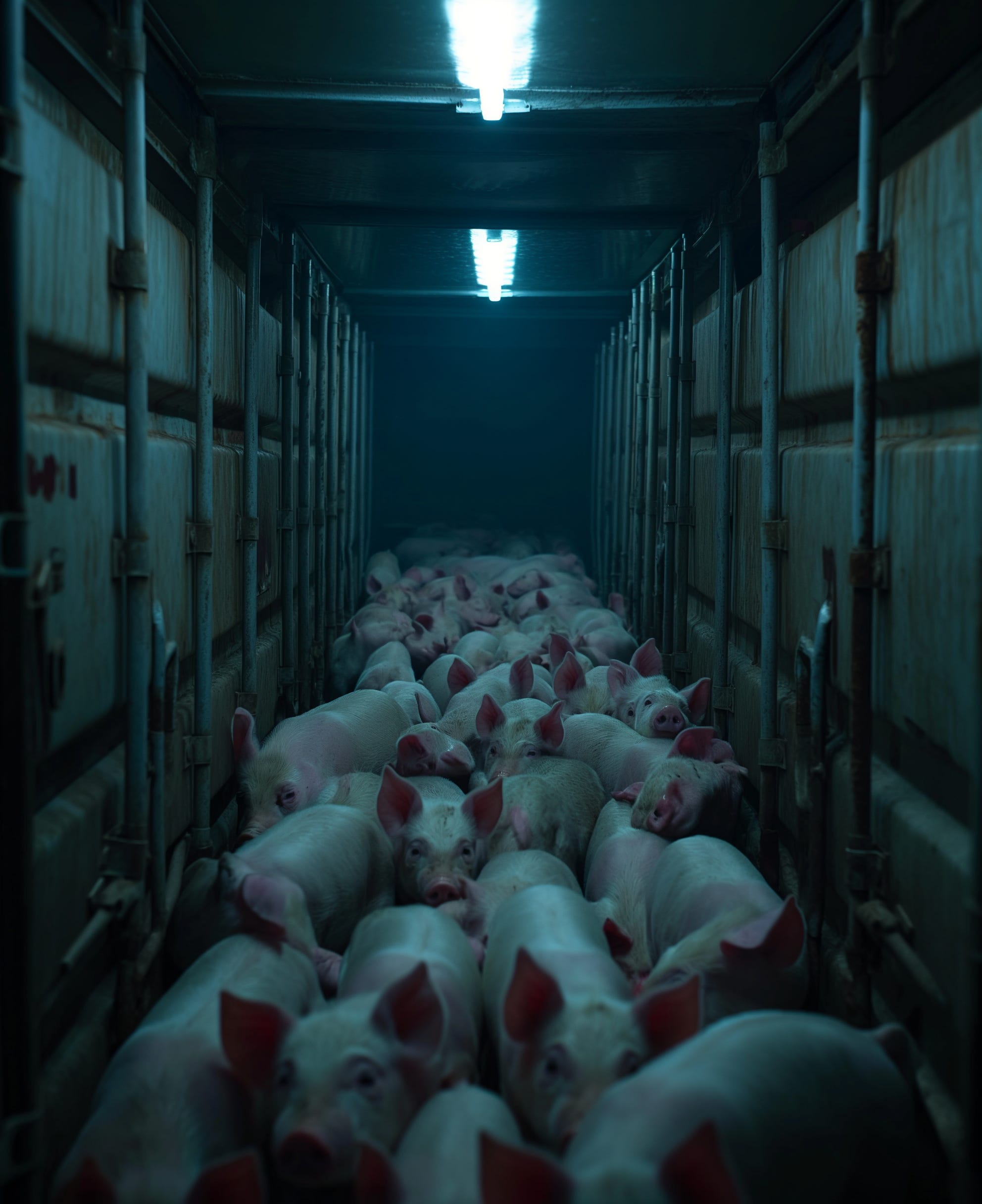
My ears adjust to the steady hum of the incinerators, and I hear a faint sound coming from the other side of the wall near the ceiling. The sound quickly grew stronger—the telltale squeal of pigs. But the sound moved toward me like a freight train. It crescendos to reveal an alarming cacophony of panicked squeals, then it travels below my floor and fades away. Is the incinerator chute on the other side of the wall? They must be mass disposing pigs. Just as I had that gruesome thought, another cluster of chaotic squeals approached and whizzed by my wall before receding into the floor again. This went on for over an hour.
It’s nearly 4:30 in the morning now, and I’ve been sitting here, enduring the sounds, unable to fall back asleep. Judging from the loudness of the squeals and their intermittent passing, someone must be releasing pens of pigs down the incinerator chute, one pen at a time. I wasn’t lucid enough to track how many clusters of squeals I heard, but it had to be at least seven or eight floors worth of pens being let down the chute. They must have found more sick pigs.
I could feel the cortisol pumping through my veins and filling my body with anxiety. I went to the bathroom sink and splashed cold water on my face. I turned the water off but kept my head down over the sink to let the water drip dry. I heard a faint, steady, gurgling noise from the bottom of the drain that couldn’t just be my face wash water. I smelled the faint earthy funk that was a blend of raw meat and alcohol. That was cultivated meat growth medium—they were flushing the bioreactors too.
I turn on classical music on my console and get back into bed. The screaming pigs are still down the incinerator chute like highway traffic. The music muffles some of the noise but can’t quiet my mind. I try to redirect my thoughts and go back to sleep, but it’s hopeless. I lie there staring at the ceiling, mind racing. The screams don’t stop until later that afternoon.
It must have gone on for at least 8 hours. Considering how long it usually takes to open a chute and eliminate a pen, management must have incinerated at least half our pigs. Dear God, what is happening?
A full day passes without any new information coming through to my console. Then, four more days with no news. The agony of not knowing what was happening is unnerving. I hear a knock on the door the day before I’m scheduled to leave. Instantly, I know who it is: the CCDI. I steel my nerves to maintain a professional and submissive appearance. I hear a loud buzz as the lock to my door is remotely opened, and a slender man in his early thirties, wearing the signature black suit with a Tristar lapel pin, enters. The door shuts behind him. I am sitting on the edge of my bed as he pulls the desk chair near me and takes a seat.
I think back to my conversation with Jie in the bathroom that night. I was recalling her account of CCDI visiting her in quarantine. The memory is foggy but begins to clear up as the CCDI officer delivers his dialogue, which is strangely familiar because of Jie. As expected, he produces two envelopes: one with the reaffirmation oath and a stack of cash, the other with surveillance images of Hao and my parents. The shock of seeing those photos was dulled by the fact that I knew they were coming. I tried to ascertain how much cash was in the pile without being too obvious. I didn’t want to suggest that money was the primary motivating factor for signing the oath, as I tried to give him the impression I was signing it out of loyalty and honor for China. I sign the document, suppressing my inner voice as I thank him for the opportunity to demonstrate my dedication to the Republic. He gives me a nod and leaves the room. The entire transaction took less than five minutes.
I count the cash immediately after the door closes. It’s much more than what Jie received. But why? Something horrible must have happened. I place the money in my pocket, realizing that Hao and I may finally have enough for the smuggler. This is a thrilling development, but I maintain a straight face, as I’m almost certainly being watched. I can’t wait to tell Hao, but I’ll have to wait until I see him in person. I slept easy that night and woke up the next day to be discharged by late afternoon. I’m back in the dorms just in time to catch dinner and regain my bearings. I prepare for my first day back in the control room since the purge, not knowing what to expect when I arrive.
BZZZT BZZZT BZZZT BZZZT BZZZT
5:30 AM. I am up. I wash. I eat. I disinfect. I dress. I report to my console. As I enter the control room, the smell of burnt pig flesh rushes into my nose. Everything here is as I left it, but there is no night-shift tech. I look out the windows and see nothing on the production floor. The pigs are gone. There is nothing but empty pens. My robots are lined up against the east wall in standby mode. I see a notification on my messaging app.
My instructions are to receive a new population of piglets. They have been shipped here from our sister farm six hours away by train. I am to feed and care for them until slaughter. I press the button to open the pale green freight elevator door at the southeast corner, and my robotic wranglers lead the first batch of piglets into the pens.
I repeat this until the pens are back to total capacity. The sound of squealing fills the room. They are active and curious. They root and play. I order my sedation bots to begin administering injections. I feed them. I bathe them. I pull up a sunset on the walls. Most turn toward it, watching the photorealistic, blazing orange fake sun slowly disappear over the phony horizon. The squealing dies down as they calm down. I notice one piglet who hasn’t turned around. It is looking in my direction. It sees the lights of the control room and me. It seems confused and curious about what might be inside the control room. I glance at it but don’t want to make eye contact. Instead, I join the other pigs and stare deeply into the digital horizon, mentally riding off into that digital sunset atop this donkey.

Three years later.
BUZZZZZ BUZZZZZ BUZZZZZ
7:03 AM. I open my eyes. I am sweating. I can feel the warm breeze coming through the window. The Sun is barely up, but I can already feel the heat rearing to scorch the city today. I lie there for a few minutes, staring at the ceiling. I hear the D train gliding over the Manhattan Bridge, flying into Brooklyn on its maglev track. I kick off the top sheet and get ready for the day.
I lock up my tiny rent-controlled apartment on Monroe and head to the grocery store where I work as a cashier. We’re short-staffed today, and it’s delivery day. It’s not yet 7:30, and I’m already sweating. I hope the power grid holds out and we don’t lose air con again in the store. I can’t believe it’s 80 degrees in November. I stop at the street cart on the corner and grab my iced milk tea with three sugars as usual. I walk into the store as the porters are offloading boxes of produce and canned goods onto the conveyor leading to the basement storage area.
There aren’t any customers in the store yet, so I have time to compose myself and caffeinate behind the counter before the rush starts. I sip my drink and stare out the window, watching the school kids walk down East Broadway in their cliques, eating shrimp chips and gossiping with each other. I spot a nicely dressed young mom holding her young daughter’s hand, probably about to drop her off at preschool before she goes to work. She looks about four years old. A pang of longing hits me as I think about Hao. He always wanted a girl. I think he would have been a great father. Maybe there was still a chance.
It’s been two years since I left him behind. Not willingly, of course. The CCDI picked him up on some flimsy charge of “illegal expression of views propagating terrorism and extremism” after he got drunk with his buddies and started mouthing off about the job market, blaming President Zhong for the shitty economy. The bartender owed the government a bunch of back taxes, so he ratted Hao out to the authorities to kiss up and try to boost his social score. Hao has just one year left on his re-education and has been treated decently there. It could have been way worse.
Hao urged me to file the divorce papers. I didn’t want to initially, but I eventually accepted the idea that I could be more helpful in getting him out of China from the outside rather than the inside. Being a convicted criminal’s wife barred me from leaving the country, and the weekly unannounced CCDI visits to the house made it hard to make any moves without raising suspicion. He was right, though. The divorce went through, and the CCDI visits stopped. My name was cleared, and getting through customs at the airport on a tourist visa was a breeze.
The journey took nearly two months, but I got out alive. As planned, I was granted asylum. I was earning just enough here at the grocery store to squeak by, and I still had his share of the CCDI hush money to pay for his smuggler after he graduated. I was even saving enough from my job to hopefully buy him a flight from Ecuador to Canada so he could bypass the Gap and surrender at the border crossing in Buffalo. I almost died in that hellhole (the Gap, not Buffalo). Anything I could do to help him avoid the Darien Gap would be worth the effort.
I snapped out of my daydream as the stench of fresh roast pork from the Cantonese barbecue restaurant next door began to seep through the walls. A miniature wave of nausea washed over me. I finished my milk tea and threw the cup in the trash. The automatic doorbell rang as it hit the bin, and a customer walked in. A stocky white guy with a receding hairline and sweat on his brow. His cheeks were rosy from the heat. He approached the counter as he eyed the display of cigarettes on the counter. His eyes locked on the row of red boxes. “Box of Chunghwas, please,” he said in a British accent. Odd. How did this laowai know about Chunghwa? He must have studied abroad in China or something. That used to be my brand.
I pulled a box off the rack and rang him up. He touched his thumb on the biometric reader, and the transaction went through. “Hey, is your name Min?” he said. I stopped dead in my tracks and looked him directly in the eyes, trying to hide my surprise. How did he know my name? Was he CCDI? Impossible. Breathe. I peeked over his shoulder, thankful to see my porters still unloading by the front door. I could yell for them to help me if this guy tried to mess with me. “Who? Sorry. Don’t know anyone named Min. Have a good day.”
“Min, it’s Jamie. I know Jie. She’s OK. Can you talk?”
Discussion: A New Superpower
The Green Dragon
Over a decade ago, Xi Jinping unveiled the Belt and Road Initiative (BRI), a decades-spanning, multi-trillion-dollar project to expand China’s reach across Asia, Africa, and Europe. The BRI was responsible for building many new railroads, roads, and port infrastructures to create a modern-day Silk Road that would theoretically secure its economic prospects for centuries. The BRI project is struggling today but can still be course-corrected to fulfill the original mission in the long term.
The focus of “A New Superpower” was to extrapolate what future infrastructure initiatives could do to propel China into becoming the world’s most prominent and influential economy. Whether you believe the BRI was a good idea or not, Xi Jinping has harnessed the authoritarian nature of his government to take on enormous projects that may have never gotten off the ground in countries where checks and balances exist. The central question I sought to explore is what could happen if new leadership used that same authoritarian structure to transition the world to clean, renewable energy?
China currently has a significant lead as the world leader in solar panel and electric vehicle battery manufacturing. “Today, China’s share in all the manufacturing stages of solar panels (such as polysilicon, ingots, wafers, cells, and modules) exceeds 80%,” according to a report by the International Energy Agency. According to Bloomberg, just two Chinese firms hold 53% of the global market share in the electric vehicle battery market. Since 2018, China’s solar generation capacity has increased by 26% per year, while wind generation capacity has increased by 18% per year.
Despite this, as of 2022, China still uses fossil fuels for 82% of primary energy consumption and 70% of total electricity generation, according to Reuters. This scenario is the most distant and speculative in the book to account for the magnitude of the transition effort off fossil fuels. If China can eventually accomplish this, barring a total government revolution, it will almost certainly use its tight grip over its people. This begs the question: is society willing to accept massive human rights abuses to convert the world to renewable energy?
Do the Means Justify the Ends?
In the story, while the rest of the world argued about climate change, China was busy getting things done with an iron fist. This is by no means an endorsement of totalitarian regimes and the plethora of human rights abuses that the Chinese government has inflicted on people. Instead, it’s a grotesque scenario that sadly reminds us how much of the world’s infrastructure has been built upon human exploitation and political subjugation. From the Great Pyramids to the American agricultural system, slave labor unfortunately played a fundamental role in creating what we view as marvels of human innovation.
This is by no means an exclusively historical phenomenon. Amazon has had many documented cases where exhaustion is common. Or the presence of exploitative child labor practices within the supply chains of big brands like Costco and McDonald’s. Or modern-day slavery in places like the Congo that mine the cobalt and other minerals required to power our smartphones, computers, and cars.
The story of Min, Jie, and Hao is undoubtedly harsh. From the violent and degrading struggle sessions that actually occurred during the cultural revolution to the droves of refugees attempting to cross the treacherous Darien Gap to the corrupt justice system used to oppress and eradicate Uyghurs today, almost all the plot points in this story are based on actual events. On a more general level, the brutal conditions that Min and Jie work in at Tian Gao represent the litany of people everywhere who have worked in food and farming operations under similar conditions.
While the ghost of exploitation still haunts our modern economy, we have the advantage of hindsight, and today’s builders must ensure we don’t incur massive human costs in service of technological progress. So much of our past and present has been tainted with human exploitation. Still, the future must integrate equity, justice, and humanity if we want to continue calling ourselves a civilized species.
Fusion Food
The energy and food industries are intrinsically woven and are two of the most significant contributors to carbon emissions and climate change. Radically changing one will undoubtedly change the other. The Tian Gao skyscraper farm exists in a distant world where scalable nuclear fusion can power such a fearsome indoor farming facility. Nothing quite like it exists in our current world, but the groundwork for its elements all exists today, from indoor pig farm buildings to farming robotics, cellular agriculture, and more.
The final phase of China’s Jade Renewal Movement is to achieve scalable nuclear fusion energy—the holy grail of solving our planet’s energy problems. It’s anyone’s guess which country—or alliance of nations—will eventually crack the code on fusion. But if it happens sometime in the next century, the feasibility of massive controlled environment farming operations will drastically improve.
By this point, China was running dangerously low on arable farmland, so it was inevitable that they would figure out how to farm vertically and indoors. Due to the real estate and infrastructure boom of the last 25 years, China has large amounts of concrete-making capacity, so it wasn’t difficult to build the kinds of high-tech, concrete pig farm buildings that Min works inside. Concrete is one of the most environmentally unfriendly manufacturing processes from an energy and emissions standpoint, but with nuclear fusion, these companies could produce as much concrete as possible with minimal emissions.
These pig farm towers are already operating in China, so they’re currently building their institutional knowledge of how to run one effectively. In 40 years, it’s entirely plausible to think that China could operate a facility as large as Tian Gao as efficiently as depicted in the story. Moreover, other energy-hungry processes, such as precision fermentation and cellular agriculture, could be run at scale, making real animal meat entirely free of carbon emissions.
In the story, Min wonders if she’s “taking care of sentient beings or protein generation machines?” They assuage their guilt by sedating the animals, which presumably spares them from experiencing the full magnitude of their environment. She’s altered their reality. But it invites us to consider where the hierarchy of animal welfare cellular agriculture sits compared to free-range farming outdoors and concentrated indoor farms like Tian Gao. If humans are going to continue eating so much animal meat, is it better to embrace a process that bypasses the entire consciousness of an animal?
True innovation only happens when cultural conditions are primed to accept it. Food is part of the fabric of culture, so it takes perfectly tuned logic and emotion to make change happen successfully. Making food at scale requires a great deal of logic, but all that logic is wasted if the food doesn’t fit into the current cultural zeitgeist. We humans make our food choices emotionally. So, while the animal welfare and carbon emissions stats on lab-grown meat may be far superior to traditional farming, people don’t eat stats; they eat food. Unless eaters have had enough time and education to acclimate themselves to cellular agriculture meat properly, it will be all for naught. And that dynamic goes for any new food technology.