



A man who goes by Clavicular punches himself in the cheekbones on camera, narrating it in a flat voice like he’s reading a parts manual. He’s trying to break the bone so it grows back sharper. Between takes he names what he injects at night, including BPC-157, a peptide he says helps him heal faster. The comments fill with teenagers asking for the dose.
It’s easy to write this off as internet weirdness. Don’t. This corner of wellness is on track to clear a hundred million dollars a year, almost all of it paid in crypto. Gwyneth Paltrow calls peptide shots a favorite tool; Joe Rogan credits two of them with healing an injury.
People have always wanted a shortcut to a better body. What’s new is the supply chain around that want, who runs it, and why so many normal people trust it over their own doctors. Their case is better than the eye-rolling suggests, and we learned the thinking behind it in the grocery store.
The Grain of Truth
The believers aren’t pulling this out of thin air. BPC-157, the peptide Clavicular named, rests on decades of animal studies showing it helps heal tendons and gut lining in rats. None of that proves it does anything in a person, and the jump from rat to human is bigger than the sales pitch admits. But it isn’t pure quackery either: there’s a plausible mechanism, and plenty of people swear a peptide fixed an injury nothing else could. Worth taking seriously, while staying wary of everything stacked on top.
The strongest point is money. BPC-157 is a fragment of a protein the body already makes, a sequence nobody invented and hard to own outright, so no company has spent the hundreds of millions a real trial costs on a drug it could never lock down. That’s why the human evidence is so thin, and read that way, a doctor saying “there’s no evidence” sounds like the system covering for itself.
Plenty also got here because the system failed them first: chronic pain that physical therapy and cortisone did nothing for, an orthopedist who offers only surgery, women told again and again that the pain is in their heads.
We let people box, smoke, and pay for vanity surgery, so they ask why injecting a molecule the body already makes is the one thing off-limits, when the rich do it with a concierge doctor and everyone else just orders a vial online.

It’s Just Amino Acids
The evidence under all of it is thin, though. Almost all of that animal data comes from one research group in Croatia whose members hold patents on the compound. Nobody has even found what BPC-157 attaches to in the human body. Fewer than forty people have ever been in a published trial of the injected version, and none of those trials had a control group.
That careful version isn’t what spreads. What spreads is simpler: they’re just amino acids, the body’s own building blocks, so how bad could they be. Insulin is a peptide. So is the venom in a cone snail that can kill a person. Calling something a natural building block tells you nothing about the dose, or what injecting a factory’s copy every day for a year does. Stuart Phillips, who studies muscle health at McMaster, calls the whole thing a giant scam. That goes too far.. But the gap between the animal results and anything proven in people is real and wide.
The trick in “just amino acids” is to name the thing at the level where it sounds like nothing. Anything frightening has a calm description if you back up far enough. Botox is a protein. Ricin, the poison a castor bean makes, is a protein too. Fentanyl is just a molecule, and a factory can turn it out by the kilo. The calm name is doing the persuading. Whether a thing is a protein or an amino acid says nothing about whether it will help you or hurt you.
What that name leaves out is exactly what you can’t find out from a stranger’s vial: the real dose, who mixed it, and what else came along for the ride. That blank space is the whole sales pitch, and it’s the real problem. It starts with where the vial comes from.
The Ban That Built the Market
Say they’re right about all of it, and the molecule is as good as they hope. They still have to buy it somewhere, and that’s where it goes wrong. In late 2023 the FDA put nineteen popular peptides, BPC-157 and TB-500 among them, on a restricted list, citing impurities and the lack of human trials. That looks like the system doing its job. What it did was pull these compounds out of the one halfway-safe place to get them, the licensed compounding pharmacy, where a regulated lab at least mixed the dose. Clinics prescribing them stopped overnight.

So the demand went offshore, into what gets called the gray market: not quite the black market, since owning these peptides isn’t a crime, but a trade outside the licensed pharmacies and inspections meant to keep a drug honest. Overseas labs ship peptides to American doorsteps under a label that says not for human consumption. No bank will touch the payments, so the trade runs on crypto.
When Chainalysis, the blockchain firm, followed the money, it found some of the sellers are Chinese chemical makers who until recently supplied fentanyl precursors to drug cartels.. They switched because the margins are better and the risk lower.
Nobody chose this. A safety ban, a profit motive, a payment rail, and a comment section did it between them, each step reasonable on its own. It’s the oldest lesson in drug policy: ban the clean version of something people badly want, and the demand moves to whoever will operate with no rules at all. The ban didn’t kill the demand. It moved it somewhere with no rules at all.
The institutions are already trying to walk it back. After RFK Jr. took over federal health policy, the FDA moved in early 2026 to pull most of those peptides, BPC-157 and TB-500 included, back off the restricted list, and he announced the reversal on Joe Rogan’s podcast before the agency finished the paperwork. None of that put the peptides on a clean shelf or sent buyers back to a pharmacy. It told you the people who banned the clean version in 2023 had lost the argument by 2026, and that the gray market had already taken the part that matters, which is the trust. The vials keep shipping either way.
Doing Your Own Research
The distrust didn’t start with the pandemic. People learned to doubt official advice about their own bodies long ago, watching the food pyramid shift with every lobbying cycle and dietary advice flip each decade.
By 2020 a big part of the country had already decided the agencies telling them what to eat were either guessing or in industry’s pocket, and once the pandemic pulled medicine into the culture war, the share of Americans who deeply trust doctors and hospitals fell by nearly half in four years.
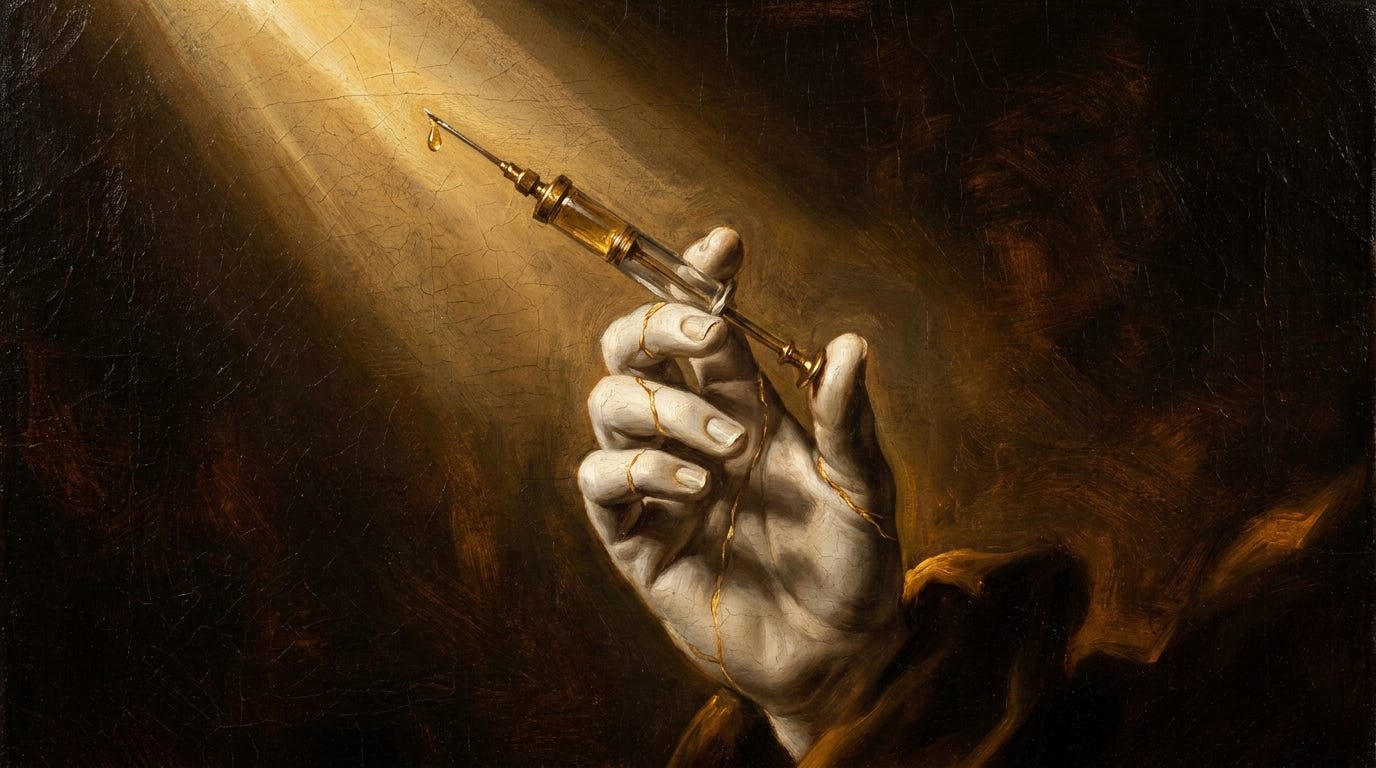
So ignoring an FDA warning now runs on decades of practice. Doing your own research feels like taking the wheel, and that feeling of control is the real product; the peptide is almost a side effect.
It makes for strange trades. The same person who won’t drink pasteurized milk, a process with a century of evidence behind it, will inject a peptide from a lab they can’t name, backed by research that never got past rats. The proven thing gets refused because a government agency vouches for it; the unproven thing gets trusted because they found it themselves. The people writing these protocols aren’t doctors. They’re influencers, which tells you how far authority has moved.
The risk is the part buyers wave off. A vial ordered from a lab no inspector ever sees can carry the wrong dose, or whatever came off the last batch in the same unsterile room. The FDA’s reason for restricting these peptides in the first place was exactly that: impurities it couldn’t account for, and immune reactions no one had tested for. The safety data doesn’t exist because the trials were never run.
The safeguard they trust instead is a lab certificate the seller posts to a Telegram channel. It checks one thing: that the powder is really the peptide it claims to be, at the purity stated. It says nothing about whether the vial is sterile, or what might be growing in it.
What This Says About Dinner
The same thing is happening in food, slower, run by companies with legal departments instead of crypto wallets. The gateway was Ozempic, the drug that made injecting yourself for weight loss feel normal. It set loose an instinct now changing how people eat: skip the experts, trust whoever feels like you. It shows up as raw milk, as carnivore, as food sold as medicine with no medicine in it.
The big food companies have watched all this and are starting to bet on a version of it. Inside any of them you’ll find the same bet the gray market is making: people will pay extra for the feeling of running their own health. Personalized nutrition keyed to a cheek swab. A QR code promising the product was built for your body in particular. Same promise as the vial, run past a legal department and printed on a clean label. Some of it will do real good. A lot of it sells the same feeling Clavicular does: that you run your own health, and nobody in a white coat gets a vote. The difference is mostly the packaging.
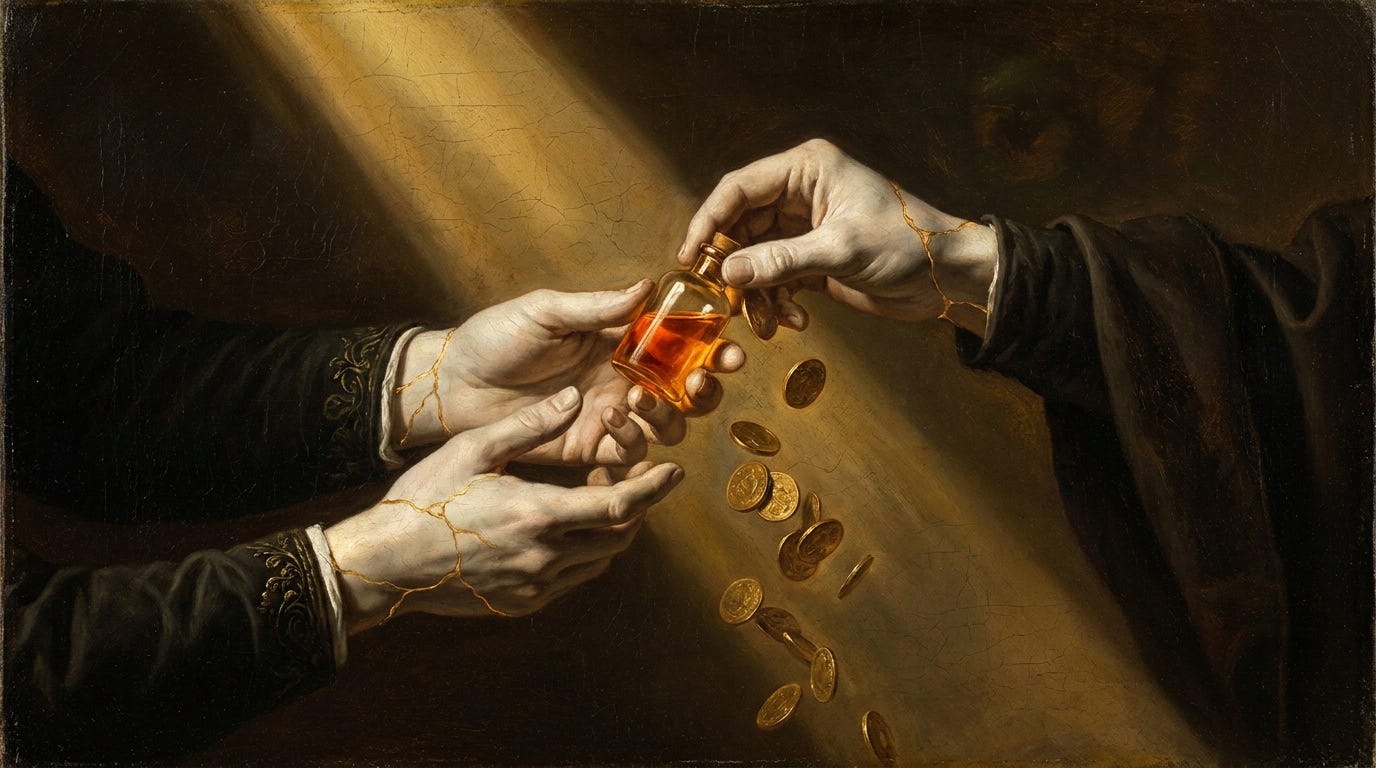
You can’t lecture people out of this, and trying is part of the problem. A warning from the institution that already lost them only confirms why they left.
The only thing that beats a gray market is a legal one that earns more trust and delivers something a person can feel. For food, that means making the better, safer option also the easy one.
The temptation is to skip that and sell the feeling instead, because a feeling is cheaper to make than the real thing. A warning label was never going to beat that. A better default might.
Somewhere a sixteen-year-old is mixing a vial from a factory that used to serve cartels, trusting a certificate that doesn’t test for what’s most likely to hurt him, because a man punching his own face on a livestream told him it would make him beautiful.
He’s not an aberration. He’s what’s left when people stop trusting the institutions meant to keep them safe, while the rest of us keep handing them stronger tools to go around those institutions.
Banning the peptides won’t change that. Pull them off the list and the demand finds the next factory, the next livestream. Nothing on that shelf gets safer until the institutions earn back the trust they lost.
—
Mike Lee is a food futurist and innovation strategist, author of Mise: On the Future of Food, host of The Tomorrow Today Show podcast, creator of Mise Futures, and is on Instagram at The Book of Mise.
—
Mise 2: The Restaurant Issue is now open for pre-orders! Ships 8/11/26. Over 200 pages of future scenarios exploring the future of restaurants.
The points in your article are frightening to me. When is humanity going to learn? Thank you for writing this down as well as you have. I have hope that some will read this and avoid the many consequences of heading down the wrong path.