


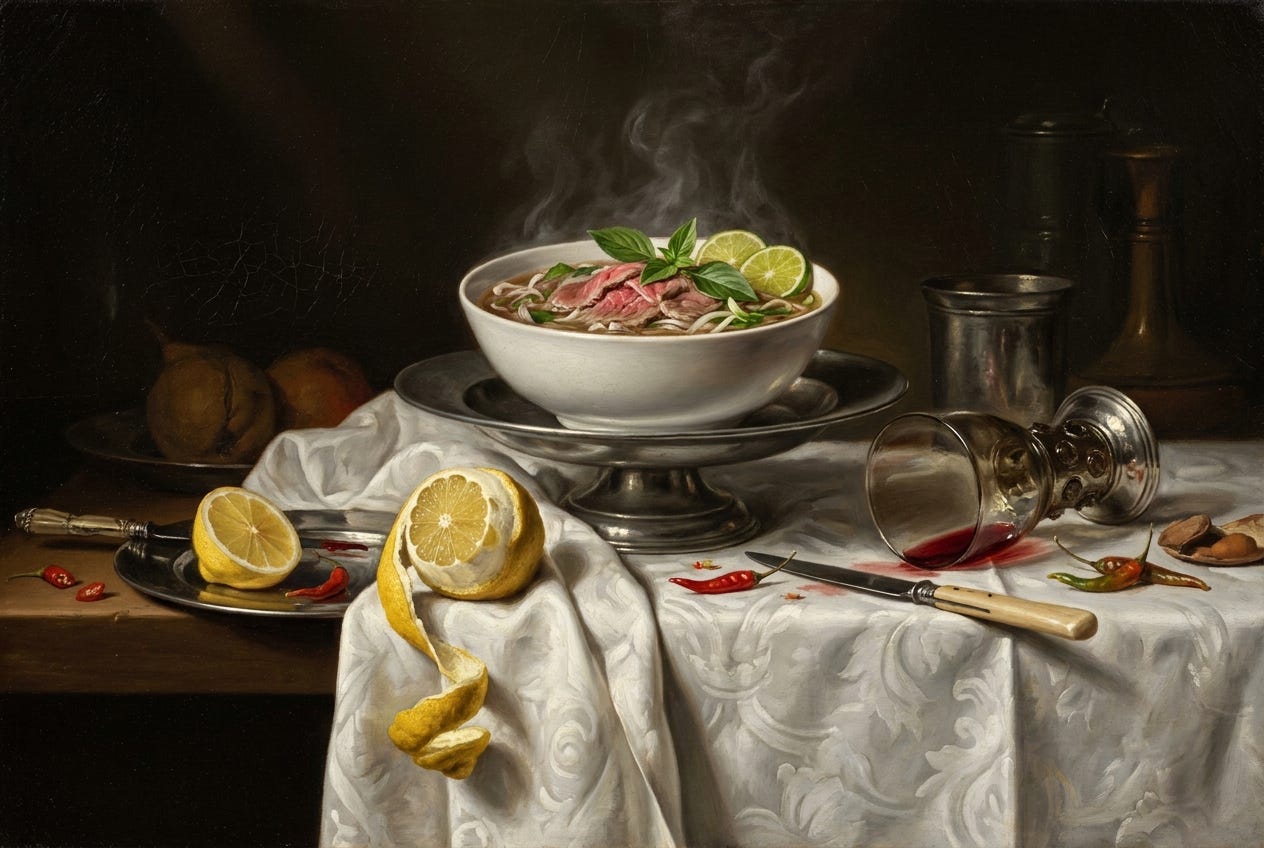
If an Italian restaurant charges $30 for handmade tagliatelle, nobody with means bats an eye. When the Vietnamese restaurant across the street charges $30 for a bowl of pho, the one-star reviews rack up.
The hipster brewery charges $18 for a smashburger and packs the room all weekend. Charge $18 for two carne asada tacos and somebody will tell you tacos should never cost more than $4.
All of these restaurants pay rent. All of them spend long hours prepping. But some of them, usually the “ethnic” ones, hit a ceiling on what they can charge.
Not all food needs to be expensive to be good. A $15 pho or a $5 taco can be transcendent, and a high price guarantees nothing. The problem is that we reject a cuisine for trying to charge more when it isn’t on the list of cuisines allowed to charge more.
Krishnendu Ray, the food studies professor at NYU, measured this in his book The Ethnic Restaurateur. He pulled decades of Zagat data and compared average checks by cuisine in New York. In 2010 dollars, French came in highest at $47.81 a meal. Thai came in last at $28.63.
Both French and Thai food are built on fresh ingredients, layers of flavor, and centuries of delighting eaters. So why does a French restaurant get away with charging two-thirds more?
It’s the People, Not the Food
Ray reasoned that a country’s culinary price ceiling is tied not so much to the food, ingredients, or technique, but to the social standing of the people cooking it in America. He even put a number on it: $30, the threshold American diners tend to resist crossing for any food they deem “ethnic.”
Which points right to the injustice, because what the hell does “ethnic” mean anyway?
The culture writer Lavanya Ramanathan says it’s “not the phrase itself, really. It’s the way it’s applied: selectively, to cuisines that seem the most foreign, often cooked by people with the brownest skin.”
Ray adds that we use the word ethnic to describe “a category of things we don’t know much about, don’t understand much about, and yet find it valid to express opinions about.” A catch-all for the exotic foods we have access to.
Professor Johanna Mendelson Forman notes that “ethnic cuisines are considered low, and fusion cuisines are considered haute cuisines.”
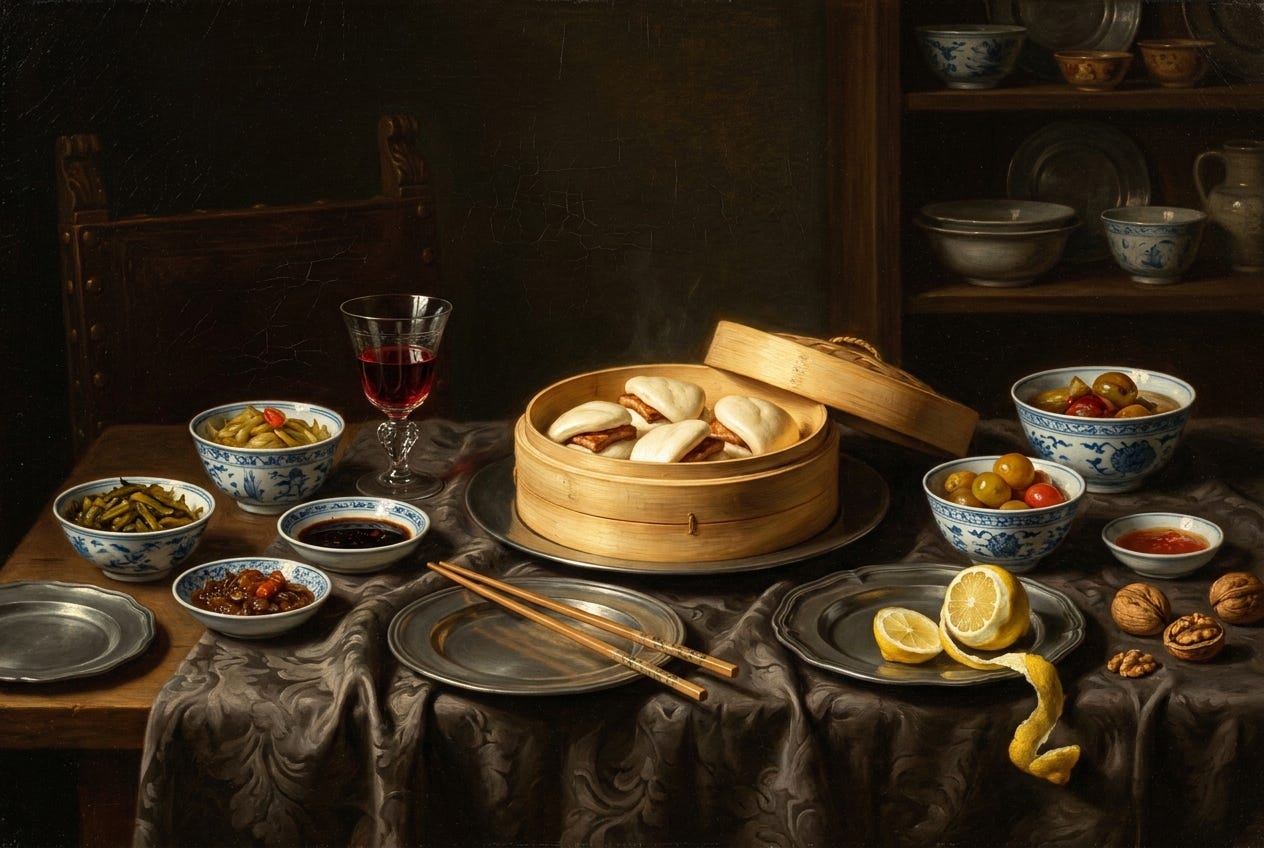
Like how pork belly in steamed buns originated at least as early as the 1970s in Fujian Province, China, and has been a popular staple ever since. But they didn’t enter the mainstream American consciousness until Dave Chang, the modern-day poster child for pan-Asian fusion (for better or worse), opened the OG Momofuku in 2004 and put a pork bun on the menu that took the city by storm and spawned thousands of copycats nationwide since.
Which means a cuisine’s price ceiling has almost nothing to do with what’s on the plate. It rises and falls with the perceived standing, from the ethnic majority’s point of view, of the people behind it. Change how America sees the cook, and the food it once called cheap gets to charge like everyone else.
Who Holds the Ceiling Up?
I remember those early Momofuku days when I’d take my mom and dad out whenever they visited me in NYC. I’d excitedly order a bunch of items and regurgitate what I’d read in Eater about Chang’s love for Benton’s bacon and his use of Greenmarket produce in his modern bowls of ramen. I raved about the pork buns, then was crestfallen when they tried them and gave a “meh” reaction, before complaining that they cost $18 and that my grandmother made them at home all the time.
The scene played out dozens of times as my Cantonese parents visited my brother and me in NYC and dined out with us. If you know my mother, she is not shy about prices. She’s usually decked out in luxury clothing head to toe, and her sunglasses probably cost more than most meals we’ve had as a family.
I can kind of understand why someone wouldn’t want to pay much for a food they didn’t themselves understand. But hearing my mom complain about the price of the Momofuku pork bun, a food that comes from her own culture, I wonder if “ethnic” people are often the ones enforcing the price ceiling on their own foods.
My parents were second-generation Chinese-American restaurant owners in metro Detroit, and they felt pressure to keep prices low. Their customers were blue collar and middle manager class auto company employes. I remember my dad worrying that a $0.20 increase on a lunch special would drive his customers away. So it’s no wonder they lost their damn minds when Dave Chang went all the way to $18 for a four-bite appetizer.
Yes, I know it’s apples and oranges. Rent in the East Village is markedly higher than in suburban Detroit. So is the labor. So are the ingredients. So is everything else. I get that. But nevertheless, I could feel that something deeply offended them about an Asian person charging what he probably needed to charge just to keep his restaurant afloat in the hyper-competitive, costly market that Manhattan was and still is.
Yet they could afford those prices. If you don’t have the means to justify $18 for an appetizer, that’s completely understandable. But that person isn’t the one paying $30 for the tagliatelle or the pho. So maybe my mom and dad, and the millions of other immigrants I’ve met who bristle at their native food going fusion and pricey in America, simply knew a less famous place that made the same thing cheaper and better. Or maybe the modern version didn’t hit like the classic one, and they didn’t need to eat it somewhere so chic.
The craziest part about ethnic food price ceilings is that the people it’s built atop often help hold it up. My mom and dad spent decades learning that their food had to stay cheap. And they learned that lesson so well that they came to believe it, even long after their bank accounts stopped requiring them to squabble about menu prices. A culture’s cuisine can escape its old price conventions long before the people born into it escape the fear that set those prices so low in the first place.
It’s All About Range
None of this is fixed. Culture is fluid, which means values are fluid. And as values go, so do wallets. Italian-American cuisine spent years as cheap fare for immigrants, the red sauce joints where nobody expected to pay much. Fast forward to today, where we have Carbone and their $35 spicy rigatoni (it’s only $18 at their more casual restaurant, Parm).
And over the past 20 or so years, previously unfamiliar “ethnic” foods like sushi, Korean BBQ, and Indian food have broken through the glass price ceiling. So the fight over the metaphorical $30 bowl of pho is not about the pho. It’s about how America collectively decides it feels about the people. The price is a verdict on the cook, dressed up as a judgment about the food. And that’s unfair, because we live in a very unfair world.
But it doesn’t have to be that way. For those of us eating another culture’s cuisine, we owe it to ourselves and the people’s food we love to shift our thinking. It’s great that a $5 taco spot can be accessible to virtually everyone. But if people love their product, why wouldn’t we want them to succeed? Why would we write off a restaurant and demonize its success if they wanted to charge more, assuming they kept the quality up and didn’t totally alienate their core audience? No one expects Apple or Lululemon to be cheap, so why do they not give the same grace to an immigrant who’s been grinding for decades to build a following for their restaurant?
Stop deciding in advance what a food is “allowed” to cost on factors aside from how it tastes and how we feel in the place where we eat it. Judge a $30 pho the same way you’d judge pasta at the same price: the ingredients, the preparation, the dining room, the service. Let the experience justify or fail to justify its price on its own, instead of assigning an arbitrary limit before the first bite.
And for those of us who do come from a so-called “ethnic” cuisine, this might be harder, because we might have a bit of that glass ceiling in us too. But we should be flexible in our thinking, because having a $200 Chinese spot doesn’t prevent the $20 one from existing. Both can and should exist, both can be wonderful, and both has its place in a diverse food culture.
The goal of breaking the ethinc food price ceiling was never to make one culture’s cuisine all expensive. It was to give that cuisine the option to be expensive if it wanted to be, and more importantly, if it earned it.
—
I get into issues like this one, and a lot of others facing the future of eating out, in Mise 2: The Restaurant Issue, now available. Over 200 pages of illustrated future scenarios (with ads from 2040) on where restaurants are headed.
Mike Lee is a food futurist and innovation strategist, author of Mise: On the Future of Food, host of The Tomorrow Today Show podcast, creator of Mise Futures, and is on Instagram at The Book of Mise.
You have written such a nuanced piece about food, ethnicity/race, and perceptions of class. As you note, "ethnic" restaurants start out as food for the immigrant community as a taste for home where you are your own boss (often because discrimination makes it difficult to get steady jobs). Then, they become fusion and adapt their tastes to a broader "American" often white mainstream market. Then, they expand unto upscale when generationally there is an larger upper class segment of the ethnic group to sustain the taste preferences yet still aspire to an aristocratic taste.
Absolutely love this.