


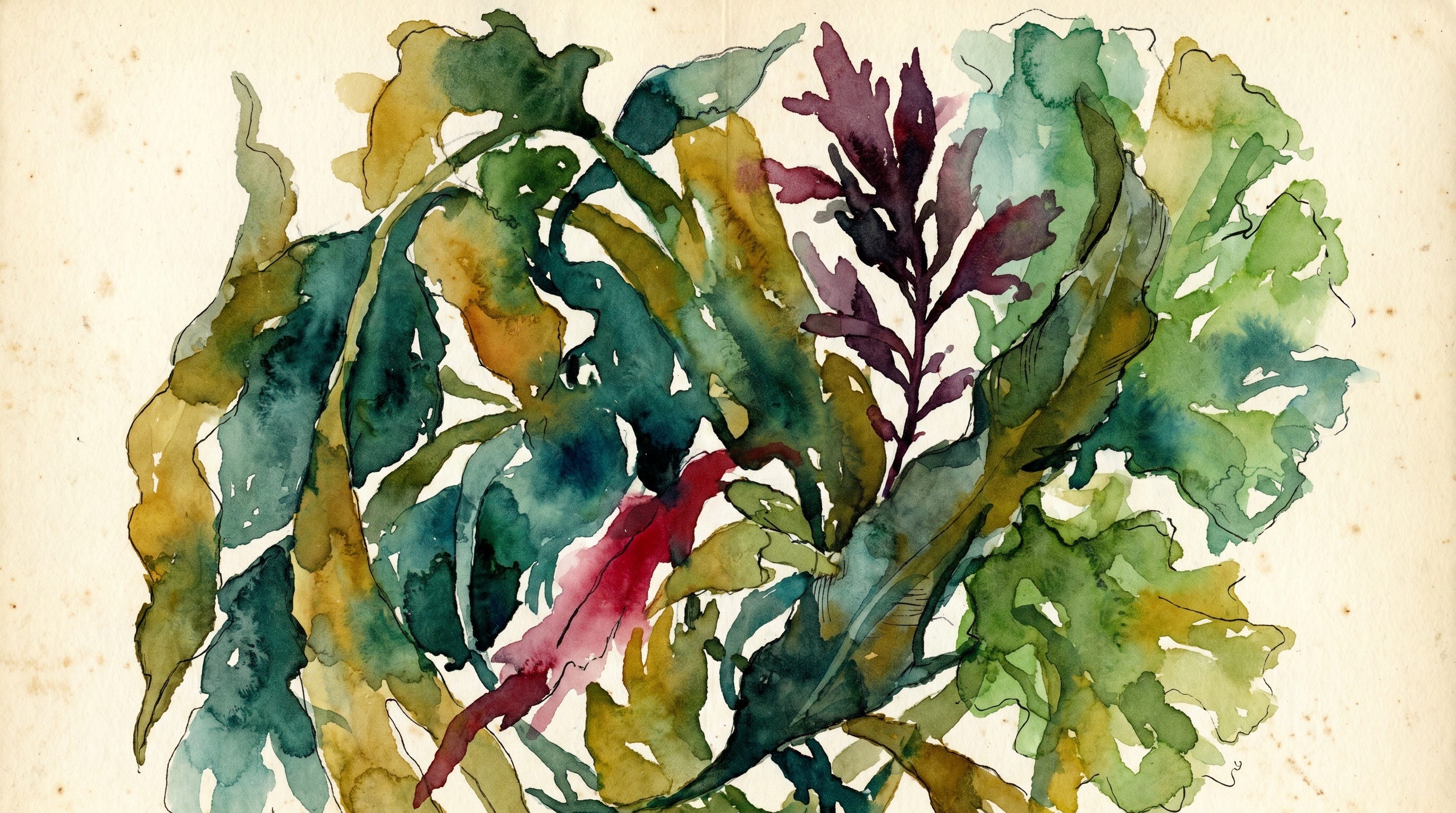
I grew up with soy sauce never far from the baby bottle. I was raised in a food culture built on umami, loving the flavor years before I had a word for it. Run down my desert-island foods and almost all of them lean heavy on that deep, savory baseline; I am hardwired to chase it. So when I went to speak at Menus of Change last week, the food industry’s sustainability gathering at the Culinary Institute of America, and the opening day was given over to blue foods, I was an easy mark.
Blue foods are the ones we pull from the water: fish, shellfish, seaweed, kelp. More importantly for my palate, they are the ocean's umami engines. A lot of these ingredients are loaded with the exact savory compounds I've been chasing my whole life, and the ones that sit lightest on the environment also happen to be some of the most concentrated flavor sources we’ve ever found. That’s why I was sold long before anyone made the case for the planet.
The planetary benefits are undeniable. Kelp grows without fresh water, feed, or fertilizer and pulls carbon. Oysters and mussels filter the water they live in, and small fish breed fast enough that eating them barely dents the system. People like Barton Seaver have made this argument for years, and I believe all of it. The science is real, and the people behind it are serious.
The challenge isn’t the science; it’s the translation. I walked out realizing that the next frontier for blue foods isn’t a conference stage, it’s the kitchen. If this movement is going to scale, we have to take that rigorous work and turn it into the absolute easiest thing to reach for when the clock is ticking, especially for home cooks.
What I keep chasing is the rare case where the choice that’s good for the planet and the one that tastes good line up, cheap and quick enough that people make it without being asked to care. That’s the idea behind what I’ve long called altruistic hedonism: lead with flavor and desire, because that’s what people follow, and let the virtue ride underneath.
Dashi, the Japanese stock built from those umami-rich blue foods, is one of the cleanest examples of frictionless sustainability I know. That opening day is what got me hunting for others. Umami is how you make food taste rich without leaning so hard on fat and salt, and dashi is one of the cheapest, fastest ways to get it.
The French Default
Walk into almost any American kitchen, home or professional, and the bones are French. It’s what the culinary schools teach, the CIA included: mother sauces, knife work, a stock simmered under everything serious. I love that tradition, but a default that deep becomes a blind spot. When we want savory depth we reach for a stockpot, and rarely notice there are older, lighter ways to the same place.
A French stock pulls flavor out of bones, meat trim, and aromatics over hours on the stove, then concentrates it by boiling off water. It’s deeply rewarding and a lot to ask of a cook, all that animal protein and heat and a pot you can’t walk away from. Almost no home kitchen has veal stock in the fridge, and plenty have never made stock at all.
Dashi works the other way around. The flavor is already in the materials and the first goal is to concentrate them. Kelp dried in the sun, bonito shaved off a hard-smoked block, dried anchovy or scallop, none of it waiting to give up flavor over a long afternoon. The drying already concentrated the glutamates your tongue reads as umami and made them shelf stable. Drop them in hot water and it steeps out in minutes, like tea.
Dashi is built on those blue foods, kelp and small fish and shellfish that carry a fraction of the carbon of a beef or veal base. But hardly any American kitchen stocks it, and where it turns up it’s usually the raw parts, kombu and bonito to simmer yourself for about 10-15 minutes, instead of hours for a classic French stock. But they also come in handy teabag-style packets from Dashi Okume that I rely on almost daily. (I have no official relationship with them, I just love the product.) I have a bag of their dashi packs right by my stove and can conjure up an umami laden stock in minutes.
Dinner Lands on You
There is a massive practical gap between nodding along at a sustainability summit and actually getting dinner on the table at 5:30 PM. When you are flying solo, trying to get food for you and your kid(s) on a Tuesday while wrapping up a workday, culinary ideals evaporate. Practicality wins. The French default requires foresight, patience, and a pot you can tend to. Tuesday night just requires food, right now, before the meltdown hits.
That is where those dashi packets stop being a theoretical exercise and become vital infrastructure. I love New England clam chowder, but making a traditional, heavy cream-and-stock version on a weekday is a non-starter, and eating it regularly would leave me dead inside six months. So I built one on dashi. I simmer two dashi packets in some water and clam juice, sweat some shallot and garlic in olive oil in another pan then pour the dashi mixture over it and boil a russet potato hard enough that it breaks down a little and thickens the pot itself. Add the clam meat and finish it with sherry vinegar, lemon, and parsley. Sometimes I’m thicken with a bit of corn stretch slurry. It comes together in twenty minutes. I make it weekly because it fits into the exact shape of a chaotic schedule, delivers the deep satisfaction of the heavy version, and I never feel wrecked after.
Dashi goes anywhere a stock or a seasoning packet would and the possibilities are endless. Pull the meat off a leftover rotisserie chicken, drop it in dashi with macaroni and carrots, and you have a deeply savory chicken noodle soup in the time it took to find the colander. Cook ramen in light dashi instead of the foil packet, or keep the packet and use dashi as the water for a massive umami punch. Add a pinch of salt and drink it straight in a mug, as comforting as a slow-simmered bone broth. On a takeout sushi night, when the included miso soup is the usual watery afterthought, steep a quick dashi, stir in real miso paste and tofu, and you have a proper bowl in three minutes.
None of these meals are conscious attempts to save the ocean. They are survival mechanisms for a busy weeknight that just happen to taste incredible. But that lack of conscious effort is exactly why they matter.

A Food Hack That Moves a Boulder
None of this is more than a food hack, and most food hacks are trivial. Cherry tomatoes sliced all at once between two quart-container lids, a head of garlic peeled by shaking it hard between two bowls, chicken shredded with a hand mixer: handy, and they save a few seconds and change nothing. Swapping dashi for stock or a seasoning packet looks like one more of those, but it’s a lever on something bigger: what people here think savory flavor is and where it comes from.
Say a lot of people made that swap next month. Maybe nothing happens. Or maybe it nudges a few of them toward the idea that deep savory flavor doesn’t need a long meat stock, that one of the oldest and cheapest versions runs on kelp and dried fish. That’s how eating habits actually shift: a small change to something people already cook, repeated until it’s just how things are done.
But this isn’t just about dashi. More precisely, it’s about how dashi fits the blueprint for a frictionlessly sustainable food. The philosophy is straightforward: make the choice that’s good for people and the planet the exact same one that’s good for their own selfish pleasure. The challenge lies in the execution—finding the tools and levers that guide people to a better option without a lecture. For this to actually work, a few non-negotiable traits have to be present.
The pleasure has to land first, and on time. Nobody trades a mediocre dinner tonight for a better planet tomorrow. The reward has to be the food itself, or it only reaches the people already converted. The benefit also has to live in the product, not the willpower of the person using it, because most of us don’t care most of the time. Anything that runs on actively caring reaches only the choir. Cheapness and minimal new effort matter just as much: a fix that demands a premium grocery budget or a complex new kitchen ritual, no matter how clever, will never achieve the scale needed to actually move the needle.
At its core, there’s a word for this: hospitality, the deep kind the CIA spends four years teaching. Figure out what someone needs and meet them there, on their terms. Do it for one table and it’s a good night out. Do it for a whole country—for the tired parent feeding their kid, the line cook, and the person who has never simmered a stock—and you change how a population eats without ever asking them to change their values first.
None of this asks anyone to care about the ocean. It asks them to make a better-tasting soup and lets the ocean come along for the ride. That’s not in any way to diminish the fine men and women who steward our oceans and responsibly cultivate its bounty. Rather, these kinds of accessible behavior shifts are what can invite more people into the Blue Foods conversation who don’t normally follow this kind of stuff
A dashi packet won’t cool the planet. But it’s sized for one person’s hands, and the boulder we’re all trying to move only budges when enough hands are pushing. Flavor is how you get the hands there.
—
Mike Lee is a food futurist and innovation strategist, author of Mise: On the Future of Food, host of The Tomorrow Today Show podcast, creator of Mise Futures, and is on Instagram at The Book of Mise.
—
Mise 2: The Restaurant Issue is now open for pre-orders! Ships 8/11/26. Over 200 pages of future scenarios exploring the future of restaurants.
Thanks Mike!
Dashi packs sold out! I’m going to share about them at an easy weeknight meals class through Stanford Healthy Living program.
The bones of my kitchen are Thai -- an over-dependence on voluminous fragrant roots and herbs, plus the umami core of fish sauce and shrimp paste. I love this article because I don't think americans understand just how sustainable those two bases are -- they're using small fish (like anchovies) and tiny shrimp. And small fish, in addition to sea vegetables, are the future of blue food ... unfortunately, since we've industrially targeted all the larger species and ecosystems tend to collapse from the top. The ocean in 30 years may just be algae, squid and jellyfish.
Which brings me to a shameless plug for our calamari jerky (available at www.thehermit.com) -- we intentionally chose to use a small squid, D. opalescens, wild caught off the California coast. We believe it's one of the most sustainable animal proteins available to americans, and it's a shame that 90% of it is exported to asia right now (all while 80% + of seafood consumed in america is imported, which is sheer insanity, and leads to americans unwittingly contributing to ecological disasters across the planet).
Sorry for the shameless plug. Students of umami must know!