



Fans of Rice Krispies living in the UK experienced a change in the recipe of their beloved breakfast cereal in September. Traditionally, Kellogg’s takes whole grains of rice and puffs them. Now in the UK, Rice Krispies are made from rice flour and wheat gluten. Kellogg’s said this change would be rolled out across Europe in the coming months, while the American version of the cereal won’t change.
Kellogg’s blamed the weather, explaining to The Grocer, a British trade magazine, that the new recipe “helps us maintain consistent quality at a time when changing weather conditions are affecting the quality and availability of some of the rice and grains used in our cereals.” A spokesperson highlighted the extreme weather and drought in Spain in 2022 and 2023, the kind of weather that climate change makes more likely.
I think this is what climate change looks like on a day-to-day level. It’s not just a series of catastrophic, individual climate-influenced events like a wildfire, drought, or flood. Instead, it can look like a bunch of recipe and ingredient changes that happen gradually to the foods we enjoy. Any one of these recipe edits wouldn’t cause waves in the food industry, but taken in aggregate over time, they show how slowly but surely our groceries are changing alongside our climate.

Why Rice Flour?
The original Rice Krispie recipe uses intact rice grains that are cooked under pressure and puffed at high temperature to make the airy, crispy product we all know. And that process is calibrated around a medium-grain rice that puffs well. Weather plays a role in how readily available those grains are on the market. Obviously, a drought might cut down how much rice is available in the first place. But heat also affects how the starch develops in the rice, leaving the grains chalky and weak so they break more easily and are harder to puff.
Rice flour makes a lot of those problems go away. A broken grain can’t be puffed in the original recipe, but chalky, weak grains can be ground into flour, which makes the Rice Krispie rice supply less susceptible to heat. Rice flour can also be milled from a much wider variety of rice, grown just about anywhere in the world, which further protects Kellogg’s from regional heat waves.
Instead of puffing whole rice grains, the rice flour is made into a dough (with wheat gluten added) and an industrial extruder consistently turns that dough into the Rice Krispie shape. That consistency and control are attractive to Kellogg’s, but so is the fact that rice flour is likely cheaper than whole grains of rice.
The switch to rice flour has a couple of tradeoffs, like needing wheat gluten to help the texture, which crosses it off the list for anyone with a wheat allergy. Some eaters in Britain also claim the “snap, crackle, and pop” of the cereal has gotten fainter with the new recipe. But who knows if enough consumers will even care. As long as eaters don’t really notice, rice flour could become the new standard recipe, saving Kellogg’s money and risk.

A Degradation Of Wholesomeness
Back in April I wrote an essay called The Enshittification of Big Food. I borrowed the term from the writer Cory Doctorow, who first used it to describe how internet platforms like Facebook or Google can get worse over time, as their owners’ financial interests push them to extract more value from its users to please shareholders. This compromises the product for the user.
This has been slowly happening to food for decades. Coke switching from cane sugar to high fructose corn syrup in 1974 after sugar prices spiked. Oreo trading lard for vegetable oil in the 90s. Annie’s using cornstarch as a thickening agent instead of butter and milk for its shells and white cheddar. And Hershey having to call some of its Reese’s products “chocolate candy,” because the chocolate content fell below the threshold the FDA requires to call something “milk chocolate.”
The word enshittification is tricky in food, because everyone’s frame of reference for “shitty” is different. Sure, there is a romantic reverence for glass bottles of Mexican Coke, where the recipe stayed with cane sugar. But most people can’t really tell the difference and are happy to buy the cheaper, less precious HFCS product day to day.
With these ingredient swaps, the enshittification isn’t just about nutrition and flavor but a degradation of wholesomeness in our food system. It’s the outcome of a system that prizes efficiency, where cheaper ingredients with stable supply chains beat out ones that might be higher quality, albeit more financially precarious to source.
Almost always, these ingredient swaps are made with the food brand’s profit and loss statement in mind, not the consumer. No one asked for them. And at best, they happen in a way consumers can’t sense, the same way you can get away with cheating as long as you don’t get caught.
And once one region of the Rice Krispies empire proves it can make the product from rice flour, which makes it cheaper and more dependable with no complaint from the consumer, it’s tempting to never go back to whole rice. From the brand’s standpoint, why wouldn’t all the other countries that sell Rice Krispies want to improve the economics and stabilize the supply chain of their main ingredient?
Even if the climate eventually cools and Kellogg’s can move back to whole rice, how is a company going to convince itself that it should go back to the more demanding ingredient that costs more after it’s enjoyed many quarters of selling Rice Krispies at the new margin? Companies almost never do.

Coping Mechanisms
On its own, this minor ingredient shift in a legacy breakfast cereal isn’t really big news. But it sadly isn’t the only signal of how climate is changing our food system.
Cocoa prices have skyrocketed due to bad weather and crop disease in West Africa. Some chocolate products in Great Britain have lost so much cocoa that they’re referred to as “chocolate flavoured” products.
The drought that hurt Spanish rice also hurt its olive oil harvest, which was cut roughly in half.
At the end of 2024, a drought in Brazil drove coffee prices up to 80% more than usual, hitting record highs.
Meanwhile in Indonesia, excessive rain damaged coffee cherries and drove down their output by nearly 17%. Globally, coffee prices were up almost 39% across the board in 2024. And similar weather disruptions have affected wheat, rice, corn, soybeans, sugar, oranges, and potatoes over the past five years.
These kinds of weather disruptions are hard on farmers and the people who depend on them, which is pretty much the entire world. But people elsewhere in the food system are finding clever ways to cope. Like the two brothers who run an upscale ice cream shop in downtown Los Angeles and have started hedging weather risk with a prediction market.
Each day, they bet $20 on Kalshi that the temperature will dip below 70°F (21°C). An ice cream shop is incredibly dependent on the weather. The brothers typically lose around 20% of their usual business on days when it’s colder. So, if it’s a cold day, they don’t get many customers and don’t sell much ice cream, but they’ll win their bet on Kalshi, which offsets some of those losses. And if it’s a gorgeously warm day, they’ll lose their $20 Kalshi bet but more than make up for it in higher ice cream sales.
That $20-a-day bet adds up to about $600 a month in wagers, which they say has brought in up to $1,500 a month in winnings. With their storefront’s rent at $3,500 a month, that’s meaningful money for the business.
A cold day for a bougie ice cream shop and a massive drought in a major agricultural region do not have the same stakes. But the Kalshi “weather hedging” move suggests how prediction markets might provide smaller businesses with a financial buffer against a range of weather events.
A mom-and-pop beachfront restaurant in Miami might bet on hurricanes or floods as a form of makeshift insurance against a disaster that could destroy the business. Or a small family farm in Iowa might use a weather bet to help cover losses its crop insurance leaves unpaid. Larger farms and food companies already have crop insurance policies and futures trading operations, but the LA ice cream shop shows how people on the ground are starting to innovate.
It’s a similar impulse to the one driving companies to develop coffee and chocolate alternatives that are less vulnerable to climate risk, from Atomo’s beanless coffee to Planet A Foods’ cocoa-free chocolate. And with governments slow or failing to sufficiently act on big climate change issues, more of the work of adapting is falling on small and medium-sized businesses and their communities.
What About Eaters?
Most people won’t care about this little shift in Rice Krispies. Because if you’re buying Rice Krispies, you were probably never expecting to eat wholesome rice anyway.
The trouble is that the little stuff is little until it isn’t. A bad harvest in one place forces a shift to rice flour. But bad harvests year after year, in place after place, mean that the foods we’ve blissfully taken for granted become luxury items. What happens if coffee one day costs $60 a pound? Or what if it’s not even on the shelf at all?
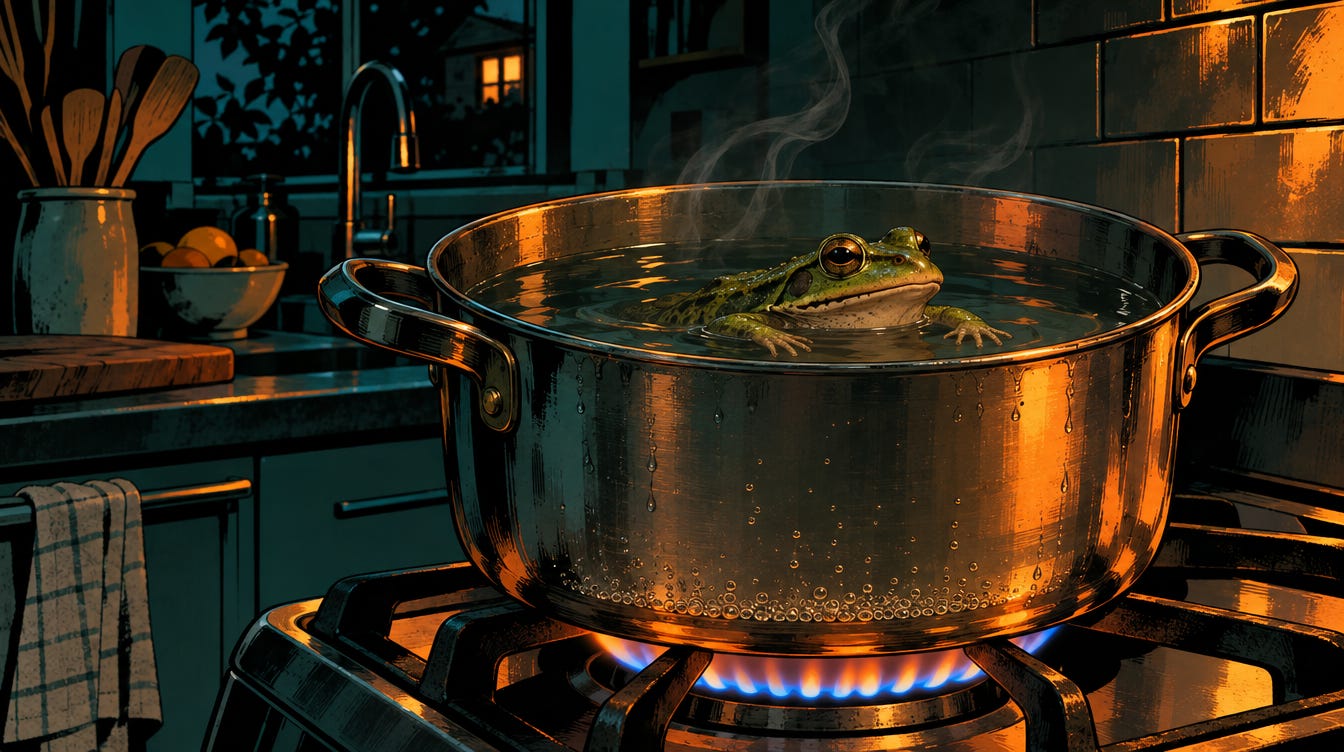
Coffee at $60 a pound would make people notice, but by then it might be too late to do anything meaningful about it. That’s what’s hard about getting people to care about climate change at scale. The changes happen slowly enough that no individual year’s weather events feel like an emergency. We’ve become the proverbial frog in slowly boiling water, too oblivious to notice.
There’s a dark irony in needing to grind up a grain of rice, turn it into a dough, then make a rice puff that’s supposed to look like the original grain of rice. It’s also an appropriate metaphor for how we’re dealing with climate change. We break a thing, rebuild it as a slightly worse version that’s close enough to pass, and move on.
When rice breaks from the heat, we grind it up and press it back into the shape of something that looks like rice. When the coffee fields are barren, we brew seeds and other stuff until we find something that tastes close enough.
If we keep clumsily adapting to a hotter planet for a few more generations instead of dealing with climate change itself, we’ll one day wake up surrounded by convincing copies of the things we used to have. Each copy just a little shittier than the last. All made from the broken pieces of the originals. At some point, close enough just won’t be enough.
—
Mike Lee is a food futurist and innovation strategist, author of Mise: On the Future of Food, host of The Tomorrow Today Show podcast, creator of Mise Futures, and is on Instagram at The Book of Mise.
This is everything that is coming for food…
Another good article, thanks. Can I please ask you though to stop using the frog analogy which is true of humans but false for frogs. Only humans are that stupid.