


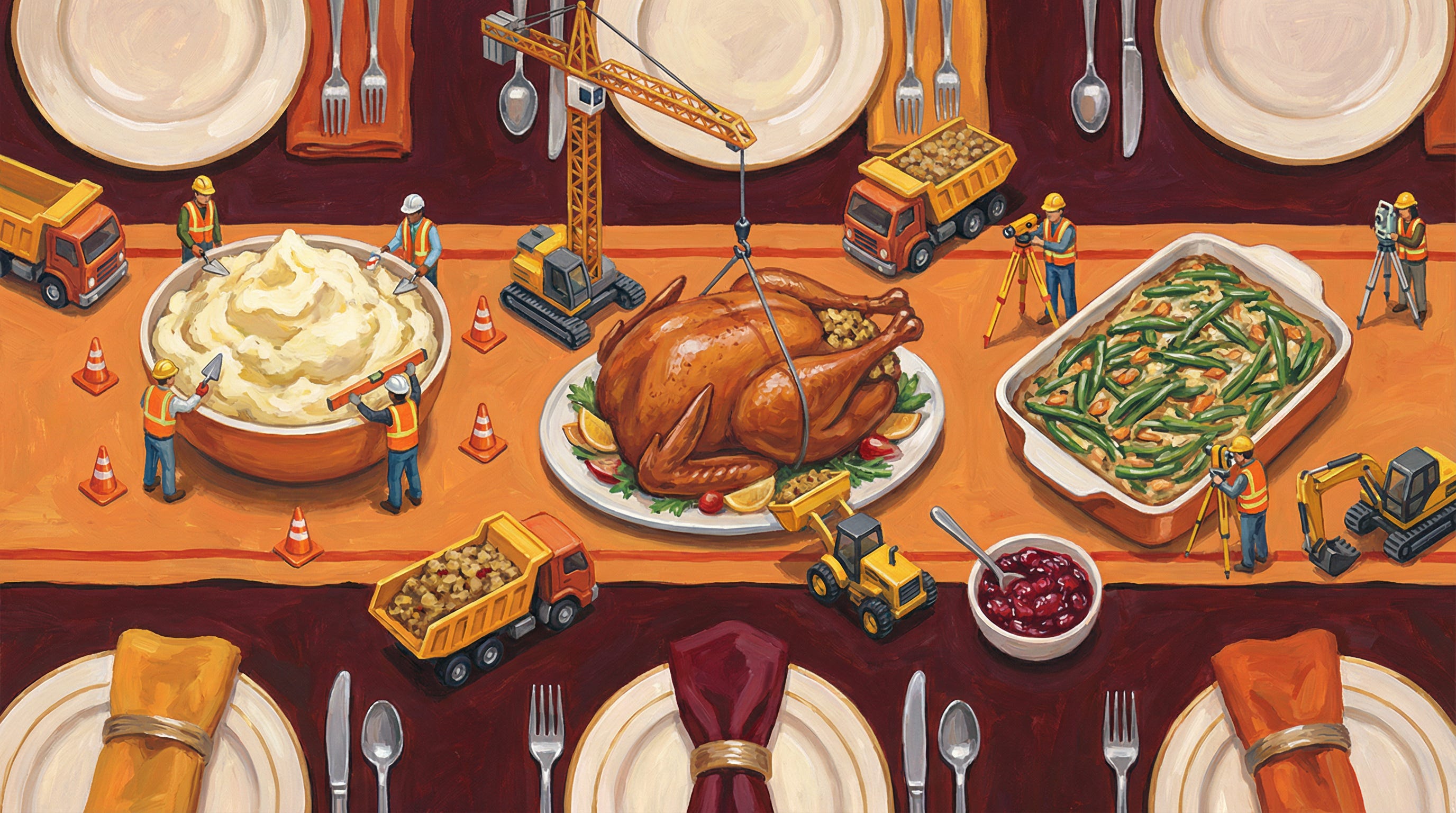
Every Thanksgiving, Americans gather around tables laden with turkey, cranberry sauce, and mashed potatoes, performing a ritual we’ve inherited as part of our founding story. We teach children about Pilgrims and Indians sharing a harvest feast in peaceful harmony. We stage elementary school pageants with construction paper buckles and feather headdresses. We’ve sanitized our nation’s origin into a comfortable myth.
But origin stories evolve to serve the needs of the present more than preserve the past. The gap between the 1621 harvest feast and your modern Thanksgiving table isn’t just four hundred years of culinary evolution—it’s a study in how nations construct myths that smooth over complex realities.
The 1621 event wasn’t a “Thanksgiving.” It was a secular harvest feast—a “rejoicing.” More importantly, it was a fragile diplomatic alliance forged in the wake of devastation. For the Pilgrims, it marked survival after half their company died. For the Wampanoag, who had lost thousands to epidemic disease, it was a strategic maneuver to secure military aid against rival tribes. A fleeting moment of mutual necessity, not a blueprint for a nation.
The Three Sisters
When the Pilgrims arrived, they saw forests and assumed wilderness. What they were actually observing was a managed landscape—a sophisticated agroforestry system cultivated for thousands of years.
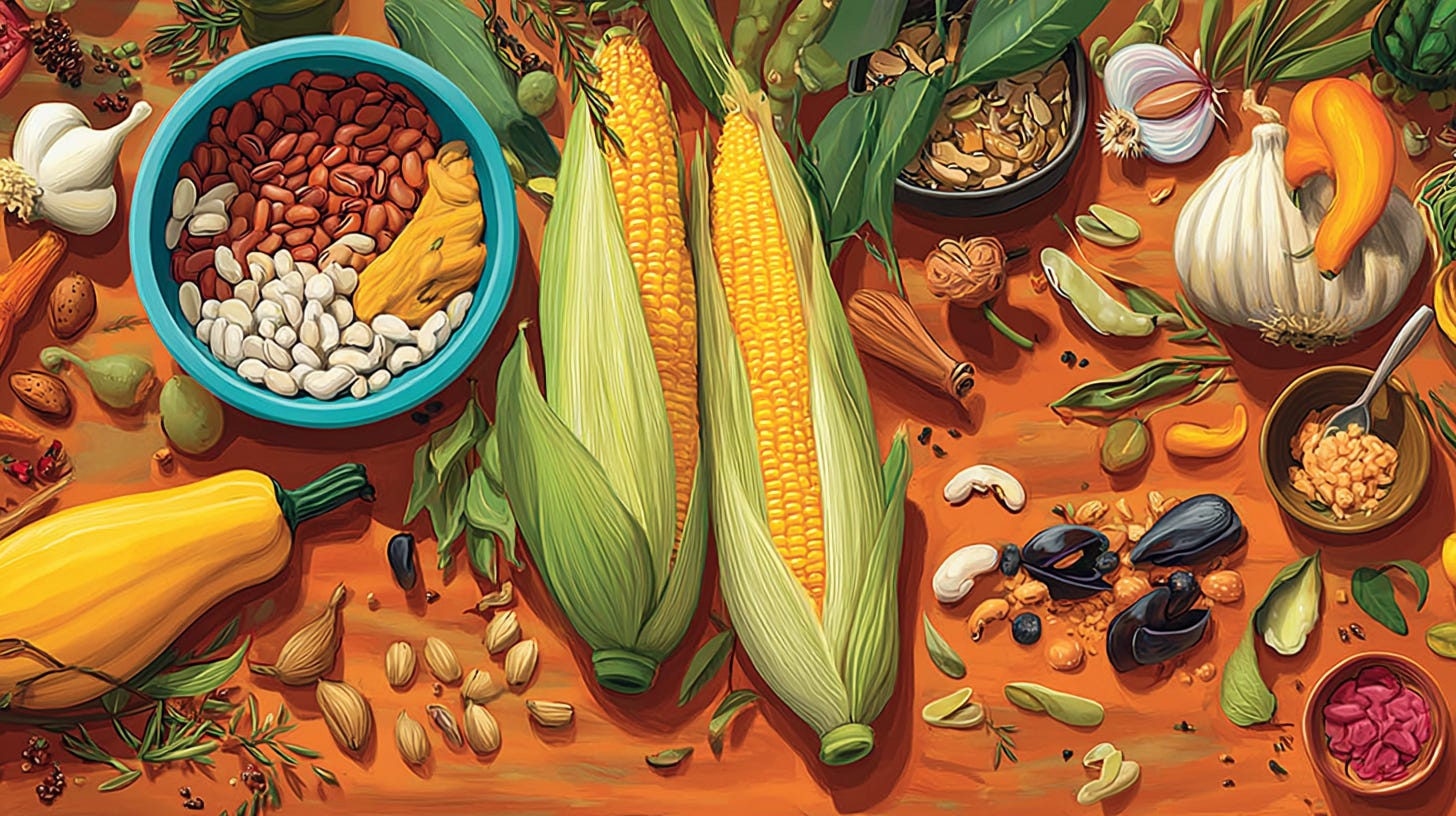
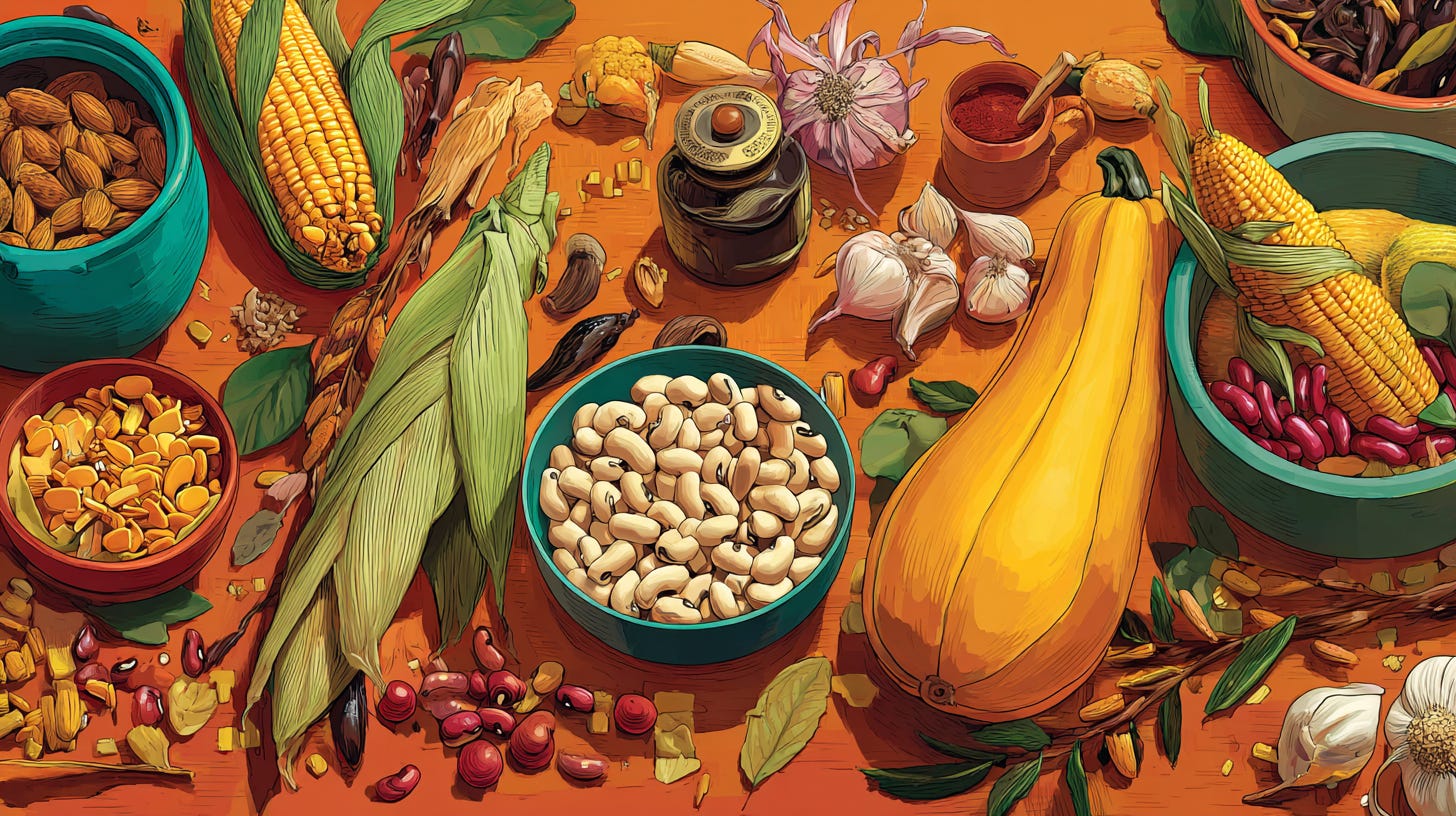
The Wampanoag practiced what modern farmers now market as “regenerative agriculture”—which was just their default approach to growing food. Their most well-known technique was the Three Sisters: corn, beans, and squash planted together in raised mounds.
The system was elegant. Corn depletes soil nutrients rapidly. Beans pull nitrogen from the air and convert it into a form plants can use—they were the fertilizer. Corn stalks provided scaffolding for bean vines. Squash spread across the ground, creating living mulch that suppressed weeds and deterred pests. A closed loop that generated its own fertility, structure, and pest management. Nutritionally complete too: corn provided carbohydrates, beans provided the lysine corn lacks, and squash delivered vitamins.
Food that was good for people and planet by default—a promise modern food brands spend billions trying to reverse-engineer.
Vacuum Domicilium
The English brought a completely different philosophy. Their worldview drew from Genesis: humans were commanded to subdue the earth and exercise dominion over it. John Locke provided the intellectual framework–land in its natural state was essentially waste, and property rights only emerged when someone mixed labor with the soil through improvement. But improvement had an extraordinarily narrow definition: permanent fields, fences, livestock, plowed rows.
The Wampanoag were absolutely growing food. They had been for millennia. They managed forests through controlled burns, built fish weirs and clam gardens, moved seasonally between planting grounds and fishing sites. Sophisticated, sustainable, highly productive.
But because it didn’t look like an English farm, the colonists declared it wasn’t agriculture at all. Their legal doctrine held that land without European-style permanent settlement was unoccupied and therefore available for claiming.
This is how food systems became instruments of dispossession: by refusing to recognize Indigenous agriculture as legitimate, colonists gave themselves legal “permission” to take land clearly being used to grow food.
Ironically, the regenerative agriculture movement is now trying to rebuild what this worldview dismantled, but once again, we have to ask who’s doing the real work versus who’s just discovered a new language for old extraction.
What Was Actually on the Table
So what did they actually eat in 1621? The Wampanoag brought five freshly killed deer—venison was the true centerpiece. The rest was wildfowl: ducks, geese, likely passenger pigeons—birds once so abundant they darkened the sky, now extinct. Seafood: eels and shellfish. Corn served as porridge called nasamp, not on the cob.
No turkey (probably). No cranberry sauce—the settlers had no sugar. No mashed potatoes—those Andean tubers hadn’t made their way back across the Atlantic yet. No pumpkin pie.
The menu didn’t just drift over four centuries. It was rewritten as radically as the history was, replacing a complex reality with industrial comfort foods. Which raises the question: how did we get from venison and eels to the meal you’ll probably eat this Thursday?
That transformation required work. It required someone to actively construct a national mythology and market it relentlessly. Enter Sarah Josepha Hale.
Manufacturing Tradition
For seventeen years, Sarah Josepha Hale wrote letters—to governors, congressmen, presidents. The most influential women’s magazine editor of her era (and, improbably, the author of “Mary Had a Little Lamb”), Hale published editorials arguing that a national Thanksgiving would heal sectional divisions. She was America’s O.G. food influencer.
She petitioned five consecutive presidents to establish a national Thanksgiving. Zachary Taylor ignored her. Millard Fillmore ignored her. Franklin Pierce and James Buchanan ignored her. In 1863, with the country tearing itself apart in civil war, Lincoln finally listened. Five days after receiving her letter, he proclaimed the last Thursday in November as a national day of thanksgiving.
But Lincoln’s proclamation mentioned no Pilgrims, no Indians. It was purely a wartime unification gesture. The mythology came later—and Hale had laid the groundwork for that too. Her 1827 novel Northwood had already described an idealized New England Thanksgiving table, complete with roasted turkey at its center. She spent nearly four decades shaping what Americans imagined when they thought of the holiday.
The “Pilgrims and Indians” narrative developed later, driven by anxieties about immigration. As millions of Southern and Eastern European immigrants arrived in the late 1800s and early 1900s, elements of the Protestant establishment sought a founding myth emphasizing Anglo-Saxon identity. The Pilgrim story provided it: pious settlers “welcomed” by helpful Natives, a peaceful transfer of territory over a shared meal. Colonization as consensual and harmonious. The Vanishing Indian trope taught children that Native peoples had simply faded away, rather than being systematically displaced.
The turkey became the centerpiece for entirely practical reasons. By the mid-1800s, venison had become scarce from overhunting. But turkeys were easy to raise domestically—no hunting skills or vast forests required.
The bird also had symbolic appeal. Benjamin Franklin had praised the turkey as “a true original Native” of America, creating a convenient mythological link. And the National Turkey Federation, formed in 1940, knew how to build on it—presenting Truman with a live bird in 1947, launching decades of parade balloons, cartoon pilgrims in buckled hats, and annual presidential pardons. Today it’s a four-billion-dollar industry.
Reclaiming Indigenous Foodways
Since 1970, the United American Indians of New England have gathered at Plymouth on Thanksgiving Day for a National Day of Mourning. It started when Wampanoag leader Frank “Wamsutta” James was censored for detailing the fuller history of disease, slavery, and land displacement. His suppressed words: “The Pilgrims had hardly explored the shores before they had robbed the graves of my ancestors and stolen their corn and beans.”
Today’s Indigenous food sovereignty movement goes further. Chef Sean Sherman reclaims pre-colonial foodways by removing colonial ingredients—no wheat, dairy, sugar, beef, or pork. His restaurant Owamni in Minneapolis serves cedar-braised bison and wojapi, earning a James Beard Award and proving Indigenous cuisine isn’t historical curiosity—it’s vibrant and contemporary. Nephi Craig runs Café Gozhóó in Arizona. Crystal Wahpepah operates Wahpepah’s Kitchen in Oakland. Elena Terry founded Wild Bearies, a nonprofit that brings ancestral foods to communities. And there are many more.
These chefs are demonstrating that Indigenous food systems are not just viable, but vital—offering a blueprint for sustainability and deliciousness that predates and outperforms industrial agriculture.
The Thanksgiving We Inherited (and Can Redefine)
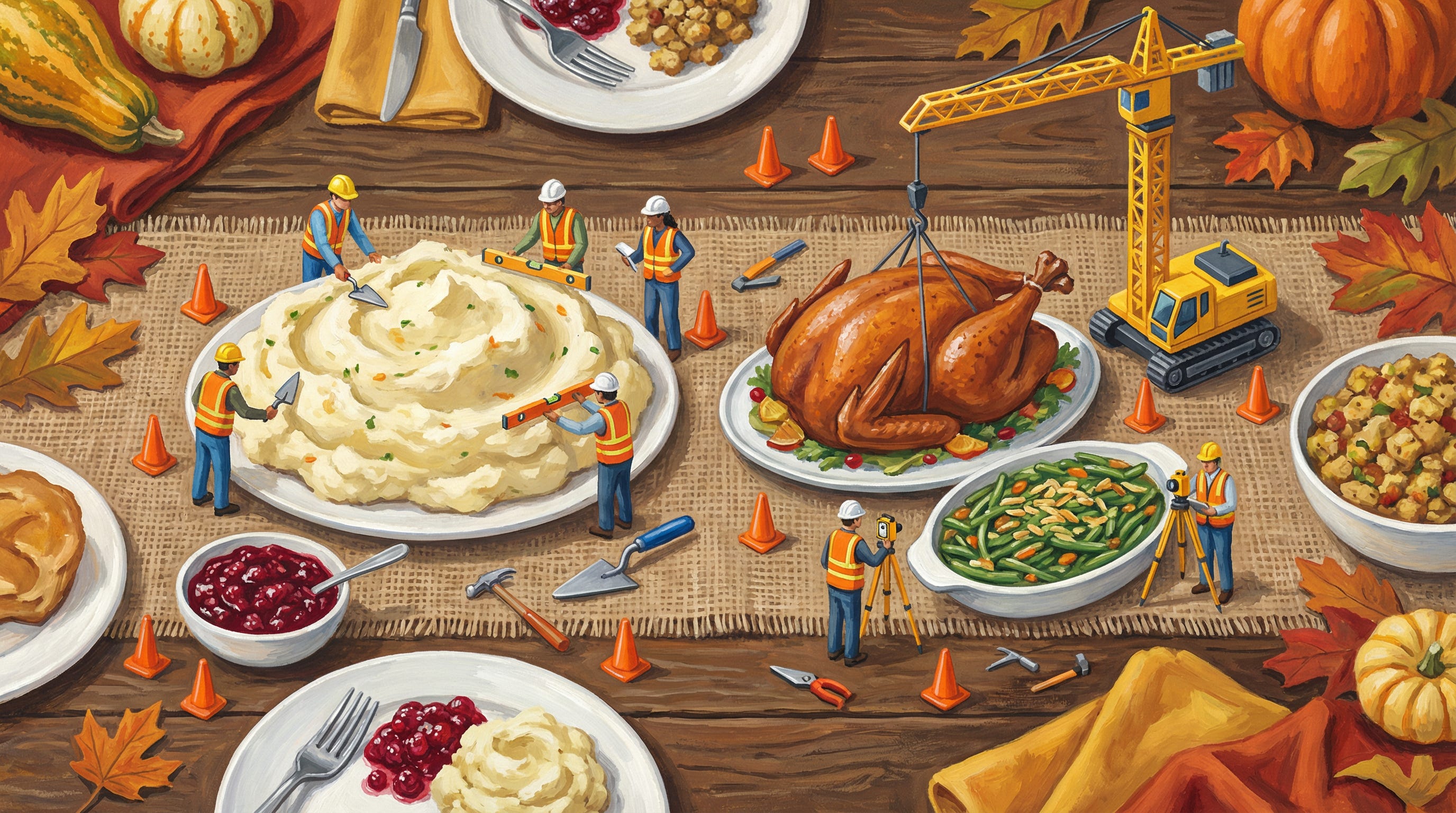
This Thursday, millions of Americans will gather around tables laden with turkey and mashed potatoes. The holiday serves real purposes: it brings families together, marks the season’s turn, gives us space for gratitude in an increasingly frantic world.
For others, it marks dispossession, violence, the ongoing erasure of Indigenous peoples. Both truths exist simultaneously. We can acknowledge that this meal is a construction—a hybrid cuisine born of colonial necessity, industrialized by twentieth-century capitalism, shaped by nationalist narratives.
The evidence is on every plate. The turkey industry made turkey the centerpiece. Stuffing came from England, not Plymouth. Mashed potatoes traveled from the Andes through European kitchens. Cranberry sauce is a 1940s commercial invention. Green bean casserole was invented by Campbell’s in 1955.
The modern Thanksgiving table is a complete fabrication. Which sounds sacrilegious until you realize that’s true of everything we’ve inherited and called tradition. Every tradition is invented; what matters is whether we’re honest about the invention. Those unharmed by its history tend to prefer the versions that don’t complicate the celebration.
We have to hold two truths simultaneously: industrial agriculture feeds us through decades of subsidy and lobbying, while Indigenous foodways hold the knowledge of soil health and resilience we displaced. It is uncomfortable to recognize that colonial systems created both abundance and erasure. But maybe that discomfort is where the work begins. This shit is really complicated. That’s not a reason to stop.
If the Thanksgiving we know was invented, it can be reinvented. It doesn’t have to be a choice between comfortable myth and paralyzing shame. This Thursday, you’ll probably still eat turkey, because that’s what we’ve been told to do. But maybe it’ll taste different. Maybe you’ll look at the table differently. Maybe you’ll let gratitude coexist with acknowledgment.
The Wampanoag are still here—still farming, still cooking, still defining their own foodways. The table can be a starting point not for revisiting the myth, but for advancing toward something more honest.
Sent from the ancestral lands of the Anishinaabe and Wyandot.
—
My Book - Mise: On the Future of Food
My Podcast - The Tomorrow Today Show
My Instagram - The Book of Mise
My Other Instagram - Mike Lee
My Consultancy - Mise Futures