


The New York Times published a great visual essay last week tracing how America got hooked on ultraprocessed food. Alice Callahan walks through the history—from Coca-Cola in 1886 to today, where 73% of the U.S. food supply is ultraprocessed.
There’s one part in the essay that called attention to a point in history I can’t stop thinking about:
“During World War II, shelf-stable foods like powdered cheeses, dehydrated potatoes, canned meats and melt-resistant chocolate bars were developed to feed soldiers.”
Then:
“After the war, food companies realized that they could adapt this foxhole cuisine into profitable convenience foods for the masses.”
Wartime food production didn’t just end when the war ended. It got rebranded. The same foods engineered to survive months in tropical humidity, desert heat, and Arctic cold—foods designed for soldiers in foxholes—became the blueprint for what Americans would eat at home for the next 80 years and counting.
What makes this transformation remarkable is that it wasn’t entirely about what consumers wanted per se. Most civilians weren’t clamoring for shelf-stable, dehydrated, artificially preserved foods when rationing ended. They wanted good food again.
But food companies had just spent years building massive infrastructure to produce military rations, and that infrastructure couldn’t sit idle. The economics of capital expenditure—the fact that factories and equipment are expensive and need to run constantly to justify their cost—meant these companies had to find civilian markets for whatever they could produce.
It’s a tragic irony: the same system that fed victory also fed the chronic diseases associated with the Standard American Diet.
When Military Demand Created Ultraprocessed Food
Between 1941 and 1945, American food companies transformed to meet military demand. The military needed foods that could survive conditions no civilian product had to endure: months in tropical humidity, desert heat exceeding 120°F, rough handling during airdrops, extended storage without refrigeration.
The incentives were extraordinary. The government guaranteed demand at profitable prices. Financial risk essentially disappeared. Companies rushed to capture these contracts.
Hormel SPAM became legendary in military rations—by 1945, Hormel was selling 65% of its output to the military, shipping up to 15 million cans weekly overseas. I was raised on and still love SPAM, a sentiment shared by millions today, especially in Asian-American, Southeast Asian, and Pacific Islander communities. So I can personally attest to the cultural power a food made out of wartime necessity can hold.
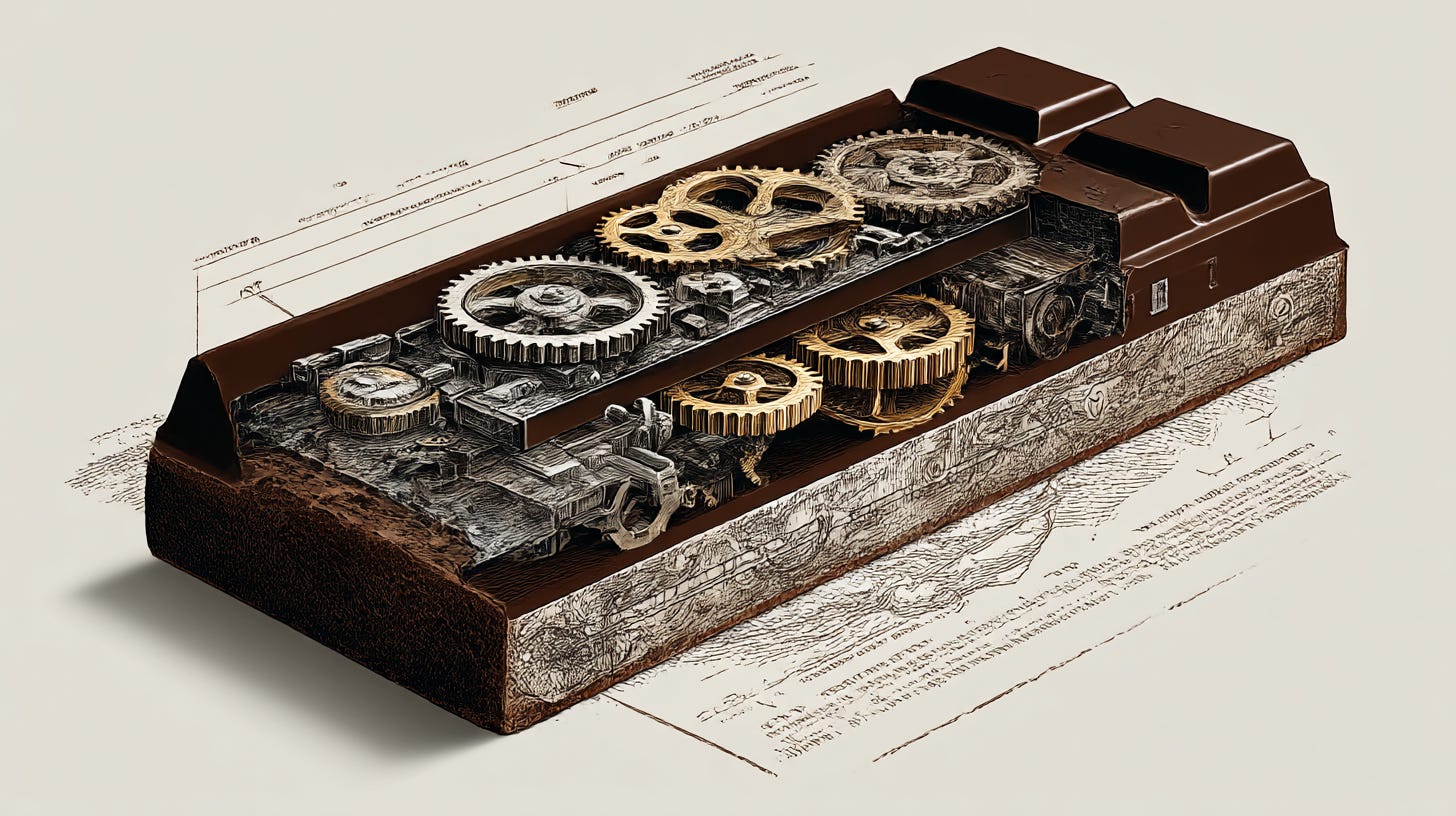
On the sweet side, Hershey developed the D-ration chocolate bar under contract with the Army, whose requirements were: a 4-ounce bar that could withstand 120°F without melting, provide concentrated emergency calories, and taste “just a little better than a boiled potato” (best food brand tagline ever) so soldiers wouldn’t eat them unnecessarily.
Just pause and reflect on the fact that somewhere in America, someone’s favorite chocolate bar was purposefully designed to taste “just a little better than a boiled potato.” Our tastebuds have been gaslit.
Meanwhile, Hershey’s archrival, Mars, developed M&Ms specifically for military use. M&Ms were created to survive in soldiers’ pockets during combat without melting. Mars even secured a patent for the technology in 1941.
The US Army funded research into cheese powder, dehydrated eggs, concentrated orange juice, and shelf-stable vegetables. These weren’t refinements of existing products. They were fundamental innovations in food science driven by military requirements. Companies developed expertise in canning, dehydration, spray-drying, freeze-drying, and chemical preservation.
The military paid for much of the research and development. Those guaranteed-profit contracts meant companies could invest heavily without normal business risk.
Then the war ended.
The Infrastructure That Couldn’t Stop
By August 1945, companies found themselves with extraordinary capabilities and no military contracts. They had factories tooled for ultraprocessing. They had mastered technologies that didn’t exist before the war. They had equipment and expertise representing millions in investment.
Food processing facilities are expensive. You don’t build a factory, install industrial equipment, and develop proprietary processes just to let them sit idle. Those capital expenditures need to generate returns. Maximum capacity becomes essential—the only way to make the economics work is to keep the machines running constantly.
What do you do when you’ve invested millions in ultraprocessing capacity designed for military rations? You use it. But most civilians in 1945 didn’t want shelf-stable, lightweight foods designed to survive jungle humidity. Rationing was ending. People wanted fresh food again.
Few Americans were asking for dehydrated mashed potatoes, but they got them anyway—along with a new gospel of convenience.
Here’s the catch: companies didn’t just impose ultraprocessed foods on Americans. They sold them the idea of modern life—clean, fast, futuristic eating after years of deprivation. Some returning soldiers had developed tastes for these foods. Many American housewives, who had worked in factories during the war, wanted time-saving options. For millions of families, convenience food was liberation from hours in the kitchen. This was “The Future of Food” for everyone then. The tragedy is how quickly liberation turned into dependence.
The pivot from ration kits to dinner plates happened quietly. Frito bought surplus military cheese powder in 1948 and coated puffed cornmeal with it—Cheetos were born from military surplus. Swanson launched the TV Dinner in 1953, projected modest sales, and sold 10 million in the first year. Minute Maid took frozen orange juice concentrate—developed under military contract—and created an entirely new consumer category in 1946. M&Ms went from exclusive military rations to general public availability in 1947.
When All You Have is a Hammer
There’s an old saying: when all you have is a hammer, everything looks like a nail. If you’ve invested millions in a hammer factory, you’re going to find reasons to keep hammering, whether or not hammering is the right solution.
For the food industry, the “hammer” is the stainless-steel vats, spray-dryers, extrusion lines, and massive production facilities optimized for shelf-stable, ultraprocessed foods. Once that infrastructure exists, it shapes everything: which products get made, which innovations get funded, which health claims get marketed.
Here’s the thing: Big Food executives aren’t oblivious. They know their legacy products aren’t winning with health-conscious consumers. They read the same research showing UPF consumption linked to cardiovascular mortality, obesity, depression, and diabetes. They watch organic food sales grow.
That’s why they’ve spent the last decade acquiring “better-for-you” brands—kombucha companies, organic snack makers, plant-based startups. It’s a way to place a side bet on growing categories while keeping their legacy production lines running at full capacity. But the legacy products—Coca-Cola Classic, Doritos, Kraft Mac & Cheese—are what pay the bills and keep shareholders happy. These products generate the profit margins that fund everything else. They’re made in facilities that are already paid for, using supply chains optimized over decades, with brand equity built over generations.
Which means Big Food can’t just blow up all the legacy factories and start making salads overnight. The economics wouldn’t make sense—the margins and volumes of better-for-you products are different from the legacy economics that shareholders have been conditioned to expect.
And those shareholders? They’re not all villains plotting to make Americans sick. A lot of them are just regular people whose retirement accounts probably contain index funds that proabably contain these Big Food company stocks. When they check their 401(k) balance, they don’t see an imperative to fix the food system—they see whether they can retire on time. Unfortunately, what’s good for someone’s retirement savings is not necessarily good for human or planetary health.
So you end up with the food innovator’s dilemma in full effect. Coca-Cola still has billions worth of soda bottling capacity. PepsiCo still has Frito-Lay plants optimized for extruded snacks. Kraft Heinz still has facilities tooled for shelf-stable processed foods. Those facilities need to run to generate returns, which creates a convenient alignment: the industry is probably not upset that the scientific debate about ultraprocessed foods is unsettled.
Because the nutrition community hasn’t reached universal consensus on whether ultraprocessed foods are harmful. Industry lobbying groups argue there’s no clear definition of what even counts as “ultraprocessed.” Big Food needs this debate to continue because you can’t regulate something you can’t define.
But the details miss a bigger structural point: regardless of what the nutrition community ultimately concludes, a massive portion of our food system is dedicated to making ultraprocessed foods because that’s the infrastructure we built. And there’s a lot of people working at, investing in, and partnering with the companies who are pot committed to that infrastructure.
The Structures We’re Building Today
The story of ultraprocessed food isn’t just about chemistry or marketing. Infrastructure plays an outsized role that often goes unexamined as people gravitate toward sexier topics like a snack’s “bliss point.” As is so often the case, it’s the boring plumbing of a thing that’s the most important part of that thing. Once you build something massive, expensive, and efficient, it develops its own gravitational pull. It must be used.
This pattern isn’t unique to food. The Bretton Woods financial system, the military-industrial complex, the interstate highway network—wartime and post-war infrastructure decisions still shape American life 80 years later. But because food is so intimate to us, it offers the clearest lens into how this works.
So what are we building right now that will define the next 80 years?
We’re not just locked into old infrastructure—we’re actively expanding it. Frito-Lay completed a $235 million expansion of its Connecticut snack plant in 2024, adding new Cheetos production lines. The company also spent $200 million expanding its largest Texas facility. Across the country, billions are invested annually in scaling up the infrastructure of industrial agriculture—new processing facilities, expanded feedlots, additional distribution centers, and more acreage dedicated to commodity crops.
And then there are the emerging food tech ventures that want to become the next lock-in. Precision fermentation tanks, cultivated-meat bioreactors, vertical farms, gene-editing platforms. The modern food industry is investing in highly specialized systems that promise sustainability and efficiency. But these technologies are still speculative, operating at a fraction of the scale that defined WWII food production. Unlike shelf-stable rations that met immediate, massive demands of a global war, nobody urgently needs lab-grown meat or indoor lettuce today.
Yet now is exactly when we should be paying most attention to these emerging technologies—so we can shape them into something we wouldn’t mind being married to for the next 80 years, lest they succeed. These systems are being built now, and they’re still flexible enough to change direction. But if we don’t speak up until these food tech innovations are fully baked and scaled up, the gravitational pull of their infrastructure will make meaningful change hard. This is where we are today with ultraprocessed foods.
The lesson from 1945 is clear: once food production infrastructure locks in, culture is groomed to create demand, which locks the infrastructure further in, which requires more demand, and so on. The same engine that kept SPAM and cheese powder profitable long after rationing ended now keeps sugary soda brands and junk food factories humming despite everything we know about their consequences.
Somewhere in America right now, a soldier’s great-grandchild is having a treat that exists because her great-grandfather wanted chocolate candy that wouldn’t melt in the swelteringly hot Pacific theater of war. But she just knows it as the chocolate candy where The Milk Chocolate Melts In Your Mouth–Not In Your HandTM.
The war ended 80 years ago, but the machinery never stopped running.
And somewhere else, new facilities are being built right now—processing soybeans, fermenting proteins, optimizing supply chains—that will determine what her great-grandchildren eat. History suggests we may never learn to stop the machinery once it starts.
—
More to process…
My Book - Mise: On the Future of Food
My Podcast - The Tomorrow Today Show
My Instagram - The Book of Mise
My Other Instagram - Mike Lee
My Consultancy - Mise Futures
Good article, thanks. You briefly make the point that people’s investments influence the need to use existing investment. Which takes us back to the basic problem of the growth model…people want more money just because they have money. They don’t have time to investigate the impacts of how their money makes money (and even ‘ethical’ funds are not without negative impact). We have few examples of how to escape our impossible perpetual growth machine…how is it possible to make wise choices re future food infrastructure when the wisest choice is minimal processing but that doesn’t make any new money?