


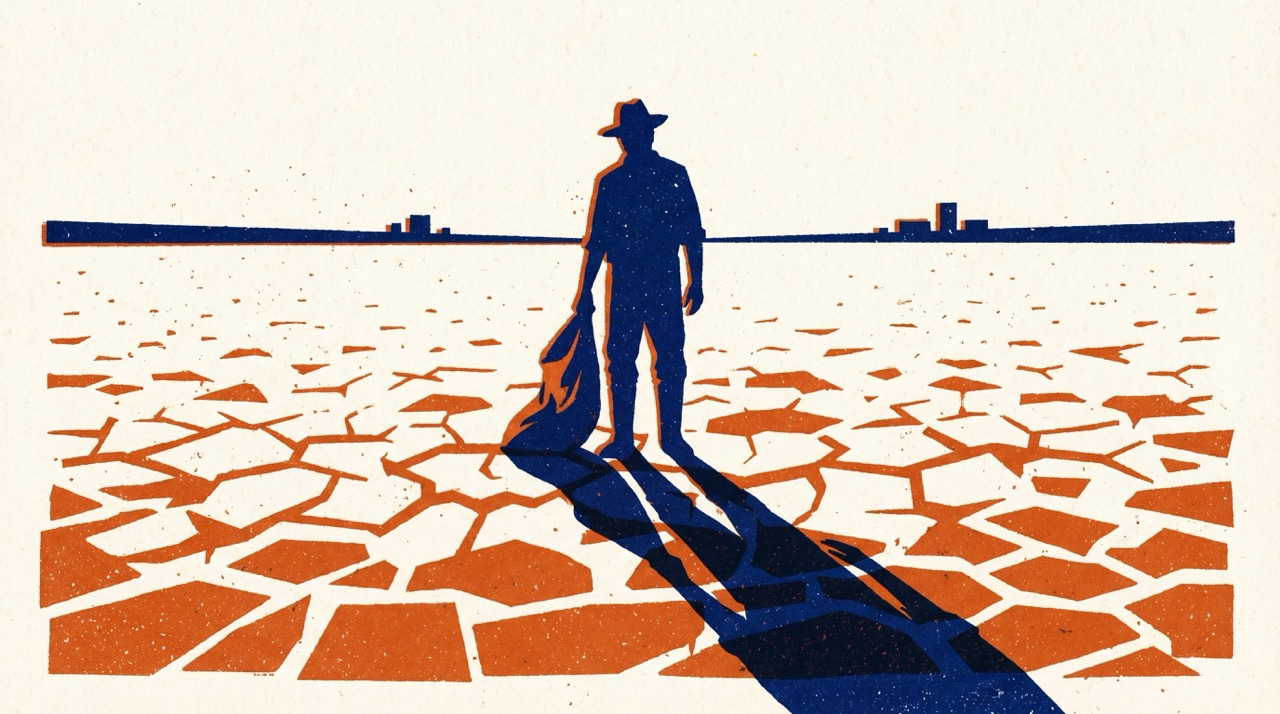
You’ve probably been hearing about the Strait of Hormuz for weeks now. It’s 21 miles wide. A fifth of the world’s oil passes through it, a fifth of its liquefied natural gas, and roughly a third of its seaborne fertilizer.
Since the U.S. and Israel launched strikes on Iran on February 28, it has been functionally closed. Peace talks in Islamabad collapsed over the weekend. On Sunday, President Trump announced that the U.S. Navy will blockade any ship trying to enter or leave the strait. As of yesterday morning, that blockade is in effect. The country that started the war is now blockading the waterway it went to war over, while Iran keeps shutting it from the inside.
Americans are watching the oil price, because that’s the number they can see from the highway. Fertilizer is the crisis they’re missing. The crops that feed the animals that become the protein on your dinner plate are grown with synthetic nitrogen, and roughly half of the world’s supply is made inside Gulf chemical plants using Gulf natural gas, then shipped through Hormuz. Losing that volume is the difference between farmers planting on schedule and farmers rationing what they managed to buy ahead.
In Iowa and Illinois, the planting window is the hard constraint. Nitrogen has to be in the soil before the seed goes in, and corn planted late or without enough nitrogen produces 20 to 40 percent less grain, a loss that cannot be made up later in the season. About 80 percent of American farmers locked in their fertilizer purchases last fall, before the war. The other 20 percent are buying nitrogen fertilizer at nearly double what it cost in January.
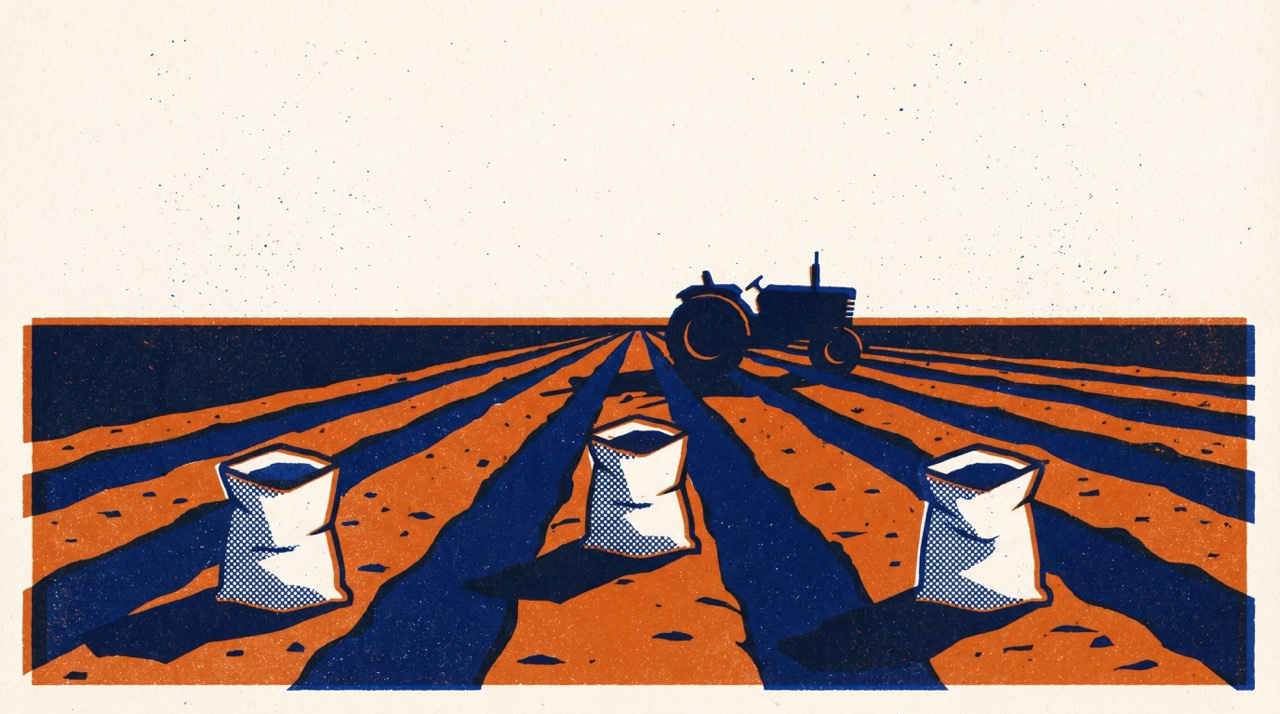
Farmers who spent the winter planning for corn are switching to soybeans, because soybeans fix their own nitrogen and don’t need the fertilizer nobody can get. It’s a forced bet that soybean demand holds through a season when the whole Midwest is making the same bet. In Punjab and the Rift Valley, the options are fewer. The International Rescue Committee warns of a sharp rise in hunger by June across South Asia and sub-Saharan Africa. Nearly 320 million people worldwide are already acutely food insecure, and many of them eat calories grown by farmers who will not see a full bag of nitrogen this season.
We have been building our most critical systems around single points of failure since the 1980s. Hormuz happens to be the one in the headlines this month, but there are other Straits of Hormuz, metaphorically speaking. The same pattern of concentration runs through the food system, the semiconductor industry, the global pharmaceutical supply chain, and much of modern life. We are only starting to feel what it costs.
The Flaw is Concentration
Raj Patel, a food systems researcher at the University of Texas, said in a recent interview: “At some point, the pattern should tell us something about the system itself, not just the latest geopolitical trigger.” COVID broke fertilizer supply chains in 2021. Russia’s invasion of Ukraine choked fertilizer exports the following year. Iran has closed Hormuz this winter. Three shocks in five years, each with a different trigger, and no structural fix after any of them, because each time the conversation stayed on the trigger and left the flaw alone.
The flaw is concentration. And in the case of fertilizer, the cost chain from farm to grocery store is short. When nitrogen gets expensive, corn gets expensive. Most American corn is animal feed, so feed gets expensive. Feed costs flow into meat, dairy, and eggs, and from there into almost everything in the middle of a supermarket. The same Congress that watched this shock coming cut SNAP funding earlier this year, so the families least equipped to absorb it are absorbing it with the thinnest safety net in a generation.
The concentration runs far beyond fertilizer. Four companies (Tyson, JBS, Cargill, and National Beef) process over 80% of American beef. A few COVID-era plant closures in 2020 threw the national meat supply into chaos. The Biden administration later spent a billion dollars trying to stand up independent processing capacity. The industry today is as consolidated as it was then.
ADM, Bunge, Cargill, and Louis Dreyfus control 90% of the American grain trade. The grain that feeds most of the country’s livestock and a good share of its export market passes through those four companies’ infrastructure. When one of them has a plant closure or a logistics failure, the bottleneck isn’t theoretical.
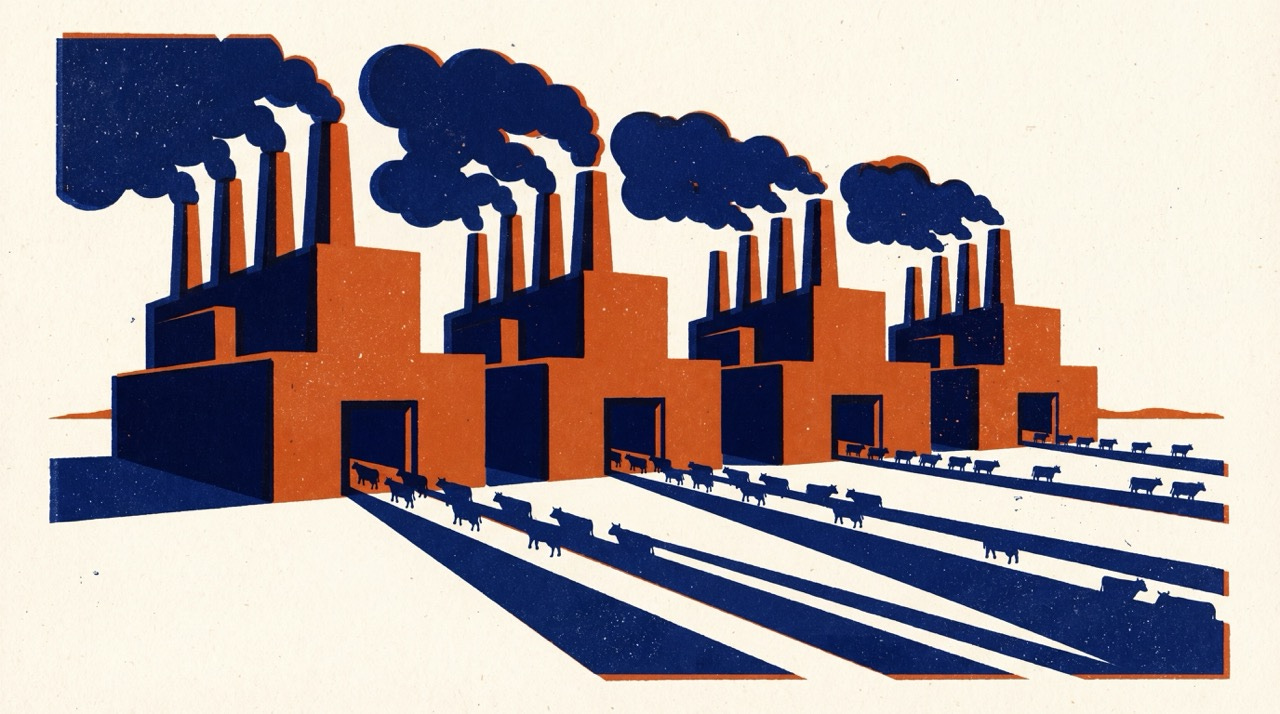
The same logic of scale has moved from commodities onto the grocery shelf. Ten parent corporations produce most of what fills a typical American grocery cart, from bottled water to frozen dinners. A shopper choosing between brands is usually choosing between subsidiaries. The food system looks diverse at the point of purchase. It isn’t.
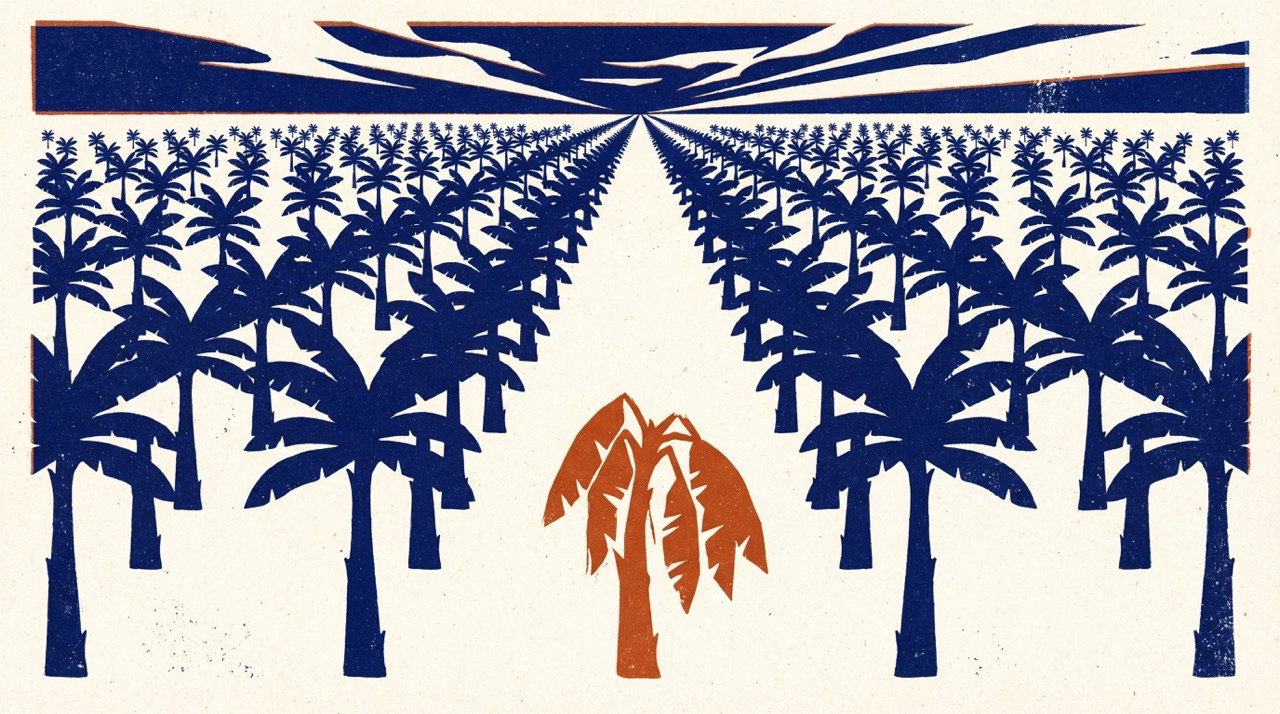
The fragility goes deeper than corporate structure. Over the past century, roughly 75 percent of the world’s plant genetic diversity has been lost as farming consolidated around high-yielding, genetically uniform cultivars. The Cavendish banana, a single cultivar, accounts for nearly half of global banana production, and a fungal disease called Tropical Race 4 is moving through plantations with no commercial-scale replacement in sight. Four varieties of wheat produce 75 percent of the crop on the Canadian prairies. Seventy-two percent of American potato production depends on four varieties. Almost every coffee tree in Brazil descends from six plants brought from a single location in Asia.
Morocco holds roughly 70 percent of the world’s phosphate reserves, one of three nutrients every crop requires, controlled by a single state-owned company. Last year’s drought dropped Panama Canal water levels low enough to restrict grain shipments from the entire American Midwest. A disease, a drought, a political decision in the wrong place, and a system built without redundancy breaks the same way every time.
Modern life runs on advanced semiconductors: the processors in your phone, your car’s braking system, the card reader at the grocery checkout, the imaging machines in hospitals. Over 90% of them come from one company, TSMC, on one island, Taiwan. TSMC itself depends on ASML, a single Dutch firm that is the only manufacturer on earth of the machines that make those processors.
If a blockade of Taiwan or a fire at ASML’s facility in the Netherlands shut down production for a year, you would not be able to buy a new car, replace a broken phone, or get certain medical imaging done, and the wait times for appliances and electronics would stretch into months. The cause would be different from a fertilizer shortage. The structure would be identical: one chokepoint, no backup, global consequences.
Patel, writing about food, put it this way: “These companies are optimized for global logistics and profit margins, not for national resilience.” He was talking about grain traders. He could have been talking about any of them. The logic is the same in every case: find the cheapest source of something critical, build the system around it, strip out the redundancy because redundancy costs money, and then, when it breaks, act as if no one could have seen it coming. We could see it coming. We have been watching it come for years.
New Fuel, Same Trap
Oil keeps putting us in wars. In this one, thousands of Iranian civilians are dead, and the president of the United States has threatened on national television to wipe out an entire civilization if its government doesn’t surrender. That is what oil dependency costs. Not in theory, not eventually. Right now, this month, in the Persian Gulf.
This has been obvious since the first Gulf War. Clean energy got framed first as an aspiration, then a burden, then a culture war, and the Trump administration is now actively rolling back the tax credits and permitting reforms that were supposed to accelerate the transition. We are choosing to stay dependent. And every extra year on oil is another year where a president has to stand at a podium and bullshit the world on why a shipping lane is worth killing people over.
Even if the clean energy transition succeeds, it moves the chokepoint. It does not remove it. The transition is still worth doing. It would do enormous good for the climate, and we should pursue it as fast as we can. But we should pursue it with our eyes open.
Solar panels, batteries, and electric vehicles require cobalt, nickel, lithium, and rare earth elements. The Democratic Republic of the Congo produces about 70% of the world’s cobalt, processed almost entirely in China. Indonesia controls half the world’s nickel. Chile, Argentina, and Bolivia sit on more than half of the planet’s known lithium. China refines nearly all of the world’s rare earth elements and manufactures most of its solar panels and batteries.
These minerals would be our new oil, and they are just as concentrated in just as few places. The fuel changes. The geography does not. If we build the clean energy economy the same way we built the oil economy, with the same concentration, the same lack of redundancy, the same dependence on a handful of foreign sources, we will end up fighting the same wars in different places.
In a world that runs on clean energy, a future US president might not be worried about the Persian Gulf at all. They might be staring at a cobalt crisis out of the Congo or a lithium dispute that freezes battery manufacturing. And someone in that White House will start talking about securing access, protecting supply lines, and the risk of depending on a single foreign source for something the country cannot live without. We have heard that speech before. We are hearing it this week. In twenty years, we may be “delivering democracy” to the Congo for the same reasons we have been “delivering” it to the Middle East for the last forty.
You don’t feel fragility until something breaks. Before that, everything just looks cheap. Cheap groceries, cheap gas, cheap electronics. Nobody notices the strategic reserve that never got funded, the processing plant that got consolidated away, the soil no one bothered to rebuild. Those are just line items that someone cut because cutting them made that quarter’s earnings palatable to shareholders.
We built this. Cheap over resilient, every time, for decades. And when the cheap breaks, we go to war to get it back. War is where life becomes cheap. The farmer who can’t get nitrogen. The family downrange of a missile meant to secure a shipping lane. The hundreds of millions of people who will go hungry. We optimized for abundance and treated resilience as waste. The price was always going to come due. It is due now.
—
Mike Lee is a food futurist and innovation strategist, author of Mise: On the Future of Food, host of The Tomorrow Today Show podcast, creator of Mise Futures, and is on Instagram at The Book of Mise.
On the ‘clean energy transition’, it’s important to remember that it’s reliant on fossil fuels and increasing environmental damage because it’s AND not OR. We are using ever more energy and we know what the end of more is…