


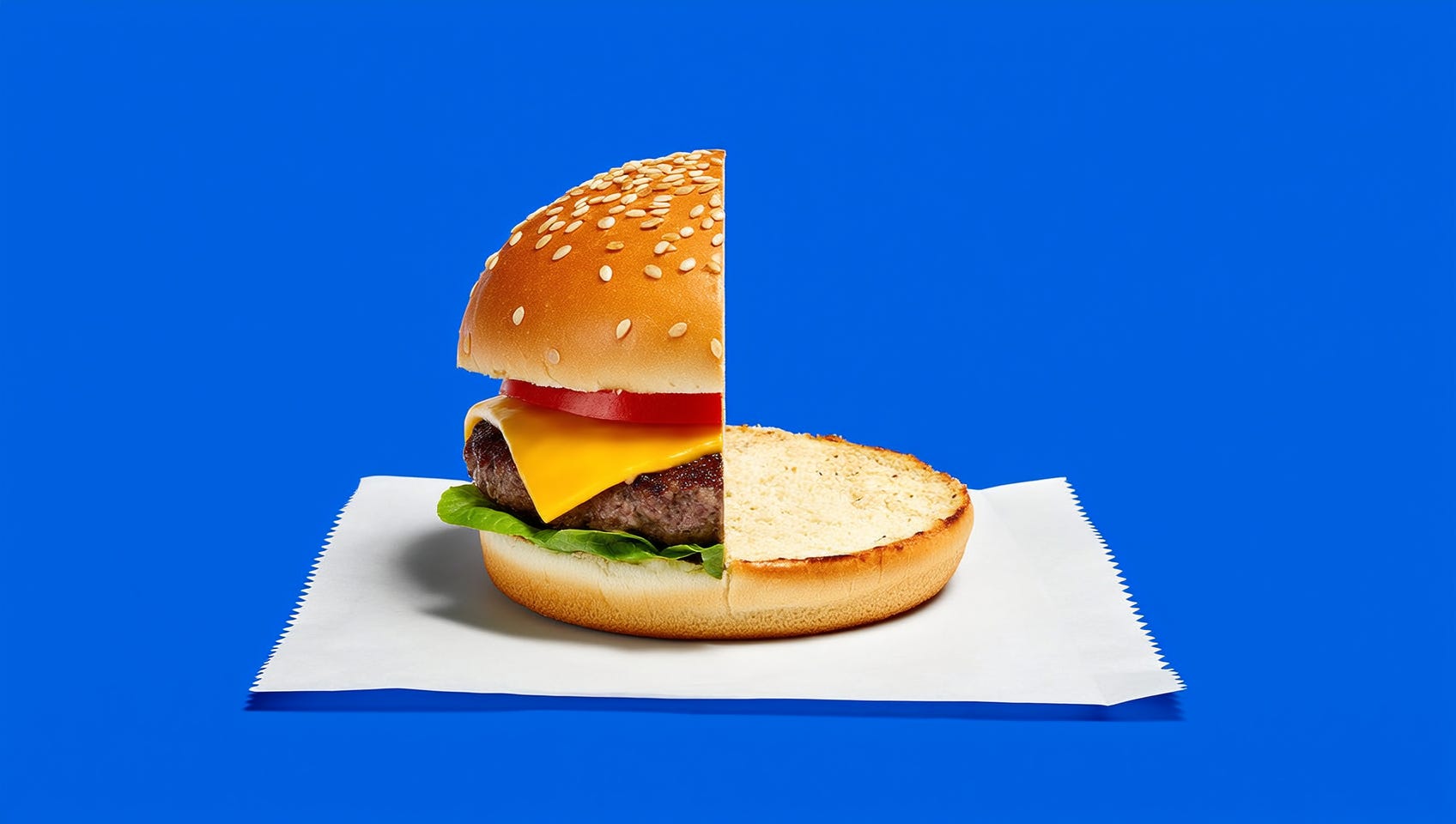
We designed our food system to do one thing: make food cheap and abundant. It succeeds spectacularly at this singular goal. What it doesn’t do is fully account for the externalities of that success: climate disruption, soil health degradation, biodiversity loss, mounting public health crises, and more—all things that make cheap food, actually quite expensive.
Now, as two out of five American adults struggle with obesity, our solution is another engineered fix. Specifically, GLP-1 receptor agonists—drugs so effective at suppressing appetite that they’re projected to become a $150 billion market by 2030.
GLP-1 medications are a mirror. They reflect the exact human tendencies that made them necessary: our faith in reductionist fixes, our willingness to treat symptoms instead of causes, our certainty that the next technological intervention will solve problems created by the last one. But ironically, these drugs might actually help solve some of the problems our food system created—just not in the way most expected.
Engineering the Problem, Then the Solution
Ultra-processed foods are engineered for maximum craveability at minimum cost. “Pre-digested” by industrial machinery so sugars and fats hit your bloodstream fast. They now account for more than half of American calories. Not because consumers are foolish or lazy, but because Big Food has made them irresistible and ubiquitous. This is not new news. But now people are starting to use GLP-1 drugs to chemically suppress those same cravings.
GLP-1 medications can reduce body weight by 15-25% on average after about a year for obese patients. Many patients describe them as quieting “food noise“—the constant, intrusive thoughts about eating. But that “noise” is just biological signals that our food system was deliberately designed to amplify. We created the noise and now we’re selling the earplugs.
30 million Americans—9% of the population—could be taking these drugs by 2030. As of mid-2024, one in eight adults has already tried one. We’re watching a pharmaceutical intervention scale to counteract a food system operating at the same scale.

Two Critical Uncertainties
The future impact of GLP-1s on food and agriculture will be shaped by several factors—among them, two particularly pivotal questions that remain unresolved.
The first critical uncertainty: Will GLP-1s achieve mass adoption or remain a limited intervention?
Mass adoption would require dramatic price reductions, broad insurance coverage expansion, and sustained public confidence in long-term safety. We’re talking about 20% or more of the population using these drugs regularly. This is the scenario Big Pharma is counting on and hoping for. Conversely, limited access would mean that GLP-1s remain expensive medications reserved primarily for severe cases, accessible mainly to the wealthy, which is more or less what we have today.
The second critical uncertainty: Can Big Food maintain revenues as their customers eat less, or do their sales just crater?
Maintaining revenues would require successful adaptation—engineering products that break through pharmaceutical appetite suppression, capturing new eating occasions, reformulating for “GLP-1 consumers” with higher-margin lower-volume products, pivoting their business models so premium pricing offsets volume losses. On the flip side, revenue collapse would mean the fundamental business simply breaks. When millions of people stop feeling hungry, no amount of reformulation or repositioning offsets the loss. Sales crater because the very physical mechanism the industry depends on—our food cravings—gets pharmaceutically neutralized.
These two uncertainties create four distinct possibilities. Mass adoption combined with successful industry adaptation produces one future. Mass adoption combined with revenue collapse produces another. Limited access paired with maintained revenues creates a third scenario. And limited access that somehow still triggers revenue collapse—through cultural and policy shifts rather than pharmaceutical suppression—produces a fourth.
Each combination generates a fundamentally different trajectory for food, agriculture, and public health. What follows are those four scenarios.
Scenario 1: The Premium Pivot
Mass adoption meets successful industry adaptation through premiumization
By 2032, GLP-1 medications have become as routine as blood pressure pills. Generic versions cost around $1 per dose. Medicare covers them. Roughly 25% of American adults take some form of appetite-regulating medication.
The food industry saw the demand shock coming and executed a strategic pivot that business schools will study for decades. The realization was simple but profound: if people eat 20% less food, sell them food that costs 40% more per unit. Volume is dead. Margin is king.
Nestlé led the charge with its “Vital Pursuit“ frozen food line——smaller portions of hyper-premium products engineered for maximum satisfaction in minimal bites. Single-serving formats at premium price points, protein-dense options formulated to feel indulgent on a suppressed appetite, products designed to deliver maximum flavor in minimal calories.
The bet is that margins on these products would far exceed what legacy products delivered. Other food companies followed suit, shuttering low-margin snack production lines and redirecting capital toward what they called “intensity-optimized nutrition.” The focus shifted from hitting bliss points that drive overconsumption to creating flavor explosions that satisfy in small doses.
The strategy worked. Revenue took an initial hit, but recovered within eighteen months as premium pricing offset volume losses. Wall Street rewarded the transformation. Food company stocks soared on improved margins and reduced manufacturing overhead. The playbook spread across the industry: Don’t fight the appetite suppression—monetize it. Don’t mourn the lost volume—extract the margin.
Agriculture adapted to feed this new model. Demand for commodity corn and soy softened, but demand for premium ingredients—heirloom grains, grass-fed proteins, nutrient-dense vegetables—surged. Some farmland transitioned to regenerative practices—not from environmental conviction, but because premium positioning finally made the economics work.
The environmental implications were significant, if unevenly distributed. Aggregate food production declined by roughly 18% as consumption dropped. This translated to measurably less land under cultivation, reduced water usage, and lower agricultural emissions. Industrial monoculture acreage contracted while regenerative systems expanded—not because of consumer demand for sustainability, but because the economics of premium ingredients finally justified the investment.
The environmental benefits were real, but they accrued primarily to regions serving affluent markets. Meanwhile, consolidated industrial operations serving low-income populations maintained their extractive practices at reduced but still significant scale.
But this transformation had clear winners and losers. The premium strategy required affluent consumers who could afford both the drugs and the expensive food. Low-income communities got left behind, still eating ultra-processed foods but now in a market with fewer options and higher prices as companies abandoned the low-margin mass market. The drugs were covered by insurance, but the food ecosystem built around them wasn’t accessible to everyone who needed it.
This scenario reveals how capitalism adapts: not by changing the game, but by changing the margins. Big Food discovered that pharmaceutical appetite suppression wasn’t a threat—it was an opportunity to exit the race to the bottom and build a high-margin business serving a chemically-altered consumer base. They maintained revenues not by selling more food, but by selling fundamentally different food at fundamentally different prices.

Scenario 2: The Demand Shock
Mass adoption triggers industry crisis as Big Food cannot prevent revenue collapse
By 2033, GLP-1s are everywhere. The drugs are cheap. Insurance coverage is standard. Nearly 30% of adults are on them. And the food industry is in freefall.
The CPG giants threw everything at the problem. They reformulated products for smaller appetites. They launched “GLP-1 friendly” lines. They hired the best food scientists to engineer products that could break through pharmaceutical appetite suppression. They poured billions into marketing campaigns designed to create new consumption occasions. They lobbied Congress. They funded dubious research questioning the drugs’ safety.
None of it worked. When you chemically suppress the biological drive to eat, you can’t engineer your way around it. The fundamental premise of the ultra-processed food business—create irresistible products that people consume in large quantities—simply stopped functioning. People on GLP-1s took two bites of reformulated chips and walked away. Ordered sodas and left them half-finished. The drugs didn’t just reduce appetite—they totally altered the reward circuitry that the entire industry was built to exploit. Revenue collapsed because the business model itself became obsolete.
The numbers were devastating. Frito-Lay’s revenue dropped 35% in two years. Coca-Cola saw volumes crater across every category. Mondelez shuttered production facilities across the Midwest. Grocery chains reported that center-store sales—where packaged foods live—were down 40%. The snack aisle became a graveyard of underperforming SKUs. Major brands that had existed for seventy years simply disappeared.
Agriculture faced its own crisis. Farmers who’d planted thousands of acres of processing corn and potatoes for chips suddenly had no buyers. Commodity prices collapsed. Rural communities that depended on contracts with food manufacturers saw economic devastation ripple through. Equipment dealers, seed suppliers, processors—everyone in the supply chain took the hit.
The environmental picture was complicated. On one hand, reduced food production meant genuine ecological relief—less water consumption, fewer agricultural chemicals, lower emissions from food manufacturing and transport. Millions of acres of marginal farmland were abandoned, creating opportunities for ecosystem restoration. On the other hand, the chaotic transition created its own problems. Abandoned infrastructure. Contaminated former production sites. Rural communities lacking resources for managed retreat. The environmental benefits were real but came at severe social cost, and without intentional planning, the opportunity for genuine regeneration was often squandered.
Some companies managed to survive by pivoting hard toward whole foods and fresh preparation—essentially becoming different companies. Others went bankrupt. Private equity swooped in to buy distressed assets for pennies on the dollar. The industry that emerged on the other side was unrecognizable: smaller, regionalized, focused on actual nutrition rather than engineered palatability.
The transition was chaos. Food deserts expanded as unprofitable stores closed. Job losses in food manufacturing hit working-class communities hardest. Government intervention—subsidies for transitioning farmers, retraining programs for displaced workers, emergency food assistance—couldn’t keep pace with the speed of collapse. The public health benefits of reduced obesity were real, but the economic and social costs of rapid industry disruption were severe.
This scenario shows what happens when you build a trillion-dollar industry on human temptation, which a pharmaceutical innovation can now simply erase. Big Food couldn’t maintain revenues because the drugs attacked the very mechanism their business model depended on. Sometimes disruption isn’t gradual. Sometimes it’s a cliff.

Scenario 3: Business as Usual
Limited access allows Big Food to maintain revenues with minimal adaptation
By 2034, GLP-1s remained expensive. Patent extensions, manufacturing complexity, and regulatory capture kept prices high. Insurance coverage expanded slightly for severe medical cases, but weight management largely stayed out-of-pocket. Roughly 8% of Americans take GLP-1s regularly—almost entirely upper-middle-class and wealthy individuals paying $400-$800 monthly.
For Big Food, this was the best possible outcome. The threat was contained. Eight percent of the market choosing premium, low-volume products was manageable—even profitable as a niche category. CPG giants launched boutique “wellness” divisions targeting GLP-1 users, but these were rounding errors compared to the core business. Ultra-processed foods still dominated 60% of American caloric intake and may have even grown in some populations. The business model—volume, loyalty, repeat consumption—remained intact. Revenues held steady.
The industry made calculated moves to capture the small but growing GLP-1 consumer segment without disrupting the core. Major CPG companies launched “wellness” lines with smaller portions and added protein. Premium “mindful eating” products appeared on shelves. These initiatives generated positive press and appealed to health-conscious consumers, but they were margin enhancers, not business model transformations. The real money still came from selling massive volumes of chips, cookies, and soda to the 92% of Americans not on appetite suppressants.
Agriculture followed the same pattern: more of the same. Commodity production for food processing remained the dominant model. Subsidies still flowed to corn and soy. Yield maximization remained the goal. A small segment of farmers served the premium regenerative market, but this represented less than 3% of agricultural output. The system that created the obesity crisis in the first place kept operating at full capacity.
Public health outcomes stagnated. Obesity rates plateaued but didn’t decline. The metabolic disease burden on healthcare systems grew. For the wealthy taking GLP-1s, health improved dramatically. For everyone else, nothing changed. The gap widened. Access to pharmaceutical intervention became another axis of inequality—like quality healthcare, good education, or safe neighborhoods.
Meanwhile, the underlying vulnerabilities persisted and in some ways intensified. Climate impacts accelerated. Soil degradation continued. Water scarcity worsened. The environmental costs of industrial agriculture—the externalities the system was designed to ignore—kept accumulating. The small reduction in aggregate consumption from the 8% on GLP-1s was negligible at the system level, creating no meaningful environmental benefit. The drugs provided individual health improvements for those who could access them, but generated no pressure for systemic ecological improvement. The opportunity to reduce humanity’s agricultural footprint through reduced consumption was lost because access remained so limited.
This scenario is perhaps the most frustrating: a genuine breakthrough that could drive systemic change instead becomes a luxury amenity for the wealthy. Big Food successfully maintained revenues by ensuring most people never got access to the demand-destroying technology. The crisis continues in slow motion, visible to anyone paying attention, but lacking the urgency needed to force transformation.
Scenario 4: The Cultural Catalyst
Limited drug access paradoxically triggers revenue collapse through cultural and policy shifts
By 2035, GLP-1s remain a niche pharmaceutical intervention—expensive, limited insurance coverage, accessible primarily to the affluent. Only about 7% of Americans take them regularly. But something unexpected happened. The visible success of these drugs—combined with their obvious inaccessibility—ignited a cultural reckoning that the food industry never saw coming.
The spark was MAHA—Make America Healthy Again. What began as a Trump-era initiative evolved into something larger and more durable than anyone anticipated—but only after overcoming significant obstacles. The movement would need to transcend partisan origins and survive beyond Trump’s presidency. It would need to resist corporate co-optation—Big Food’s decades of experience neutralizing threats.
Most critically, MAHA would need to develop actual intellectual rigor. The movement in its early years scored surface wins—pressuring companies to remove artificial dyes—while also promoting dubious science, like claims that Tylenol causes autism. For MAHA to have real teeth rather than remaining a quasi-scientific platform, it would need to ruthlessly purge the pseudo-science and build relationships with credible researchers. A movement that couldn’t distinguish between “ultra-processed foods override satiety signals” (true) and “acetaminophen causes autism” (false) would never build the coalition needed for lasting reform.
But in this scenario, MAHA cleared those hurdles. The movement underwent a painful but necessary maturation. Leaders who prioritized evidence over ideology gained influence. The intellectual framework sharpened: keep the legitimate critique of corporate food engineering, jettison the anti-scientific paranoia. The inequity was too blatant to ignore—pharmaceutical proof that obesity was a biological condition that could be manipulated, and a solution that worked but only for people who could afford $800 a month.
A genuine coalition formed: public health advocates, food justice organizers, parents furious about marketing to children, farmers tired of commodity economics, conservative populists angry about regulatory capture, progressive activists focused on health equity. The case was impossible to refute: if pharmaceutical companies could suppress artificially induced cravings, maybe the real solution was stopping the artificial induction in the first place.
Policy changes came fast. Cities banned junk food marketing near schools. States required warning labels on ultra-processed foods. The USDA redirected subsidies toward diversified farming. The FDA enforced restrictions on health claims. Lawsuits proliferated—municipalities suing food companies for public health costs.
Big Food lost the public relations battle. How do you defend engineering addictive products when there’s pharmaceutical evidence of the addiction? The industry’s traditional defenses—personal responsibility, consumer choice—rang hollow.
The demand collapse came not from appetite suppression but from cultural rejection. Consumers started viewing ultra-processed foods the way previous generations viewed cigarettes: as products that exploit biology for profit. Sales declined because people were angry. Brands that had dominated for decades became toxic. Revenues cratered despite limited drug adoption.
Sometimes limited access to a solution creates more pressure for systemic change than universal access would have. When the drugs remained expensive, they became a symbol of everything broken about our food system. And that visibility—combined with a cultural movement that overcame its contradictions—triggered the revenue collapse Big Food couldn’t prevent.

What Gets Lost (and What We Might Gain)
The central question isn’t whether GLP-1s are good or bad. It’s whether we use them as a bridge to something better or as permission to avoid harder questions. The four scenarios aren’t predictions—they’re possibilities. Plausible futures that could unfold depending on choices being made right now about pricing, coverage, subsidies, research priorities, business models, and cultural values. We have the power to steer toward one of these scenarios, or toward something entirely different that we haven’t yet imagined. The future is not a spectator sport.
What the scenarios reveal is this: outcomes aren’t predetermined by the drugs themselves. They’re determined by what we choose to subsidize and value, how we structure access, whether we prioritize raising the floor over raising the ceiling.
Here’s the unexpected answer to how GLP-1s might help solve the problems our food system created: not through better nutrition or restored food culture, but through simple math. If drugs reduce aggregate food consumption by 15-20% across a significant portion of the population, they reduce demand for industrial agriculture at scale. Less land under cultivation. Less water extracted. Fewer chemicals applied. Lower emissions from production and transport.
The pharmaceutical intervention could accomplish what decades of sustainability advocacy couldn’t—a meaningful reduction in humanity’s agricultural footprint. Not through conscious choice or cultural transformation, but through chemically suppressed appetite. It’s an answer that works mathematically while feeling deeply unsatisfying philosophically. We’re solving an overconsumption crisis not by addressing why we overconsume, but by medicating away the desire to consume. The environmental benefits are real. The moral complexity is unavoidable.
But step back and consider what we’re actually doing here. GLP-1s are a tool that removes the hard work of losing weight and turns it into a simple injection or pill. They’re the latest innovation designed to mitigate the damage created by a previous innovation—ultra-processed foods engineered for maximum craveability at minimum cost. We industrialized food production to achieve scale and efficiency. That industrialization produced foods that override our natural satiety signals. Now we’re using pharmaceutical intervention to override the override.
Are we forever locked in this loop where every big innovation creates value and harm? The next innovation comes along to reduce or remove that harm—often creating new harms in the process. We optimize for yield and get soil depletion. We optimize for shelf stability and get nutrient-poor food. We optimize for palatability and get obesity. We optimize for appetite suppression and get... what exactly? New dependencies? New inequities? New unforeseen consequences that the next pharmaceutical breakthrough will need to address?
Optimization—the relentless drive to maximize a single metric, to engineer systems for peak efficiency—is the worldview that created both ultra-processed foods and the drugs we’re now taking to resist them. It reduces complex problems to solvable equations. We don’t need better optimization. We need to recognize that optimization itself—as a governing philosophy—is fundamentally insufficient for complex systems like food, ecology, and human bodies. In complex systems, you can’t always engineer your way out of problems that engineering created, without creating new problems in the process.
The solution isn’t to reject GLP-1s. They’re a legitimate breakthrough that could prevent millions of heart attacks and reduce healthcare costs. Nor is it to romanticize some pre-industrial food system that never existed. The solution is recognizing that every technological fix is also a choice about what kind of future we’re building.
Progress at scale requires meeting eaters and the industry where they are. It requires building bridges between pharmaceutical intervention and systemic transformation rather than treating them as mutually exclusive. It means focusing on outcomes that matter: soil health, biodiversity, farmer livelihoods, actual nutrition, flavor, culture. It means making healthy, sustainable food actually delicious and culturally relevant—not as a luxury for the wealthy, but as a baseline for everyone.
The future of food—how it’s grown, what it costs, who can access it—depends on choices we’re making right now, in this moment of pharmaceutical disruption and agricultural reckoning. The drugs are here. The question is what we build around them.
—
If you have the appetite for more…
My Book - Mise: On the Future of Food
My Podcast - The Tomorrow Today Show
My Instagram - The Book of Mise
My Other Instagram - Mike Lee
My Consultancy - Mise Futures
This is informative and enlightening. Thank you.
The road to get to different scenarios is bumpy and filled with obstacles. The more people on GLP-1 eventually some bad outcome and litigation will happen and then who knows what happens. Some patients will stop responding and some will decide to drop out unless it is a pill. Change does not always happen as expected and reality likely will be a hybrid version of all the scenarios thought of and some that will be created in the future