



The food system doesn’t exist apart from the world, and the world is in a genuinely difficult place. Regulatory infrastructure that took decades to build is being dismantled faster than anyone can track. The workers who pick, process, and pack most of what Americans eat are living under conditions of active fear. Food prices haven’t recovered. The political coalitions that once made food reform possible have fractured into tribes that now use food itself as a cultural weapon.
In moments like this, I find it useful to try to destroy the thing I care about — on paper, as a thought experiment, with as much honesty as I can manage. Not because I want to see it fail, but because finding the vulnerabilities yourself is better than letting your actual enemies find them first. If you wanted to kill the good food movement, what would you attack? Where are the walls thin? Which threats are already inside the building?
The good food movement, as I use the term, is food whose full chain of production and consumption leaves people and the planet in better shape than it found them: the soil, the labor, the bodies of the people eating it. Not organic as an aesthetic. Not farm-to-table as a restaurant category.
In February 2017, I wrote “The Four Horsemen of the Good Food Movement” on Medium and reprinted it here on Substack in 2023 without changing a word, because the thesis held. I named four threats: Apathy, Consolidation, False Truths, and Elitism. Bayer had absorbed Monsanto for $68 billion. False Truths had a ChatGPT upgrade. The horsemen were still riding.
It’s 2026. I ran the exercise again, and four threats kept surfacing: Pharmacology, Poverty, Capture, and Tribalism. Each one attacks the movement from a different direction, and together they’re bearing down simultaneously. The first one is also the newest — something that didn’t exist as a serious force in 2017 or even 2023, and that the movement hasn’t fully reckoned with yet.
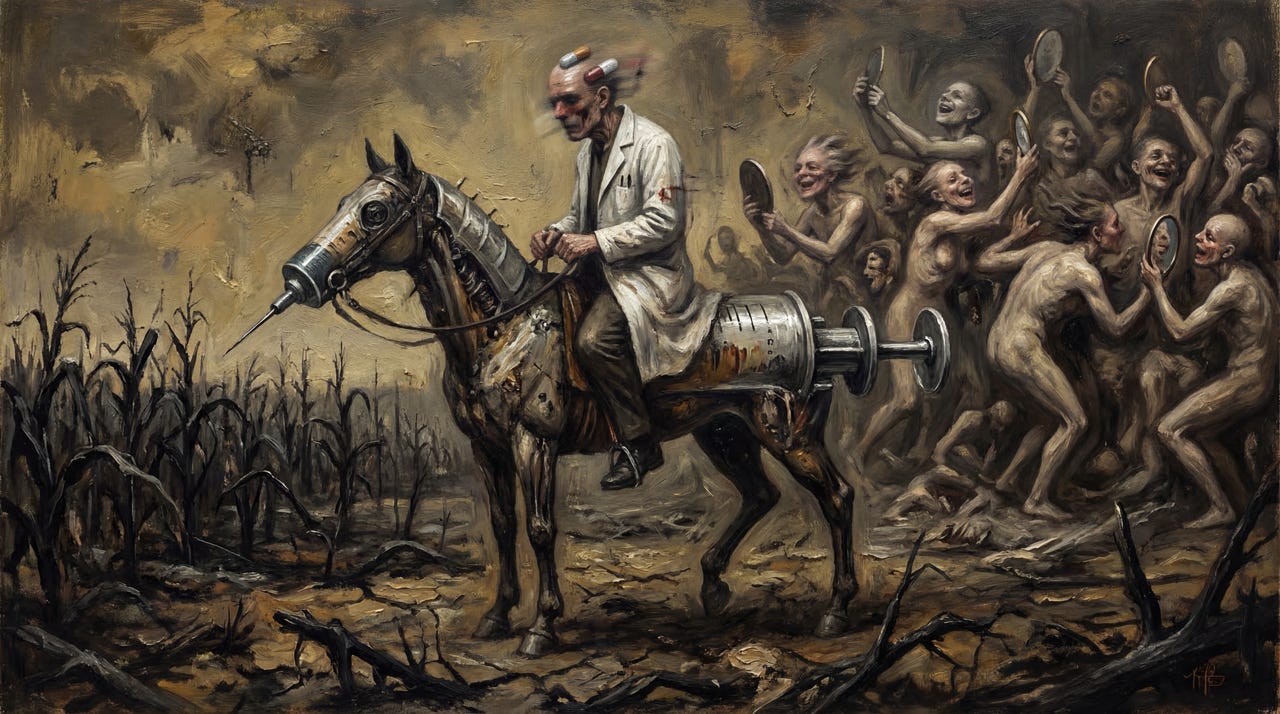
Pharmacology
The optimistic version of the GLP-1 story goes like this: people on Ozempic eat less, their appetite shifts away from ultra-processed snacks toward actual food, and the market follows. Tens of millions of Americans eating differently is a different food culture. That’s not nothing.
Conagra put a “GLP-1 friendly” badge on 26 existing Healthy Choice frozen meals in January 2025. They didn’t change the recipe. They changed the label. Nestlé launched a companion product line. Danone reformulated an Oikos yogurt drink. The food industry looked at a moment when millions of people are trying to eat less and better, and saw a badge opportunity.
The drugs are genuinely helping people lose weight and manage blood sugar. But “people feel better” and “the food system got better” are two different things, and the food industry is working hard to make sure nobody notices the gap.
Here’s the deeper problem. When you feel good, it’s very easy to conclude that your relationship with food is healthy. Your weight is down. Your doctor is pleased. Your energy is up. Food feels like a solved problem — something you’ve handled. And in a culture that has always understood food primarily through the lens of personal health, feeling fine is basically the whole test. If your body is okay, what else is there to worry about?
Quite a lot, as it turns out. The way we produce food in this country is doing damage that has nothing to do with how any individual body feels. The soil that grows our food is depleting. The carbon load from agriculture, processing, and transport keeps accumulating. Water systems are being strained. The labor conditions for the people who actually grow and harvest food remain, in many cases, genuinely grim.
None of that shows up in your bloodwork. None of it gets better because your A1C improved. Getting people to care about those things has always required asking them to feel something on behalf of a system, rather than themselves — and that has always been a much harder ask than “this food is making you sick.”
GLP-1 drugs can address the personal health track. They do nothing for the systemic one. The risk is that as more people feel better, the urgency to fix either track softens, and the movement loses the one argument that has ever reliably moved people: that what they eat is hurting them. The movement still needs to make the systemic case, more concretely and more urgently than it has, and it needs to make that case to people who increasingly feel fine.
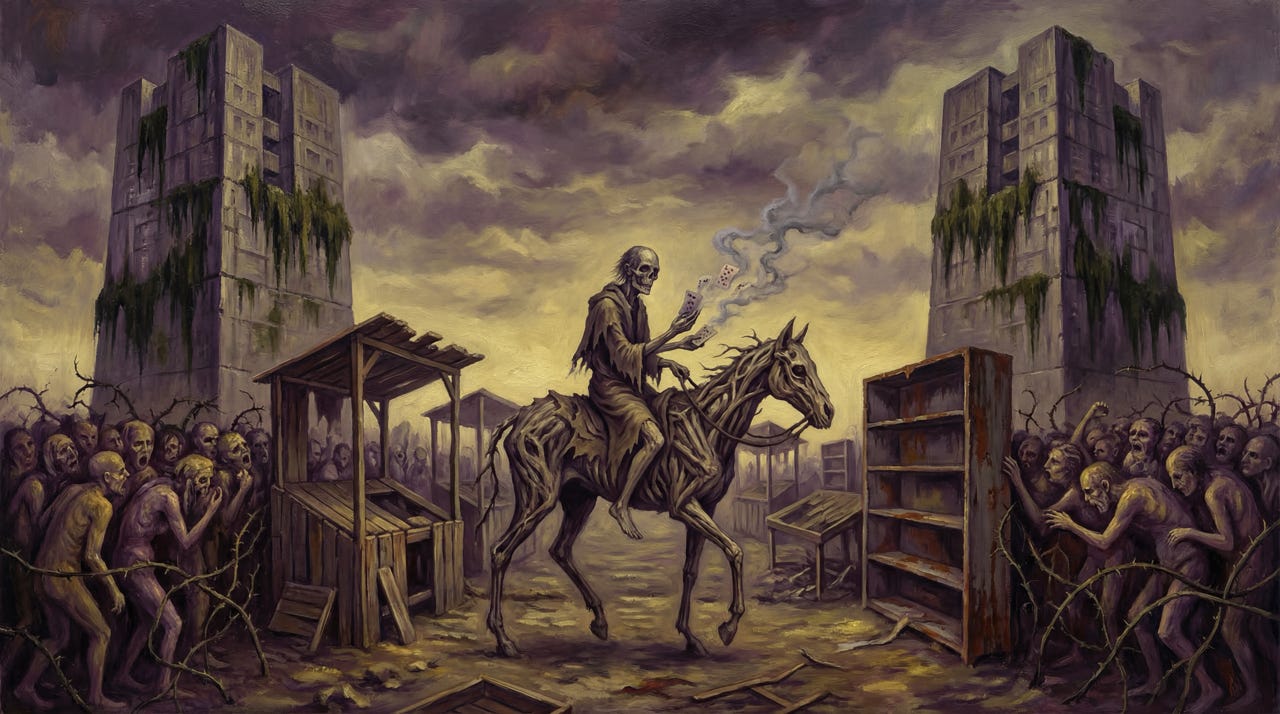
Poverty
Poverty has always been the good food movement’s original sin. The foods the movement champions cost more than the foods it’s trying to replace, and they’re sold in places that large portions of America can’t easily reach. That’s not new. What’s new is how many things are getting worse at the same time.
Food prices haven’t come back down to where they were before the pandemic. The SNAP cuts passed this year are the deepest in the program’s history, close to 20 percent over the next decade, which means families who rely on food assistance have less money for groceries at precisely the moment groceries are still expensive. The Kroger-Albertsons merger failed in federal court in late 2024, but the grocery consolidation that merger represented didn’t go away. In many lower-income communities, there are still basically two stores, and those stores know it.
Higher prices, fewer benefits, less retail competition — all three running simultaneously means the households most affected by a broken food system have less capacity to do anything about it than they did five years ago.
The good food movement has always told itself that scale would eventually solve this. Get enough people buying regenerative chicken and organic produce, the argument goes, and prices come down, distribution broadens, and better food stops being a luxury. That story has been circulating for twenty years. It hasn’t really happened.
The premium end of the food market has grown significantly, but the structural distance between what the movement produces and what most Americans can actually afford and access hasn’t closed in any meaningful way. If anything, the economic conditions of 2026 are pulling in the opposite direction — compressing the budgets of the people the movement most needs to reach, at exactly the moment when the political environment is making the systemic fixes harder to pursue.
The good food movement is largely a movement for people who already have enough. That’s been true for a long time. What’s different now is that the conditions making it true are getting harder to reverse, and the movement doesn’t have a serious answer for that yet. A movement that can’t reach the people who most need it isn’t a movement. It’s a product category.
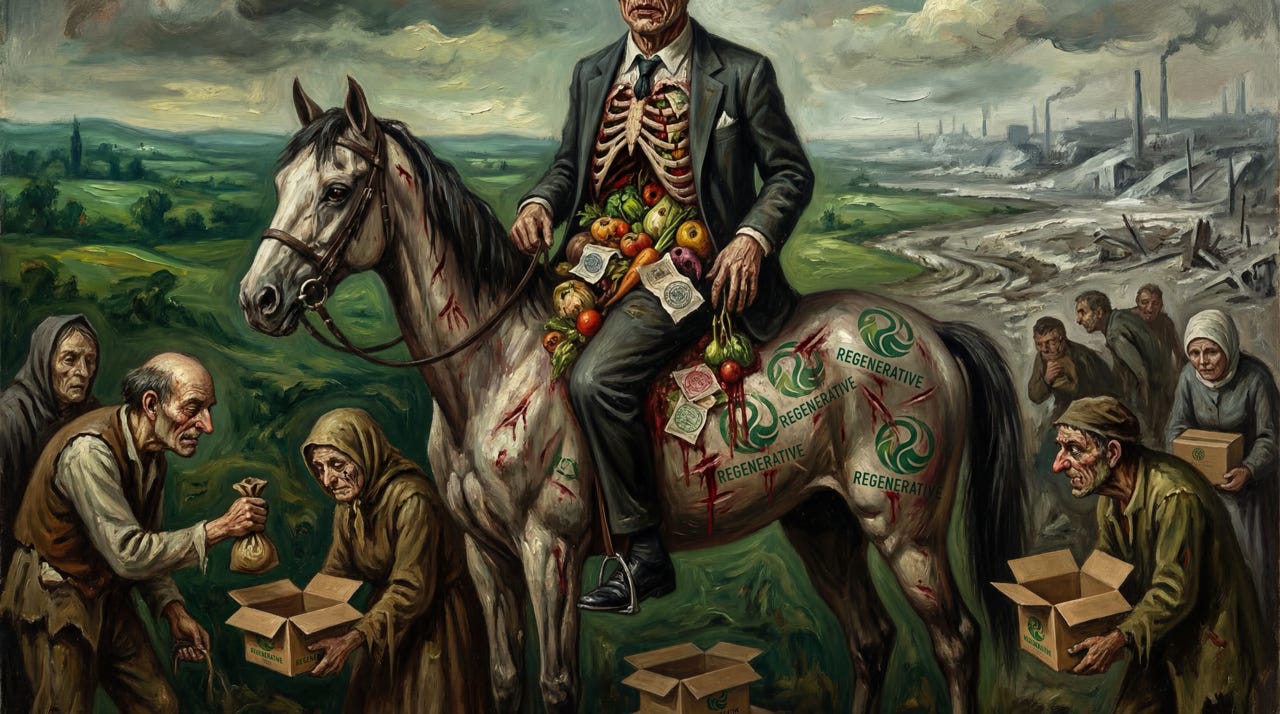
Capture
This horseman doesn’t attack the movement from outside. It joins it.
The mechanism is straightforward enough that it’s easy to miss. A large food company acquires a brand that genuinely represents what the movement cares about. The brand keeps its name, its packaging, its founder story, its farmers market origin myth. What changes is the procurement process, the margin targets, and the pressure to scale. The practices that made the brand worth acquiring in the first place get quietly renegotiated until they’re something else. The label stays the same. The label is the whole point.
“Regenerative” is the current front line of this. It’s doing the work that “natural” did in 2017: a term that started with real meaning, got absorbed into marketing departments, and ended up written into voluntary certification programs with enough exceptions to drain it of operational content. Major retailers now put “regenerative” on private-label packaging while sourcing from farms whose practices wouldn’t survive any serious scrutiny. Danone, General Mills, and PepsiCo all carry regenerative agriculture commitments. Some of that represents genuine investment. Much of it is what happens when a procurement team is handed a sustainability mandate and told to hit it without touching the cost structure.
The harder problem is what this does to the people who actually care. When General Mills says it’s committed to regenerative agriculture, and Walmart puts regenerative labels on its house brand beef, and PepsiCo announces a seven-million-acre regenerative farming initiative, the average engaged consumer reasonably concludes that the movement won. The big guys came around. What else is there to fight for? But “regenerative” in a General Mills press release and “regenerative” as a genuine long-term commitment to soil health, carbon sequestration, and farmer livelihood are not the same thing — they just use the same word.
The advocates who understand that difference and try to say so out loud face an exhausting task: explaining why a win isn’t a win, why the label on the bag doesn’t reflect what happened in the field, why you should still be skeptical of a company that has now said all the right things. It’s a hard argument to make without sounding like someone who simply refuses to be satisfied. And that perception — that the critics are just moving the goalposts — is exactly what makes Capture so effective. The movement’s own vocabulary becomes the instrument of its neutralization.
That’s the real damage. Not the consumers misled by a label, though that matters too. It’s the gradual erosion of the movement’s ability to say what it actually stands for, because the words it stands for have been borrowed by people with different intentions and different incentive structures. The movement hasn’t figured out how to defend its vocabulary the way it defends its practices, and Capture is counting on that continuing.
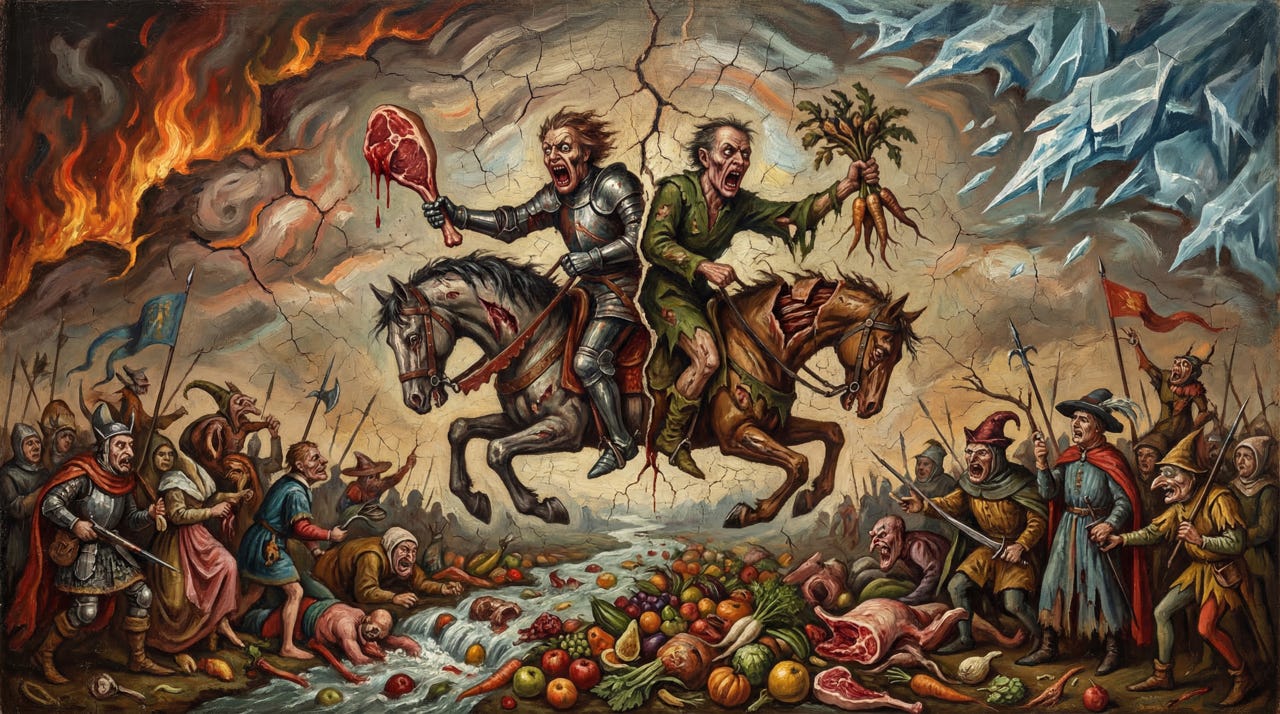
Tribalism
The good food movement has always depended on the idea that food is common ground. People across the political spectrum eat. People across the political spectrum get sick from bad food, pay too much for groceries, and live in places where the options are limited. The argument was never that food reform required political consensus on everything — just that food itself was universal enough to build a working coalition around. That assumption is in worse shape than it’s ever been.
Food tribes are not inherently a problem. The regenerative agriculture movement is a food tribe. The slow food movement is a food tribe. Tribes form around genuine shared values and do real work. What’s different now is what happens when tribalism metastasizes — when the identity of the tribe becomes more important than its actual positions, and when the boundary between tribe and outsider becomes more important than the pursuit of any shared goal. At that point, tribes stop being productive subcultures and start being epistemological silos. People inside them stop evaluating evidence and start evaluating loyalty.
That’s the condition the food world is increasingly in. Seed oils are a right-wing wellness cause. Veganism is coded culturally left. Raw milk has become a freedom issue for a certain kind of libertarian voter. The carnivore diet functions as much as a political identity as a nutritional philosophy.
What’s striking is how often these factions are identifying real problems — genuine issues with industrial food, with dietary guidelines that have shifted over decades, with the outsized influence of large food companies on public health recommendations — and then retreating so far into their own frameworks that the conclusions become untethered from evidence. Fluoride in water is poison. Tylenol causes autism. The FDA is a captured institution that has been deliberately making Americans sick. These aren’t fringe positions anymore; they’re traveling alongside legitimate food policy arguments in ways that make the whole conversation harder to have.
The sharpest version of this is MAHA — Make America Healthy Again, the health platform associated with Robert F. Kennedy Jr. and his tenure at HHS. The policy targets are not exotic: federal scrutiny of ultra-processed food, a harder look at artificial additives, a rethinking of dietary guidelines that haven’t meaningfully evolved in decades. These are arguments the good food movement has been making since before 2017, in many cases much longer. The fact that they’re now being advanced alongside positions that strain credulity — and by people the movement strongly disagrees with on other issues — has created a kind of policy paralysis. Engaging with the substance feels like endorsing the whole package. So the movement largely doesn’t engage.
Some of that caution is warranted. But there’s something else going on worth naming. The good food movement has developed a cultural identity that operates somewhat independently of its actual policy goals. A policy win that arrives from outside the movement’s own codes doesn’t feel like a win. It can feel threatening to the identity itself, which is a very different thing from a substantive objection to the policy.
The result is a movement that has become better at protecting its culture than advancing its agenda. We’ve spent thirty years being told the movement was too elite, too coastal, too precious to translate beyond a certain kind of consumer. Now there’s a political moment making some of our arguments, to audiences we’ve never been able to reach. And we’re largely sitting it out. That’s worth examining more honestly than the movement has so far.
The Harder Work
The good food movement is not losing. It’s also not winning in the ways that matter most. More brands are using the right language. Fewer people are eating the right food. More companies have regenerative commitments. Less of the soil is actually being regenerated. The gap between what the movement says and what the food system does has arguably gotten wider at the same time that the movement has gotten louder.
None of these four horsemen require the movement to be incompetent or corrupt or asleep. Pharmacology is a genuine medical advance that happens to relieve pressure on the food system. Poverty is a structural condition that predates this movement and will outlast any administration. Capture is what success looks like when the wrong people show up to claim it. Tribalism is what happens when people who care deeply about something start caring more about who else cares than about the thing itself. These are hard problems precisely because they don’t have villains. They have incentives, and conditions, and the accumulated weight of a lot of individually reasonable decisions pulling in the wrong direction.
The movement has always been good at making the moral case. The food system is broken, the evidence is overwhelming, and the people with the most power to fix it have the least incentive to do so. That case is still true. What’s becoming clear in 2026 is that moral clarity, by itself, is not enough. The horsemen don’t respond to arguments. They respond to power, access, money, and organized political will — the things the movement has been slowest to build, and the things it most urgently needs now.
—
Mike Lee is a food futurist and innovation strategist, author of Mise: On the Future of Food, host of The Tomorrow Today Show podcast, creator of Mise Futures, and is on Instagram at The Book of Mise.
Well written and once again I agree with you, and have been struggling for years on how to rectify this situation in the food industry. I do recall a while back, when organic producers were struggling to even pay for certification, those small producers, are now doing better. I suspect that Walmart getting into organic food, making it more accessible has helped democratize organic food. Is organic food the answer to all the issues you addressed, no, but it does show the change one large retailer can have on our landscape. I would like to work on helping to solve on some of these issues. If anyone has interest on working groups, ping me, https://www.linkedin.com/in/ariellagastel/
For millions of years, the forces shaping our relationship with food — what you are framing as the “Four Horsemen” — have been present, guiding behaviour long before we were aware of them. Human action rarely begins with pure intention; it is shaped by what is easiest, most available, and least demanding in the moment. The same has been true of food systems since time immemorial — from the landscapes that nudged early foragers toward certain diets, to today’s highly engineered retail environments that optimise for convenience, shelf life and profit. What has changed is not their existence, but their scale, speed and intentional design. Which raises a familiar question: are we choosing what we eat — or are these modern “horsemen” simply more effective than ever at choosing for us?