


I’ve been writing my way toward a wider picture of what the food system could become, in two essays so far: first a diagnosis, then a vision. The Enshittification of Big Food laid out how the food on our shelves keeps quietly getting worse, and why that isn’t an accident: it’s what happens when shareholder return is the only goal a food company answers to. A New Blueprint for Big Food sketched the alternative, a different future where taking care of people and the planet is the only way a food company earns a profit. Not a finished plan. A direction worth walking toward.
Over 141 substantive comments came in across Substack and LinkedIn. They clustered into five big themes, and I’ll work through all of them in the essays ahead. This week takes the foundational one: the economic rules the blueprint depends on. Profit, who pays whom, what counts as a cost. Most people treat them as laws of nature, which is why the blueprint reads as wishful thinking. They’re agreements people made, and what people agreed to, people can renegotiate. That’s my argument.
Should we be fixing capitalism at all?
Three readers pushed on this, from three different angles. The furthest-reaching version came from Gunnar Rundgren, who writes the Garden Earth newsletter on agriculture and ecology. “Profit has nothing to do with sustainability,” he argued. What we need instead is to “establish alternative markets and networks where consumers and producers are motivated by socially beneficial purposes,” networks that “gradually replace the profit-laced capitalist turf with new playing fields.” Putting nature on the balance sheet, he added, “means privatisation and commodification of nature, which is the last thing we need.”
Yuwei Shi, who teaches and writes on impact and sustainability transitions, extended that thought into a phrase I keep returning to: “scale and speed capitalism is not going away by epic battles but can be rendered irrelevant gradually by millions of cuts. Profit-maximizing capitalism will become irrelevant when a million oases appear on Earth.” He also asked the sharpest question in the threads: whether anything that scales eventually falls back into the same monopolistic control, and whether that’s exactly what the hedge funds are betting on.
And Miyoko Schinner, one of the trailblazers of the plant-based movement, pushed the moral version hardest. “Milton Friedman was not God,” she wrote. “We need to get over that.” Her case: “I do think a moral argument, not just a financial incentive, needs to be core in food, because healthy and affordable food is a basic human right.” That puts a moral floor under the whole industry, said plainly, in language B-corp branding and impact-investing decks tend to soften before it gets that direct.
I take all three seriously. None of them is wrong about what’s broken or about what a better food system would have to honor. But I land on a slightly different question. They ask what to do about the system. I keep asking how to bend the system we already have toward the outcomes they’re all reaching for, and how fast.
Someone Is Already Paying for Nature
The worry about commodifying nature is fair, and it has a long, ugly history behind it. The enclosure of the commons turned shared English land into private property and a generation of villagers into landless laborers. Water rights have been stripped from communities that held them for generations. Mineral extraction ran as colonial policy across half the world. The through-line in each case was an ownership claim: a powerful actor declared that something used in common was now property, and the people who’d depended on it without owning it lost. That concern is warranted. I’m not waving it away.
But the blueprint isn’t asking anyone to claim ownership of nature. It’s asking that the damage corporations are already inflicting on it show up on their ledger instead of someone else’s. The trouble is who’s paying the price. Running the soil down, drawing an aquifer below the next pump’s reach, mailing a future diabetes ward its bill: every one of those is a real cost, and someone pays it. The farmer pays in yield twenty years out. The town pays in deeper wells, and a kid eventually pays in a clinic waiting room two decades after that.
The one party who never sees the cost is the buyer choosing between a cheap commodity ingredient and a better one. On the ledger that actually decides what a food company sources, those costs are entered at zero. That’s what priced at zero means: the price exists, it’s just set at zero, on the only ledger the decision runs on.
So the choice on the table isn’t whether to put a price on the damage. The price already exists. The choice is who sets it, what they set it at, and whether the people who pay for it have a seat at the table. Stephen Leider named the financial version of this plainly: the market still treats purpose as “narrative, not as an asset class with measurable economics.” Once soil health, labor resilience and flavor translate into margin durability and pricing power, regenerative stops being defended by “mission language” and starts being defended by “cash flow quality, lower risk, and better multiples.” Make the cost measurable, in other words, and it has to be argued for on the same spreadsheet that’s currently erasing it.
None of this is an argument against parallel systems. Regional, community-owned food economies should keep growing alongside the existing one. But two-thirds of American grocery dollars run through ten companies so we are forced to try and rewrite the legacy food system too. Parallel systems reach the person who already cares about better food.
Repricing externalities reaches the person who didn’t know there was a debate. Both matter, and the climate isn’t giving us time to pick one over the other. I’d rather redefine the worst of capitalism than wait for it to collapse, because collapse hurts real people. My interest is in how that rewiring could work. But I have no ego about which path wins. What I’m rooting for is human and planetary health and wellbeing for everyone, and the best ideas making real progress, by whatever combination of paths gets us there.

Altruistic Desire
The moral case is the right foundation: healthy and affordable food is a basic human right, and the system we have fails to deliver it. Nobody pushing to reprice externalities cares about the accounting for its own sake; we care because the current price produces a food system any honest moral reading would reject. But waiting for every executive whose bonus depends on not having a moral awakening to have one is a long bet. So the spreadsheet move, making the better choice for people and planet the one the math picks anyway, does half the work. The other half is older than any spreadsheet, and it’s the half we keep underrating: desire.
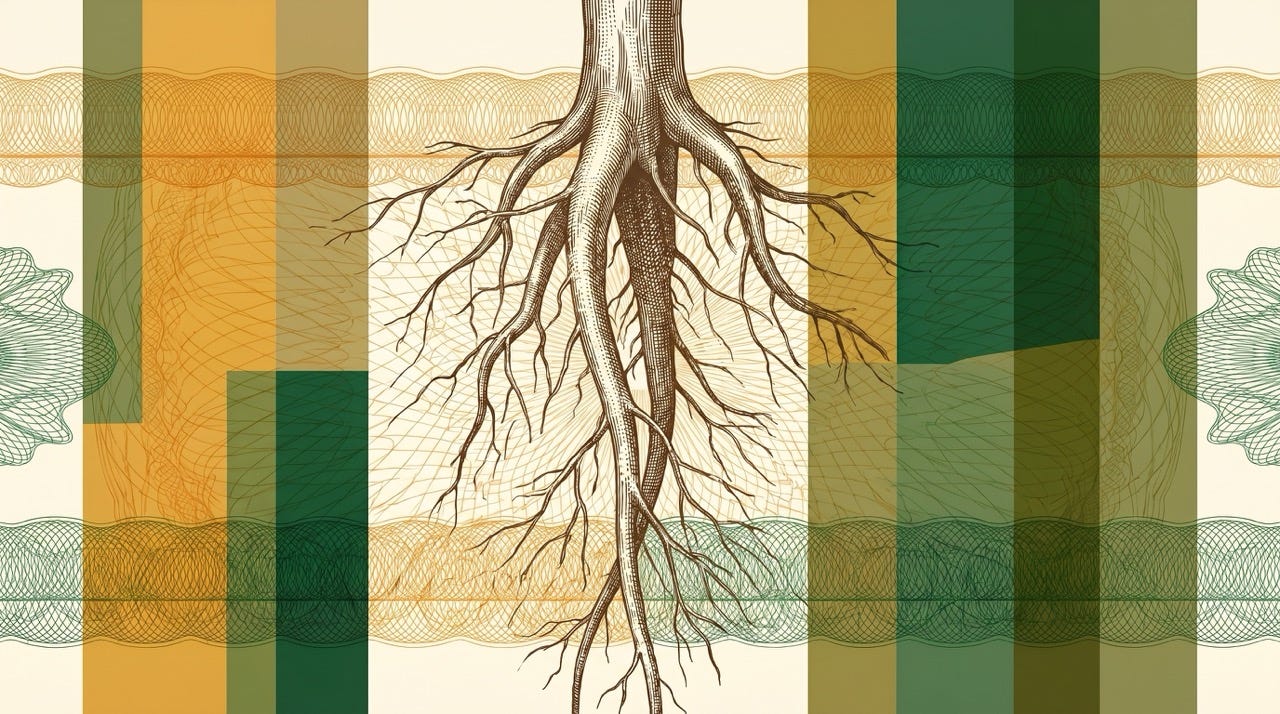
Take Kernza. It’s a perennial grain, roots ten feet down, holding soil and water in place year-round where annual wheat leaves bare dirt every harvest. That’s the ecological case, and ecological cases told that way don’t move many cases of product. But Patagonia Provisions and Topa Topa Brewing Company already turned Kernza into a beer, Kernza Lager, and the beer is just good. You take a grain grown in a way that improves the ecosystem around it and the lives of the people who farm it, and you make it into the most delicious version of itself, a beer that beats the conventional pilsner on flavor before anyone says a word about watersheds.
The deliciousness pulls demand. Demand creates margin. With margin comes supply, and supply means more acres growing Kernza instead of annual wheat. And more acres of Kernza means soil holding more water, aquifers recharging instead of dropping, biodiversity surviving where annual monoculture would have flattened it. The planetary outcome arrives as a byproduct of the consuming.
Now run that forward. The future I want: every serious brewmaster in the world chasing a better Kernza beer than the last. Connoisseurship forming around Kernza beers the way it has around barrel aged stouts and hazy IPAs. The whole thing turning into a meme. A Costco shopper reaching for a case of some new Kernza beer because he had it last weekend at his neighbor’s backyard barbecue, and learning only later, somewhere on the back of the can, that the grain it’s brewed from is rebuilding a watershed in Minnesota. Nobody having to be lectured into any of it. And all the while, the soil healing under more acres of Kernza, paid for one case of beer at a time.
Then run the same play across bread, distillers, chefs, fast food, snacks, beverages, every category big enough to move acres at scale. Heritage wheats, perennial rices, dry-farmed tomatoes, rotationally grazed beef: each one has a version of the Kernza story waiting to be made. This is how I envision a food system where desire and altruism move in lockstep.
Profit Is a Construct
Everything in economics rests on agreement. A dollar buys something because enough people agree it does, and on that one shared belief the whole structure sits: prices, contracts, property rights, the definition of profit itself. None of it descended from anywhere. The equation is just arithmetic: revenue minus costs. The choice is what we count on each side. The version we run today enters soil, water, human health, and harvest labor at zero on the cost side. That’s a choice we keep making every quarter.
People treat capitalism the way they treat gravity, as a fact of the universe that isn’t up for discussion. But gravity pulls on you whether you believe in it or not. An economic system only works as long as enough people keep believing in it. Which means it can be edited.
Take the Friedman Doctrine. I’m with Miyoko on this one: he is not a God. Milton Friedman didn’t discover a law of nature the way Isaac Newton discovered gravity. He was a University of Chicago economist who wrote an essay for The New York Times Magazine in 1970 arguing that a company’s only obligation was to its shareholders. The argument took off. A generation of business schools taught it as though it had been handed down.
It’s still just an idea. We aren’t required to accept it the way we’re required to accept the laws of nature. Positions get revised. Some get replaced. B-Corps are one revision in progress: somebody invented the certification in 2007 because they thought extractive capitalism could use some new rules, and enough companies signed on for it to count as a serious counter-position. It’s not the final answer. None of these are. The rules get written by somebody, and that somebody is us. The real question is whether the next version of the operating system gets written from inside the system or outside it, and the honest answer is probably both.
What stays with me, reading through all of this, is that the destination doesn’t actually change from one person to the next. Nobody in this conversation thinks the current system is fine. The argument is about route and speed, and that’s a sharper, more honest argument than the one we were having ten years ago.
The hardest sentence in food right now is “nice idea, won’t happen.” It costs nothing to say, and it forecloses everything. Insisting the future can’t be different is the surest way to make sure it isn’t. The next version of the operating system is already being written, in pieces, by the people closest to the work, including the three readers whose arguments this essay has been wrestling with. Slower than I’d like. Faster than “won’t happen” leaves room for.
And to be honest, I don’t yet know how this vision could fully happen. Maybe it won’t. But it feels compelling and important enough to me to keep trying and bringing you all along for the journey. This shit is hard. But it’s supposed to be. And for the sake of the future of our food system and planet, I’m not going to shy away from wrestling with these kinds of ideas just because I can’t immediately see the solution.
Four more themes are still on the table from those comment threads: whether anything that scales eventually re-monopolizes, what private equity does to a regenerative brand once it buys one, how the demand side finds the time to choose better food, and what the next ingredient swap is going to be. Each one gets its own essay. This was the one underneath the rest, so it had to come first.
—
Mike Lee is a food futurist and innovation strategist, author of Mise: On the Future of Food, host of The Tomorrow Today Show podcast, creator of Mise Futures, and is on Instagram at The Book of Mise.
—
Mise 2: The Restaurant Issue is now open for pre-orders! Ships 8/11/26. Over 200 pages of future scenarios exploring the future of restaurants.
I love this, and I agree with all the points, and there is a giant data gap at the farmland level. Without consistent measurements how can we turn healthy soil into a food company's balance sheet asset?
For the record, I don’t think ‘basic human right’ is a law, either. That’s one framework. Another framework would encompass basic rights of all organisms with humans being one little part of the picture, though I don’t think that’s so likely. But it’s just as logical.
To me, the other big gap is that companies are made up of people. There are millions of people, including me, who allow the organisations they work for to do what they know is wrong, for a variety of reasons including greed, fear, apathy… If most people did what they know is right…but they can’t.