


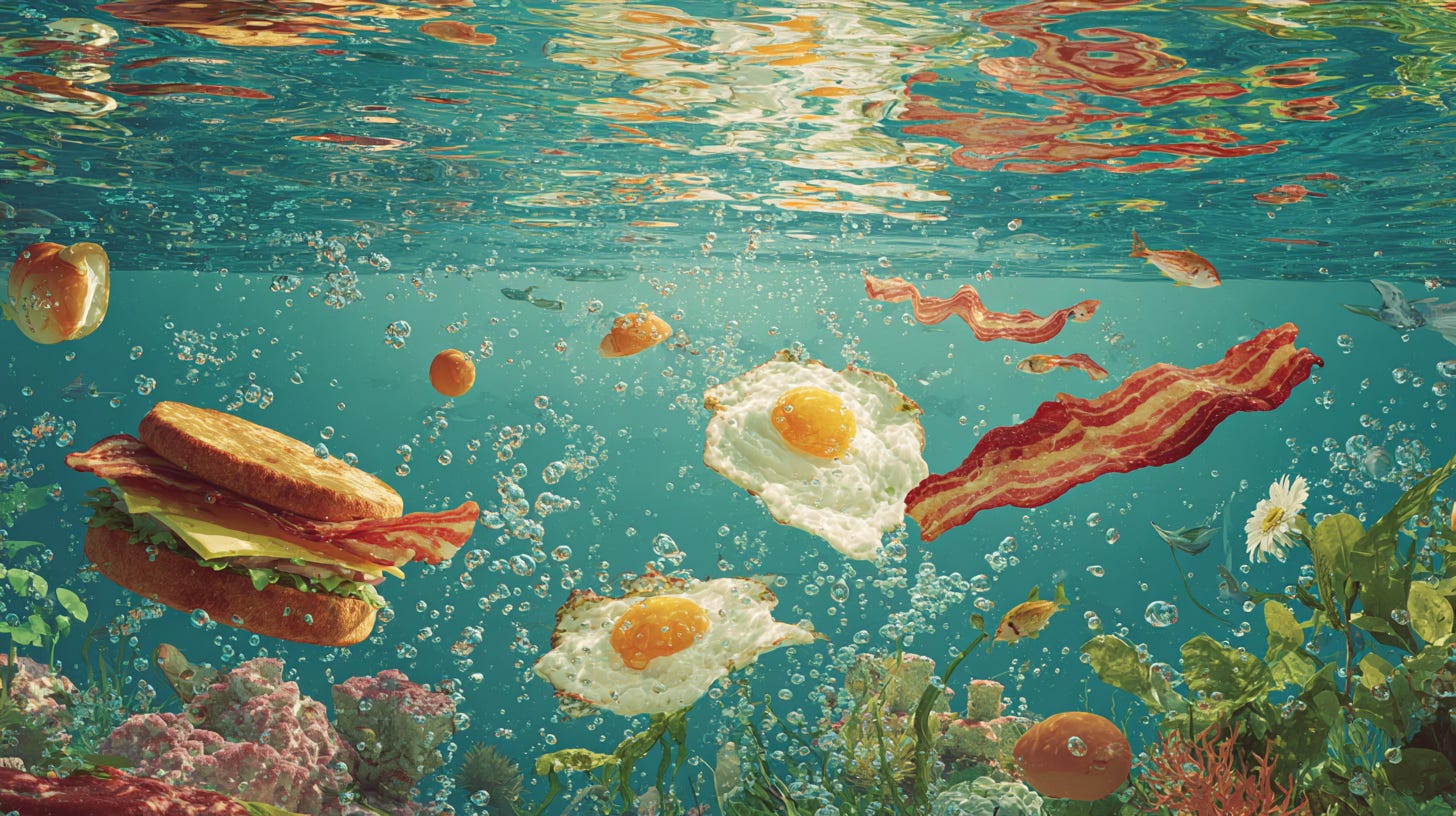
There are these two young fish swimming along and they happen to meet an older fish swimming the other way, who nods at them and says "Morning, boys. How's the water?" And the two young fish swim on for a bit, and then eventually one of them looks over at the other and goes "What the hell is water?"
This David Foster Wallace parable underscores the fact that the most obvious, important realities are hardest to see. In food, we swim through dozens of daily decisions while barely noticing the currents carrying us along.
In food, the “water” isn't H2O. It's a food system so embedded in our existence that we've stopped seeing it. We mindlessly fill our online and IRL carts with groceries we’ve bought a million times before. We order the “Number 5” combo meal at our local Chinese take-out spot without even noticing there are new specials on the menu. We think we're making conscious choices, but most of the time we're just fish following currents engineered by others that we’ve swam in for years.
The Engineering of Choice
Wallace's key insight was about default settings—the unconscious ways we move through the world. In food, these defaults run deeper than we realize: when we eat, how much, what constitutes normal portions, which flavors we crave.
Consider that bacon and eggs became America's default breakfast not through cultural evolution, but because in the 1920s, Beech-Nut Packing hired Edward Bernays—Freud's nephew and the father of public relations—to boost bacon sales. Bernays didn't just advertise; he convinced doctors to recommend heartier breakfasts. Within a generation, a marketing campaign became cultural tradition, invisible as water to a fish.
These defaults feel natural but are learned. A child born in 1950 developed different food defaults than one born in 2020. The first expected three meals daily, seasonal foods, simple flavors. The second defaults to constant availability, year-round strawberries, engineered palatability.
Neither set is inherently right or wrong, but recognizing them as defaults that arise from current day cultural, social, and economic conditions rather than natural laws is the beginning of consciousness.
Take spaghetti sauce. For decades, companies tried creating one perfect sauce for everyone. Then Howard Moskowitz, working with Campbell's Prego in the 1980s, had a different insight: instead of finding the perfect sauce, create multiple variants capturing different preferences.
Moskowitz's chunky sauce seems obvious now, but it fundamentally shifted how food companies think about consumers. Rather than one unified market, they began segmenting us into tribes with manufactured needs met by slightly different products. This launched extreme customer segmentation—the illusion that 40,000 supermarket products represent choice rather than variations on basic themes.
The Tyranny of Constant Deciding
Food becomes invisible precisely because we interact with it constantly. From the moment we wake up—coffee or tea, cereal or eggs, milk or oat milk—through the day's cascade of micro-decisions about snacks, lunch timing, portion sizes, whether to finish what's on the plate, what to grab for dinner on the way home.
If we deliberated each decision fully, we'd spend most waking hours contemplating meals. So we develop automaticity—mental shortcuts for repeated decisions. We rely on "the usual" order, trusted brands, familiar patterns not because we've evaluated them, but because they worked before and require minimal mental energy.
This is why you have a go-to restaurant order. Getting "the usual" is easier than reading menus, weighing options, considering nutrition, optimizing for mood. The pizza that satisfied two weeks ago becomes a cognitive and culinary bookmark that preserves mental bandwidth.
But this frequency pushes us toward unconscious patterns, not conscious evaluation. That’s us swimming. We're constantly touching food yet become less aware of our choices. The water becomes invisible precisely because we're swimming in it all day.
The Mythology of Individual Choice
Wallace warned against believing we're complete authors of our experience rather than participants in larger systems. In food, this manifests as the myth that eating is purely personal choice and willpower.
This mythology flatters our agency while absolving systems of responsibility. Diabetes? “Oops, I made those poor food choices.” Obesity? “Dammit, why do I have such lack of self-control?” Food deserts? “Well, those Individuals should demand more fresh food.”
It’s easy for institutions to put the onus on individuals to take sole charge of their food choices. Because then companies can just say “we’re just giving the people what they want,”while conveniently ignoring the fact that their company was the one who introduced junk food to the public in the first place.
This ignores the water entirely. It treats people as making decisions in vacuums rather than within systems designed to influence decisions in particular directions. It mistakes symptoms for causes, individual behaviors for isolated phenomena rather than predictable responses to environmental pressures.
The food industry depends on this mythology because it shifts responsibility from institutions to consumers. As long as we believe health outcomes are purely personal choices, we don't examine the systems shaping those choices.
The Economics of Attention
Wallace's real education was learning how to choose what to pay attention to. In a food system designed to capture attention for commercial purposes, this becomes crucial.
Every package design, product placement, marketing message competes for attention serving someone else's agenda. Bright colors, health claims, celebrity endorsements bypass conscious evaluation to trigger automated responses. As much as big brands are talking a much better game today when it comes to personal and environmental health, their stocks rise from increasing profits, not increasing the health of people or planet.
But this creates an opportunity for those making and deciding what goes on grocery store shelves: consciousness is becoming a competitive advantage. As people wake up to the water they're swimming in, companies that help consumers understand their choices rather than obscuring them may find themselves swimming with the current rather than against it. The preference for year-round strawberries, supersized portions, and highly processed convenience foods weren't inevitable—they were created through decades of systematic reinforcement. New preferences aligned with health and sustainability can be created the same way.
Conscious participants recognize this dynamic without paranoia. They understand attention itself is the scarce resource everyone fights over, protecting it like a wallet in a crowded marketplace.
Beyond Individual Enlightenment
Wallace's speech was about choosing what to worship—taking conscious control over default settings. But individual consciousness, while necessary, isn't sufficient for systemic change.
The most conscious consumer still must eat from options created by others. They can make better decisions within constraints but can't single-handedly change the constraints themselves.
This is why conscious eating requires moving beyond individual perfection toward systemic participation. Every food dollar becomes a vote for the kind of food system you want to support, but this goes beyond just buying organic or local—it means considering which companies are designing better currents versus which are simply marketing within existing problematic ones. We need more brave, mission-led companies who have the financial resources and governance to redesign currents rather than just swim in them.
For those working in food, this shift toward consciousness brings both opportunity and responsibility. You're not just selling products—you're shaping habits, defaults, and cultural norms around food. Humans design food products, but food products also design humans.
Every product decision, marketing campaign, and distribution choice shapes the water consumers swim in. With great power to shape eating patterns comes responsibility for considering not just immediate sales metrics but long-term health outcomes, environmental impact, and social equity.
The Practice of Attention
Individual fish becoming conscious don't escape water, but they swim differently. When enough wake up simultaneously—both eaters and food professionals—they influence the current's direction.
For eaters, this means occasionally slowing down to notice what we're actually eating rather than consuming on autopilot. It means curiosity about where food comes from—not from anxiety, but genuine interest in systems we're participating in.
For food professionals, it means designing for conscious participation: clearer sourcing, education about preparation, packaging that encourages mindful consumption. It means questioning inherited assumptions, recognizing that many "consumer preferences" are learned responses to existing systems rather than natural desires.
The most promising opportunities emerge when conscious eaters and responsible food professionals recognize their interdependence. Eaters can't access what doesn't exist; companies can't sell what consumers won't buy. Both groups must recognize that food choices inevitably support some approaches to agriculture and economics while discouraging others. Individual choice alone cannot solve systemic problems like climate change—these require collective action.
The Water We Might Choose
Wallace's fish story suggests awareness is the first step toward freedom. But in food systems, freedom doesn't mean escaping constraints—it means consciously participating in creating constraints we want to live within.
This is harder and easier than individual dietary perfection. Harder because it requires engaging complex systems. Easier because it doesn't require food sainthood—just showing up consciously in conversations about organizing our food systems.
The real work isn't finding the one right way to eat, but creating systems supporting many right ways. Wallace acknowledged conscious living is "unimaginably hard to do," but represents "the freedom to be lords of our own tiny skull-sized kingdoms." In food, this means recognizing we're swimming in water designed by others, occasionally questioning the currents, and remembering that small acts of consciousness, multiplied across many people, can redirect even established streams.
The water is still water. But conscious fish swim differently. And if enough wake up at once, they can change the stream's direction—not through individual perfection, but through collective attention to currents we're all swimming in together.
The Practice of Attention
Individual fish becoming conscious don't escape water, but they swim differently. When enough wake up simultaneously—both eaters and food professionals—they influence the current's direction.
For eaters, this means occasionally slowing down to notice what we're actually eating rather than consuming on autopilot. It means curiosity about where food comes from—not from anxiety, but genuine interest in systems we're participating in.
For food professionals, it means designing for conscious participation: clearer sourcing, education about preparation, packaging that encourages mindful consumption. It means questioning inherited assumptions, recognizing that many "consumer preferences" are learned responses to existing systems rather than natural desires.
The most promising opportunities emerge when conscious eaters and responsible food professionals recognize their interdependence. Eaters can't access what doesn't exist; companies can't sell what consumers won't buy. Both groups must recognize that food choices inevitably support some approaches to agriculture and economics while discouraging others. Individual choice alone cannot solve systemic problems like climate change—these require collective action.
Wallace's fish story suggests that freedom doesn't mean escaping constraints—it means consciously participating in creating constraints we want to live within. This is harder and easier than individual dietary perfection. Harder because it requires engaging complex systems. Easier because it doesn't require food sainthood—just showing up consciously in conversations about organizing our food systems.
The real work isn't finding the one right way to eat, but creating systems supporting many right ways. Wallace acknowledged conscious living is "unimaginably hard to do," but represents "the freedom to be lords of our own tiny skull-sized kingdoms." In food, this means recognizing we're swimming in water designed by others, occasionally questioning the currents, and remembering that small acts of consciousness, multiplied across many people, can redirect even established streams.
Conscious fish swim differently than unconscious ones. And if enough wake up at once, they can change the stream's direction entirely.
—
And there’s much more…
My Book - Mise: On the Future of Food
My Podcast - The Tomorrow Today Show
My Instagram - The Book of Mise
My Consultancy - Mise Futures