


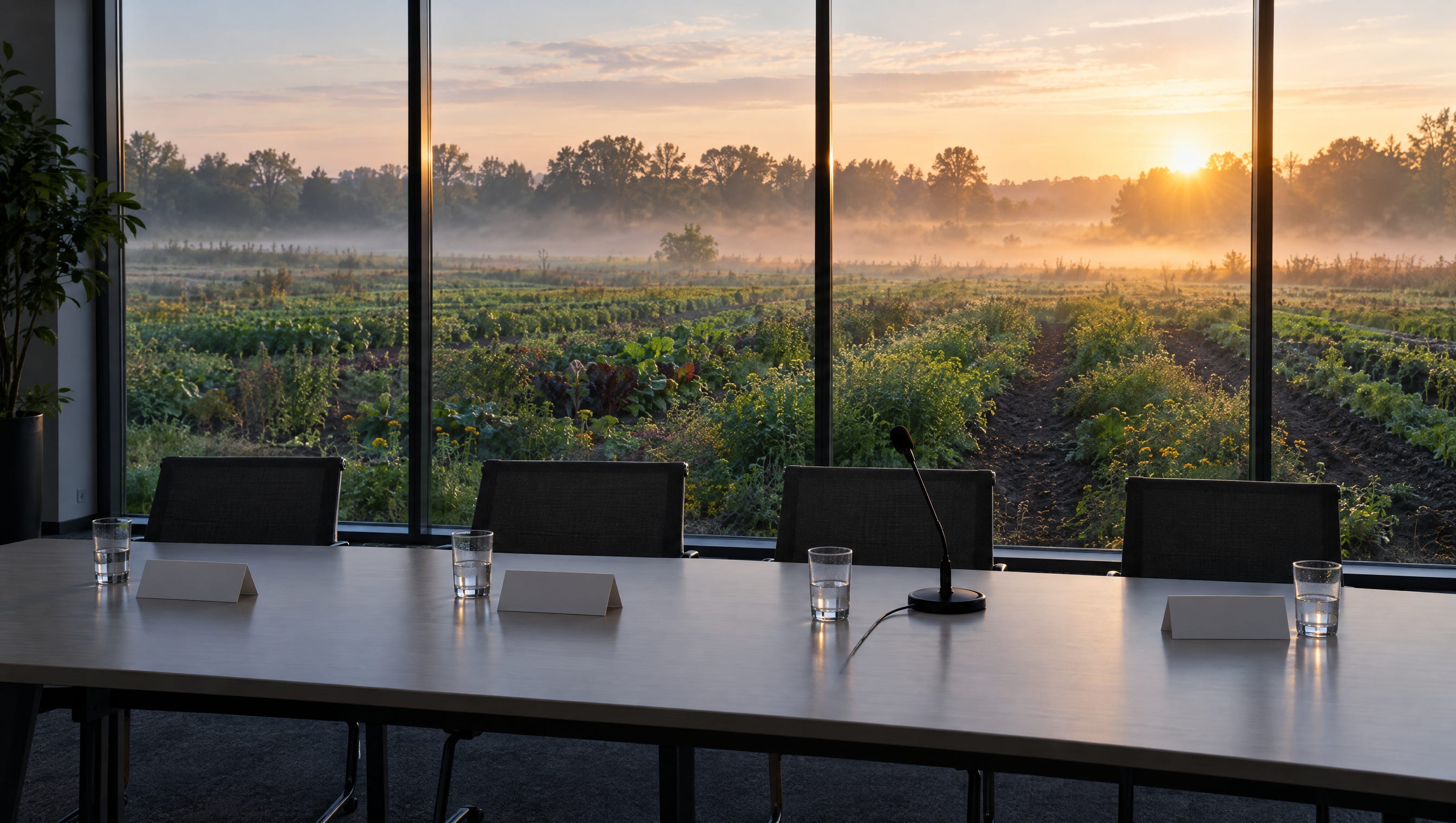
I got home from Climate Week NYC last week and was thinking about how much of the climate change conversation goes through corporations now. Nearly every activation, panel, cocktail party, and dinner had some kind of corporate sponsor attached. Governments and NGOs were there too, of course, but throwing events in NYC during the UN General Assembly is expensive, and corporations have cash.
Some companies are pushing hard to curb emissions and lighten their footprint on the planet. Others are just paying to look good. Either way, corporations play an undeniable role not only in climate change itself but in how the world interacts with it through the things it buys.
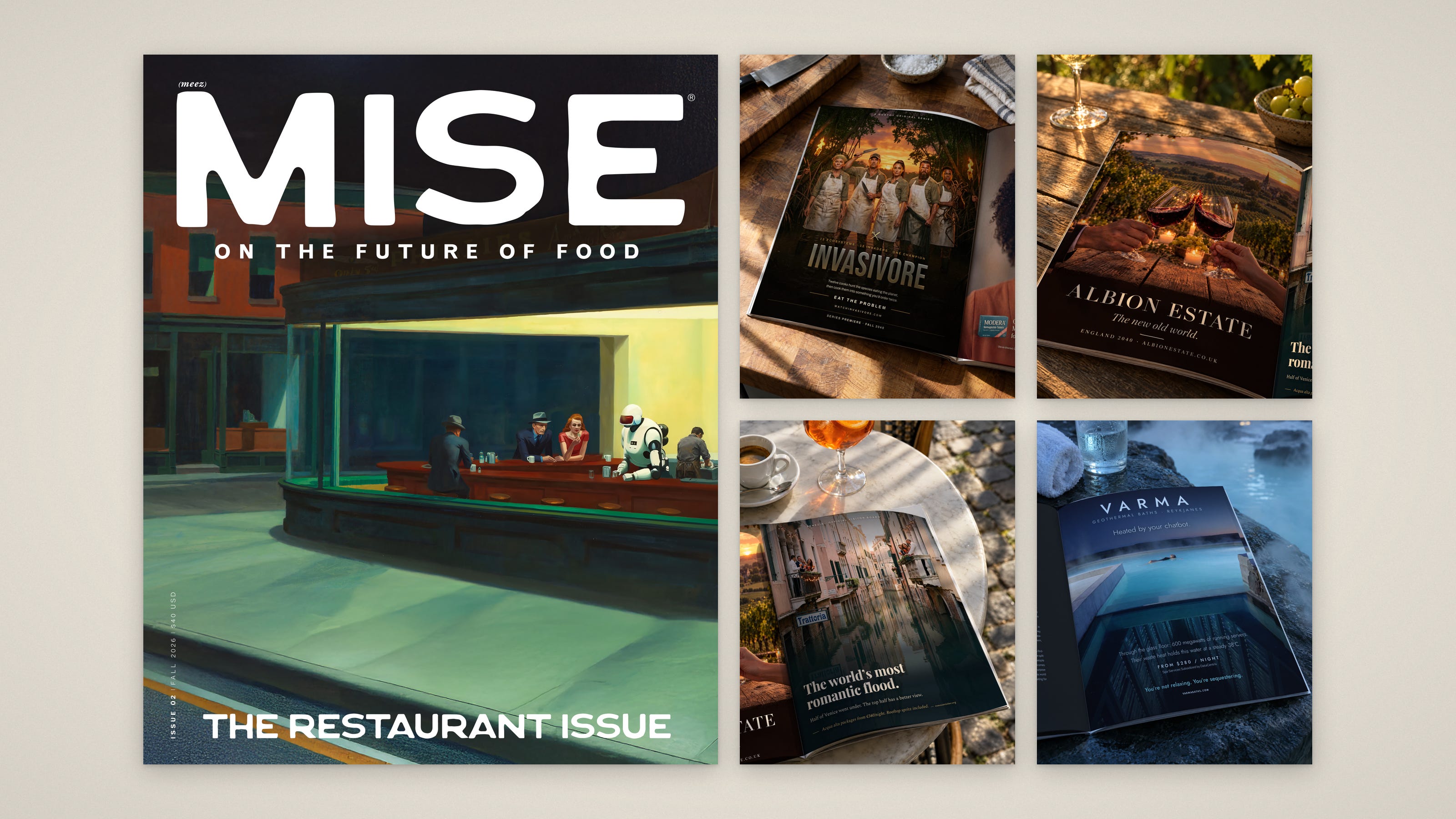
In my latest book, Mise 02: The Restaurant Issue, where I envision the future of restaurants and foodservice in the year 2040, there are ads throughout. I created Mise on purpose to look like a magazine. It’s a book about the future, so time is a main character, and unlike traditional books, magazines are strongly tied to their place in time.
Open an issue of Time magazine from the 1980s and you instantly know that you’re not reading something modern. Mise is like that old magazine, but in reverse: it’s from the future, not the past. So the ads play a key role in building that world of 2040 beyond what’s literally written in the main stories.
The ads in Mise are satirical. I like to use humor as mental lubricant to explore ideas that require suspension of disbelief. My hope is that the (dark) comic relief eases the shock and potential rejection of weird future ideas so that readers can sit with them and think more deeply about what they say, instead of shutting them down as impossible or ridiculous from the start. Thinking about the long-term future requires curiosity before judgment.
Today, I chose four ads from Mise 02: The Restaurant Issue that all circle around a single question: when the climate changes, who profits, and does that profit grow as things get worse or better?
From Problem to Profit
Climate change represents innumerable costs for companies and the world at large. Ruined crops, flooded warehouses, rising insurance premiums. But like life, profit tends to find a way. And in a capitalist economy, some will profit from disaster if the market allows them to.

For thousands of years, wine has been a drinkable snapshot of the weather. The ad for Albion Estate depicts a wine brand from England, which has warmed enough in the future to have a Mediterranean-like climate as historically legendary wine-growing places like Bordeaux in France, Piedmont in Italy, and Rioja in Spain have become unfavorably hot and ravaged by drought. Their loss is England’s gain.
And if the idea of paying top dollar for a bottle of English-grown wine feels odd, this future isn’t that far-fetched. Researchers at ETH Zurich paired current-day cities with the cities whose climate they would resemble by 2050. London would feel like Barcelona, even in a scenario where the world cut emissions significantly. They projected summers warming by 3.5°C and winters by 4.7°C on average, which is like moving European cities south by 1,000 kilometers.
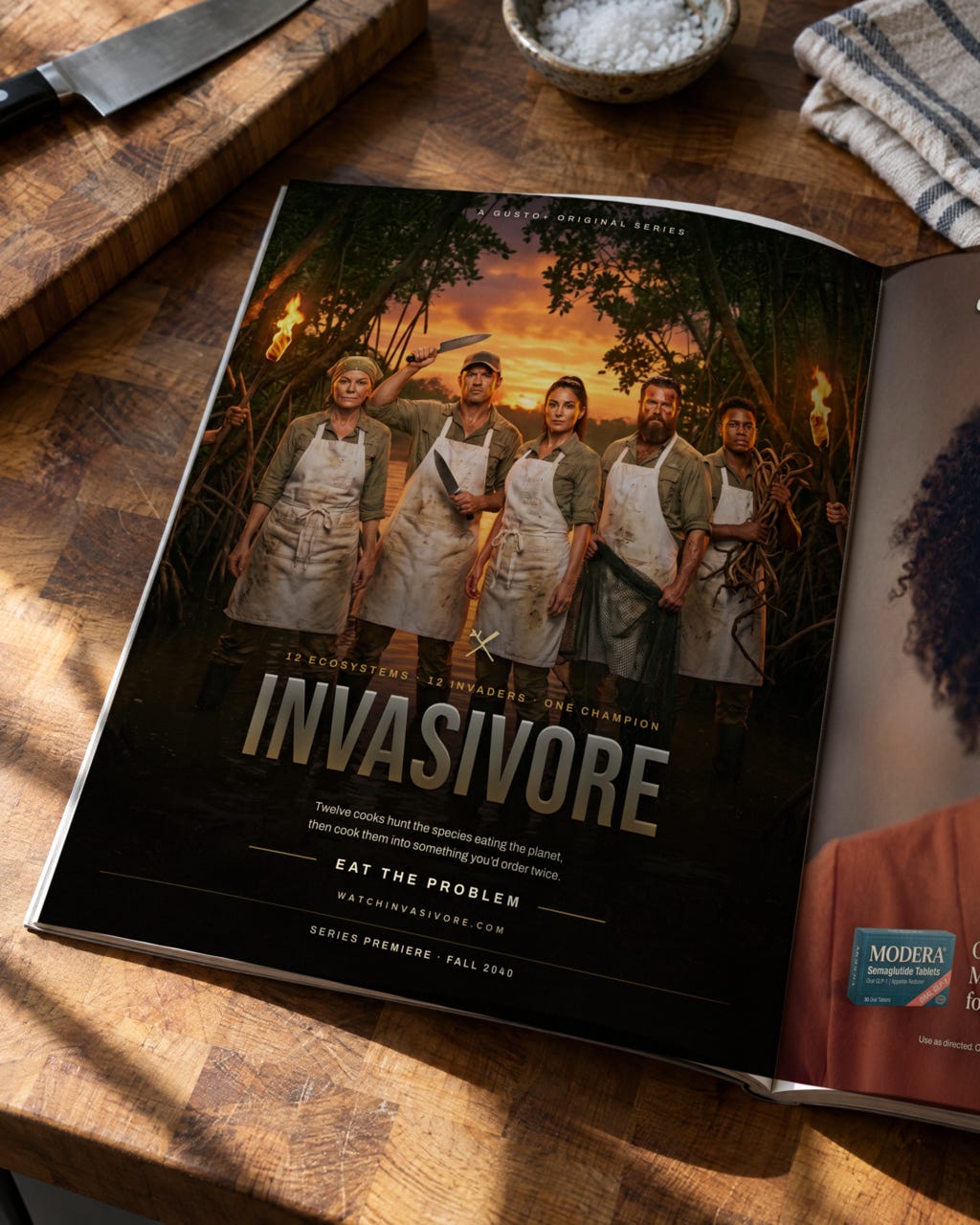
Global warming moves more than wine regions. It also moves pests. Milder winters let invasive plants, insects, and animals spread to new places and crowd out whatever already lives there. Take the lionfish, for example. They arrived in places like Florida through the aquarium trade as early as 1985. Since then, they’ve spread up to North Carolina, hunting native fish and lacking natural predators, and have turned up as far north as Long Island. Cold weather prevents them from going farther north, but as the Atlantic continues to warm, lionfish are likely to move with the heat, disrupting ecosystems as they migrate.
The ad for Invasivore, a new reality cooking competition, shows how the entertainment industry kills two birds with one stone, earning ratings while eradicating harmful animal species and turning them into TV food porn.
Disaster Tourism
Climate change is slowly destroying population centers, but can that destruction both be a feature and a bug? That’s what the ad for Venezia asks. It’s 2040 and Venice’s famed waterways have gotten even more watery. In real life, Venice already floods more than it used to. Italy installed new flood gates that had to be raised 49 times in the first two years to prevent excessive flooding. Engineers originally expected to raise them five times per year.
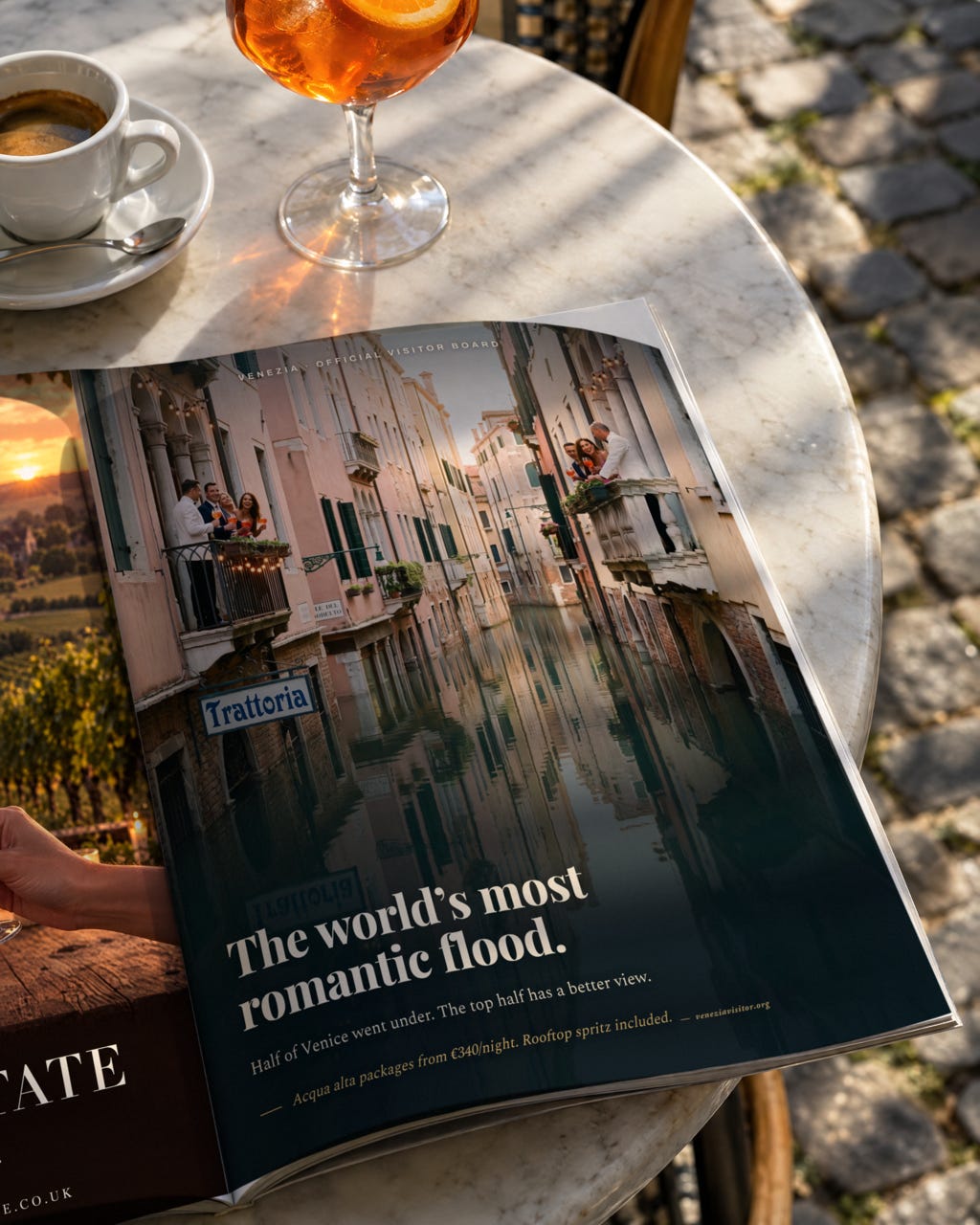
The ad shows two couples toasting their spritzes from a balcony above the canal that has flooded up past the doorways. It’s “The world’s most romantic flood,” the ad touts, with the dark refrain, “Half of Venice went under. The top half has a better view.”
Disasters have always gone hand in hand with tourism. From Pompeii to Ground Zero to Hiroshima, there’s a certain energy in a place where mass casualties once occurred that humans find intriguing to visit. In places like those, the tone is somber and reflective. But in the Venice of 2040, people are celebrating above the flood, presumably oblivious to the destruction that rising sea levels have inflicted on the world.
That’s the unsettling undertone of the ad. The revelers on the balcony aren’t ignoring a disaster, because to them, it isn’t one. This is what’s called shifting baseline syndrome, where every younger generation grows up with a different definition of “normal.” A flood that happens to one generation is shocking. But to their kids, who grew up in a world where a region has always been flooded, it’s as if there was never a flood. Given enough time and generations, a flooded coastline stops looking like damage and just looks like a regular coastline.
If Venezia makes a flood feel normal, then the ad for Varma, a luxury spa in Iceland built atop a data center, makes one of the causes of climate change feel like a good idea. The ad shows an idyllic and austere hot spring under a twilight sky. “You’re not relaxing. You’re sequestering.” it assures you, inviting you to enjoy the more sensual side of data center exhaust heat.
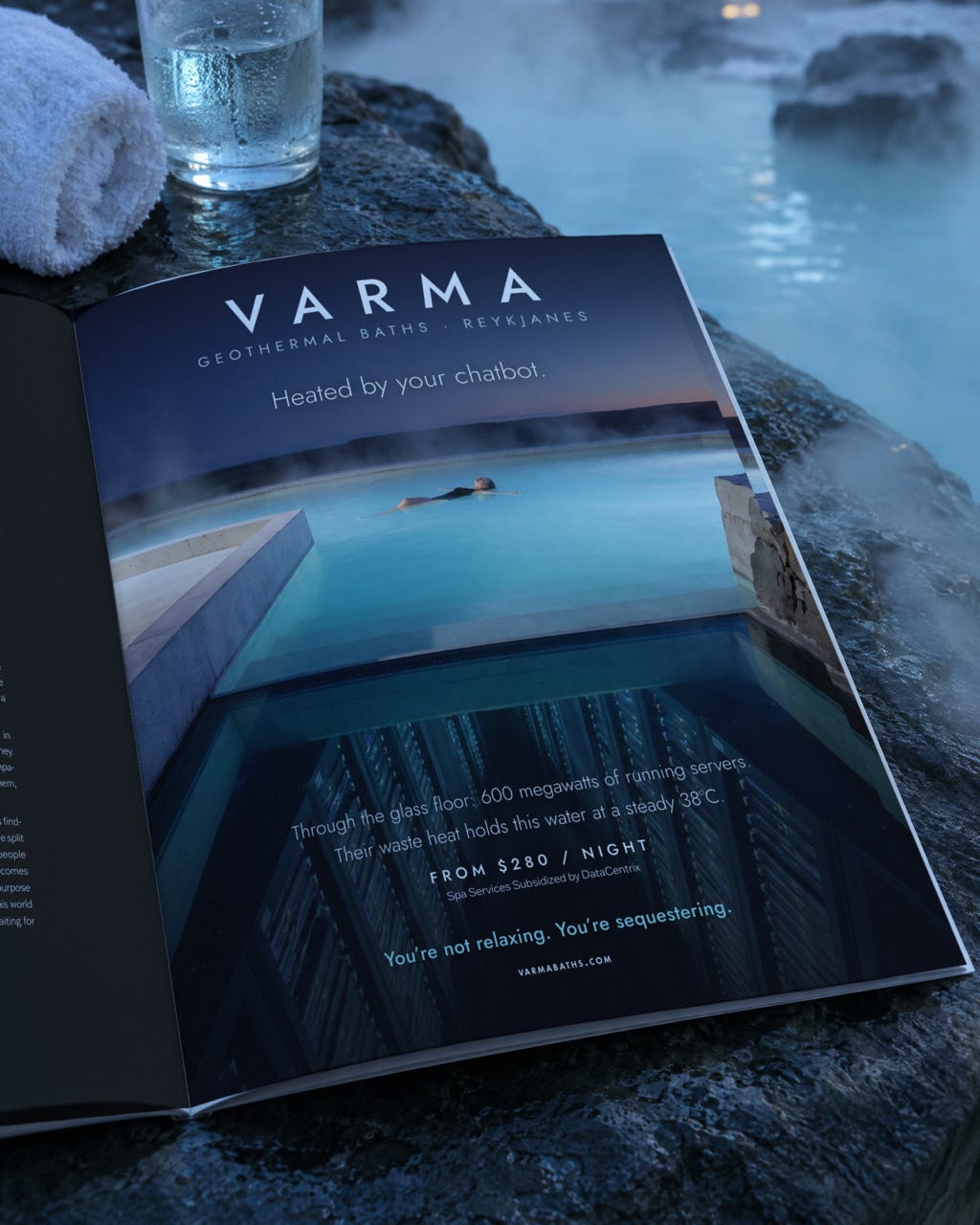
The idea for Varma was inspired by the architect Bjarke Ingels’s concept of hedonistic sustainability, a concept I’ve long borrowed from to apply to the food system. In architecture, hedonistic sustainability looks like a power plant with a ski hill on top. In food, it might look like eating a more biodiverse diet, which can diversify and strengthen our agricultural system but also be more thrilling and delicious for eaters.
But does soaking in a hot spring or going skiing on top of a power plant do good for the planet? The more ecologically friendly thing would be to not even need the data center or power plant in the first place. Isn’t the hot spring and ski hill simply trying to make us feel better about polluting?
Maybe there’s a clue in the wording: Hedonistic sustainability. Sustainability, as in sustaining what is already there, assuming the status quo is worth sustaining. But is it? Fans of regenerative agriculture are quick to call out this lyrical flaw in the sustainability movement: that it just sustains, but does not regenerate. And with the planet on pace to exceed the 2°C warming threshold, I’m not sure the current state of the planet is good enough to merely sustain. We need healing, not life support.

Which Way Does the Profit Go?
None of these companies are real, but the instinct behind them is. The profit motive doesn’t switch off when the world gets too hot. Businesses watch conditions change and they adapt, sometimes with a new product or service.
That isn’t a judgment, but an observation. Profit can come from exploitation, or it can keep a business open and give honest, hardworking people a decent living. A crew selling invasive fish to restaurants and a vineyard worker in Kent are both earning a living from climate change, and it’s hard to say either of them is doing something wrong. So asking whether it’s ethical to profit from climate change doesn’t get us very far. People will, and some of them should.
Maybe it’s better to ask where the profit takes us. Does it grow if the climate problem gets worse, or better? A reality show about cooking invasive species, however well-meaning, needs a new invasive species to cook every week. A community in England depends on its newly minted wine region staying hot. Neither of them needs to be acting in bad faith. Yet when enough families depend on a climate disaster to put food on the table, do those people start to quietly root for it?
Many huge businesses both profit from and help people in the midst of climate disasters. Air conditioning can be both lifesaving and profitable. Flood insurance can help regular people avoid bankruptcy while being profitable. But the more acceptable a company can make the new normal feel, the faster we forget there was an old normal. It’s the shifting baseline, except now someone is paid to keep it shifting.
The businesses we should be cheering on are the ones that make more money as the planet heals. Like farmers who enrich their soil, their families, and their communities as they grow, providing nutrient-dense and abnormally delicious food that most people can afford.
In food, being big has been a liability for the past 20-ish years. “Big Food Bad, Small Food Good” has been a battle cry in many food circles. But under what conditions would we all want to cheer on a Big Food company to get even bigger? We’d want them to get bigger because they treated their employees, customers, and suppliers better each year they grew, and because they regenerated the planet.
Could a company like that exist? This is the goal of the B Corp, the société à mission, and others like them: getting companies to work honestly and effectively toward people, planet, and profit. Danone tried it in 2020, and investors ousted its CEO less than a year later. So how might we rewire the political and economic incentives we have today to create such a company?
But a more practical question we can all use today: the next time we’re listening to a climate panel with corporations on it, ask, “Would you make more money if climate change got worse, or if it got better?” Then check where their money actually comes from.
—
See all the ads in Mise 02: The Restaurant Issue, out now.
—
Mike Lee is a food futurist and innovation strategist, author of Mise: On the Future of Food, host of The Tomorrow Today Show podcast, creator of Mise Futures, and is on Instagram at The Book of Mise.