

Last week I described how our current food system is organized around chokepoints: a 21-mile strait carrying a fifth of the world’s oil and a third of its seaborne fertilizer, four companies processing most of America’s beef, a single banana cultivar feeding half the planet. That essay was a diagnosis, this one is about the redesign.
The food world already has a word for the new system it wants: resilient. It runs through policy reports, USDA white papers, industry sustainability decks. The picture is recovery: the system takes a hit, like a hurricane or strait closure, and bounces back.
Resilience gets built through redundancy: backup suppliers, buffer stocks of grain and fertilizer, plans for the recovery curve. It’s a defensible goal. But bouncing back means bouncing back to the same design that produced the vulnerability in the first place, and a system that returns to baseline after every shock has learned nothing from it. The next one finds the same weak point.
Nassim Taleb, the risk theorist who wrote The Black Swan, already had the better word for it. In his 2012 book Antifragile, he laid out a three-part distinction. Fragile things break under stress. Antifragile things get stronger from it. Resilience sits in the middle: you survive without gaining. Muscle is antifragile. The immune system is antifragile. And our food system should be antifragile too.
In practice, that means small regional plants that pick up customers every time a giant one goes down, farms with living soil that out-produce depleted ones in a drought, and prices and insurance that get smarter after each bad year instead of just more expensive. Most of today’s industrial food system is fragile, dressed up as resilient. It looked steady through a sixty-year run where the big inputs cooperated and nothing serious tested it. Resilience isn’t wrong, just inadequate.
The Food System Is Built On Three Big Assumptions
The industrial food system runs on three assumptions so embedded they’re invisible. Together they make it fragile.
Efficiency is the highest good. This is why four meatpackers process 85% of American beef: fewer plants, lower cost per pound. The same logic explains why 90% of the global grain trade runs through four companies and why roughly 75% of global food comes from just 12 plants and 5 animal species. Each consolidation made the system cheaper. Each also made it more fragile. We treated the fragility as an acceptable side effect, until it wasn’t.
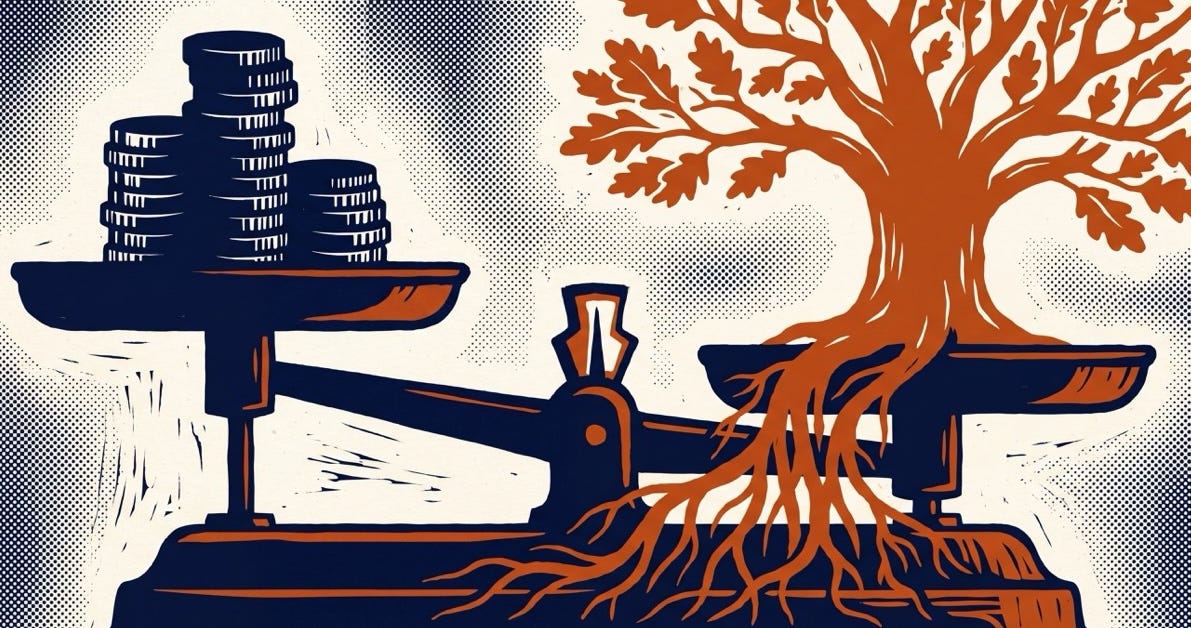
Nature comes free. Soil gets treated as a substrate for chemical inputs, but it’s a living system that took thousands of years to build and decades to deplete. Water is priced for delivery, but the watershed producing it doesn’t appear on anyone’s books. Pollinators, genetic diversity, the nitrogen cycle, grassland carbon all produce enormous economic value, none of which shows up on any income statement. When something is priced at zero, people use it like it’s infinite. Policy has made the math official. In January 2026, the Trump EPA stripped the health-benefit valuation from a soot and ozone rule that projected $46 billion in annual benefits. Combined with broader rollbacks of clean air and water rules, federal accounting now matches industry practice: clean air and intact ecosystems are worth zero unless somebody proves otherwise.
Damage is someone else’s problem. Nitrogen runoff from Midwestern corn fields creates a Gulf of Mexico dead zone the size of New Jersey, and the cost never lands on any grain company’s P&L. The FAO’s 2024 true cost accounting report put the hidden costs of global agrifood systems at $12 trillion a year, roughly 10% of global GDP. Over 70% comes from diet-related disease, the downstream consequence of a system engineered around cheap calories. Another 20% covers soil depletion, nitrogen pollution, biodiversity loss, and the carbon baked into every step from fertilizer to shelf. These costs land on public health systems, ecosystems, and future generations, not the companies that create them. Economists call this externalizing. The blunter version: we designed the system so the people who profit from the damage seldom see the bill.
These three assumptions aren’t failures of the food system, they are the food system. The goal was cheap, abundant food, and the design delivered. The concentration, the fragility, the ecological cost, the diet-related disease were consequences of optimizing for cheap food. What the system wasn’t built to do is improve under stress, so it keeps breaking in the same places. Reform work stalls for the same reason: it tries to fix outputs without touching the logic that produces them. You can fund a thousand regenerative pilots, but if the prevailing inventives of the economy and food system still reward depletion, then depletion is what you’re going to get.
What Antifragile Looks Like In Food
Muscles tear under load and rebuild stronger. The immune system meets a virus, learns it, and fights off the next exposure before you notice. Both turn stress into improvement. The same mechanism already operates inside the food system, but only in pockets, and not as the default.
Start at the field. Wine grapes grown under a little drought stress make more concentrated, more flavorful fruit than well-watered ones. Same for dry-farmed tomatoes and olive trees, which push their roots deeper and concentrate their oils when forced to fight for water. Biologists call it hormesis: a little stress triggers the plant to make the very compounds that taste good and command higher prices. The stressed crop out-earns the pampered one. Taste and toughness, it turns out, are usually the same project.
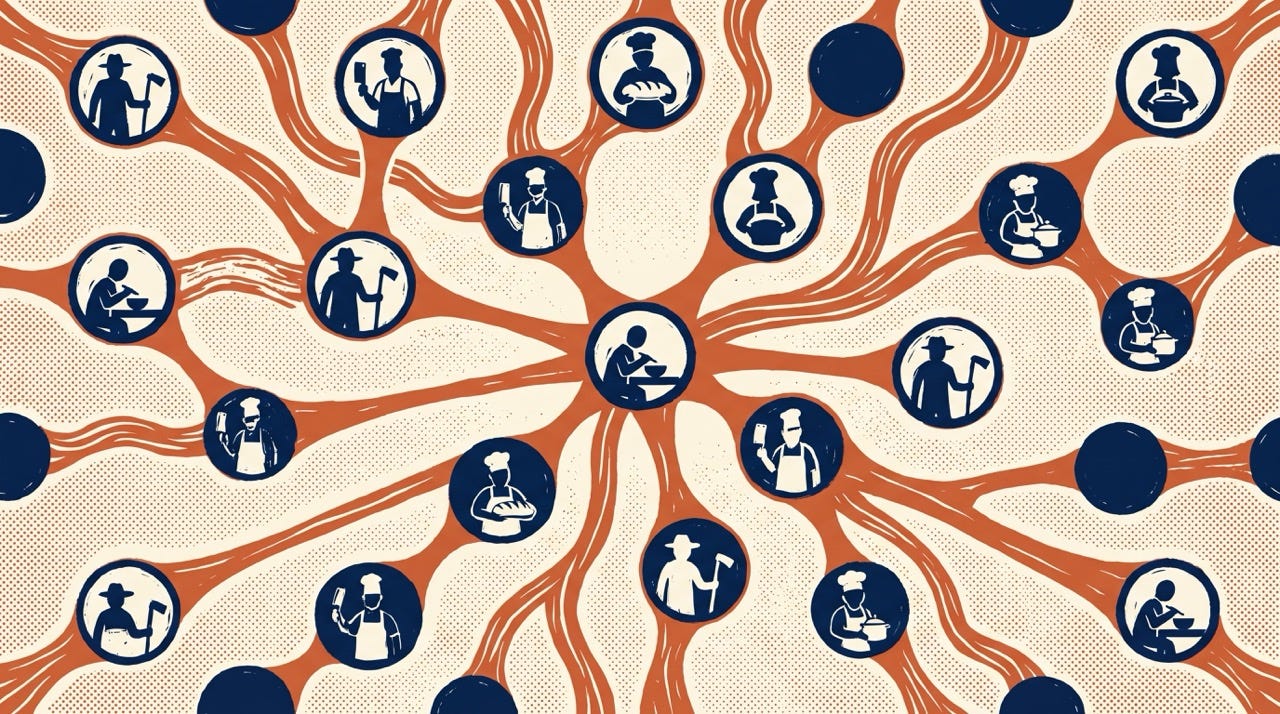
Now zoom out to the network. When the JBS ransomware attack shut down the company’s U.S. beef plants in May 2021, and again when the big packers went dark during the early months of COVID, prices spiked and shelves emptied. The chokepoints cracked exactly where last week’s essay said they would. Beef is still that consolidated, and the next ransomware attack will hit just as hard. But each disruption did something else too. Smaller regional processors that stayed open picked up customers and orders they couldn’t have won in a calm market, and federal money for small and regional meat processing climbed in the years that followed. Each centralized failure was free marketing for the distributed alternative. The decentralized layer gains share whenever the central layer stumbles, and gains capital to expand for the next round.
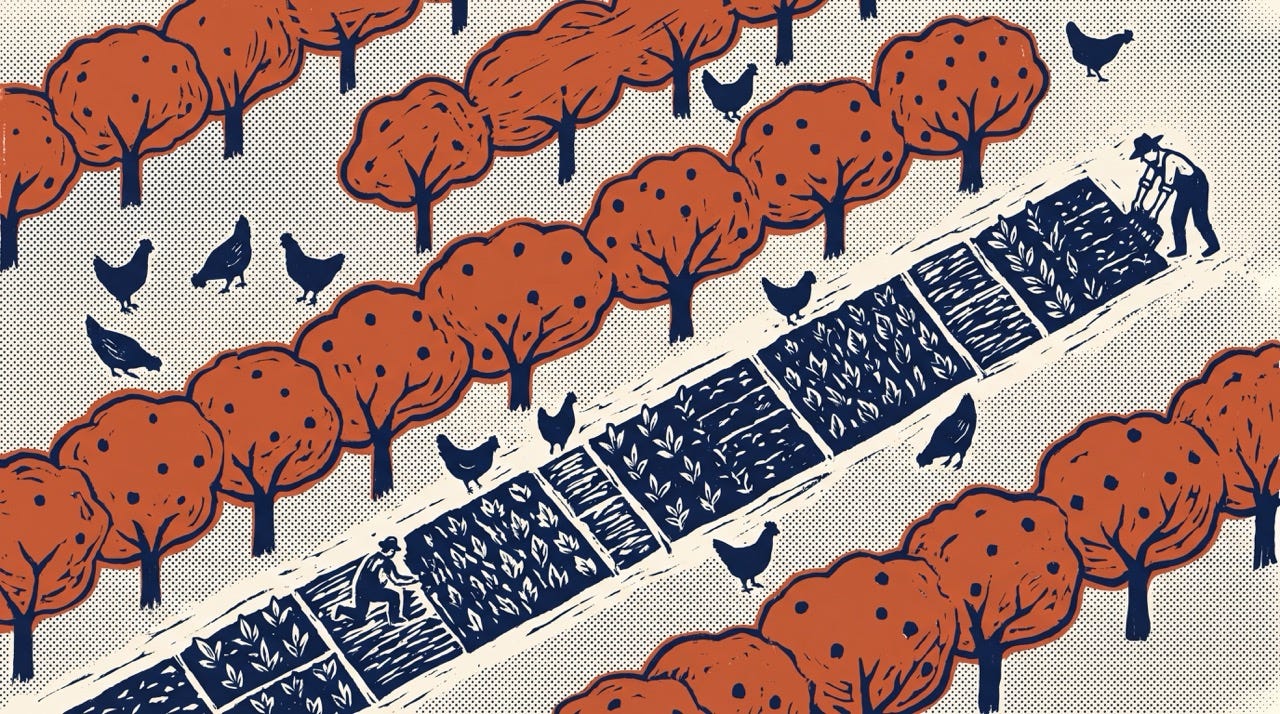
Now the soil. Drought hits everyone, but soils with high organic matter hold more water, so the regenerative field outyields the depleted one when it matters most. Each bad year widens that yield gap and makes the case for switching practices harder to argue against. The shock doesn’t damage the regenerative farm in the same way, it promotes it. Same logic for diverse rotations during a pest outbreak: when one crop fails, the others carry the season, and the farmer learns which mixes to lean on next year. The failure trains the system. Regenerative agriculture is what antifragility looks like on a farm.
None of this is theoretical. It’s already happening at the margins, against a default that still rewards the fragile option. The job is to restructure the incentives so the parts already working this way can grow into the dominant ones.
Making The Invisible Visible
Most corporate behavior follows the numbers. Right now the numbers lie. Nature doesn’t appear on a balance sheet; soil health doesn’t factor into insurance; the damage from a dead zone is paid by fishermen rather than by the fertilizer company. Change those three things, and the cheapest option stops being the most damaging one.
I’m skeptical of the pastoral vision where everyone shops at farmers markets and eats seasonal heirloom vegetables at every meal. While idyllic, that vision doesn’t readily scale past affluent zip codes, and it leaves the system’s incentives untouched for everyone else. The redesign I have in mind is more boring than that: a food system where the financial signals tell the truth about what things actually cost. Shift the signals, and the system tends to find solutions no single planner would have designed.
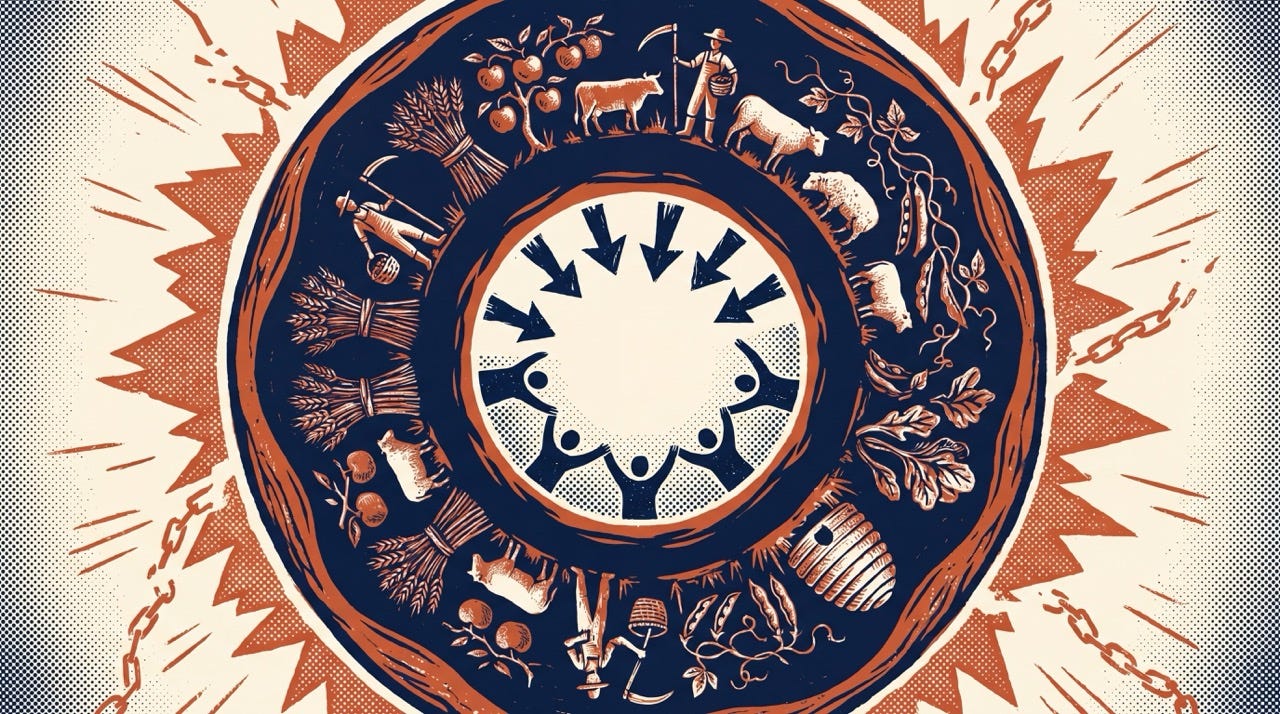
Kate Raworth’s Doughnut Economics model gives the shift a useful frame. She draws two boundaries. A social floor, below which people lack the essentials of a decent life. An ecological ceiling, beyond which human activity destabilizes the planetary systems we depend on. The food system is one of the few enterprises that breaches both at once. It overshoots the ceiling and leaves hundreds of millions below the floor. Any redesign has to operate between those two lines.
Three mechanisms are trying to fix the accounting: one for public companies, one that creates a new kind of company whose assets are ecosystems, and one that reaches the farmer through the insurance contract they actually sign.
The first is the Taskforce on Nature-related Financial Disclosures, or TNFD. It does for nature what climate disclosure does for carbon: forces public companies to disclose what their business actually depends on. A grain trader would have to put soil, water, and pollinators on the same page as quarterly earnings. In April 2025 the IFRS Foundation, which sets the world’s accounting standards, adopted the framework. Agriculture will be one of the first sectors to get its own rulebook.
Natural Asset Companies (NACs) are a stranger idea. Today, an investor can buy shares in a logging firm that profits from cutting a forest down. NACs would let an investor buy shares in a company that profits from leaving the forest standing, by putting a price on what intact forests do for free: filter water, absorb carbon, hold soil in place. The NYSE proposed listing them in 2023; political opposition killed the proposal in 2024. NACs may not be the mechanism that cracks this open, but some mechanism has to. A system that prices ecosystem destruction at zero just keeps producing more of it.
Crop insurance is where the accounting meets the dirt. The federal crop insurance program is a $17 billion-a-year operation that currently treats a farmer who builds soil and a farmer who depletes it the same. A research project launched in late 2025 is testing whether soil health could be priced as a risk factor, the way a credit score is.
In a 2024 paper in the American Journal of Agricultural Economics, Aglasan and colleagues found that Midwest counties with higher cover-crop adoption logged lower crop insurance losses from drought, heat, and excess moisture across 2005 to 2018. If that holds at scale, the farmers doing the work get lower premiums, paid for by lower payouts to the ones that aren’t. The reason to switch shows up in the budget instead of in a sustainability report no one reads. Each bad year also feeds the model: the system learns what survived and prices the next round accordingly. That’s antifragility built into the financial layer.
The Circular Consequence
Once prices start telling the truth, a lot of things that look like sacrifices start looking like good business.
Right now the food system is linear: extract, produce, consume, discard. Nitrogen gets mined or synthesized, applied to soil, absorbed by crops, eaten by people, flushed into waterways. A Cornell study published this month in Nature Sustainability found that if the U.S. just recovered the nutrients in its animal and human waste, it could cover all of its agricultural nitrogen needs and half its phosphorus needs. We are importing nitrogen from the Persian Gulf while flushing a surplus into our own rivers. The only thing keeping the loop open is that the open loop is cheaper, because nobody pays for the rivers and oceans we’re polluting downstream.
Close that loop and the rest of the logic clicks into place. Food waste becomes compost. Compost rebuilds soil. Healthier soil needs less synthetic input, which means less dependence on a volatile global supply chain. Cover cropping, agroforestry, and silvopasture all predate industrial agriculture and cycle nutrients instead of consuming them. But they lost to cheaper farming methods because historically for our food system, “cheaper” was the only thing that mattered.
The same logic reshapes infrastructure. Past a certain point, scale itself is fragility. When one giant plant breaks, whole regions go without dinner; a dozen smaller plants can lose any one node and keep running. Decentralized nitrogen production, regional meat processing, local food hubs, distributed cold storage all cost more per unit than their centralized equivalents, and all of them keep working when a single node fails.
They also gain customers and capital every time the central nodes go down. A 2024 Nature Food study found small-scale ammonia production could meet up to 96% of global demand once transportation and disruption risk are priced in. Nitricity, a company in Delhi, California, turns almond shells into nitrogen fertilizer and has sold its output through 2028. Whether Nitricity specifically wins matters less than whether the distributed architecture takes hold.
The Demand Problem
Supply-side changes, no matter how well priced, run into a wall called consumer choice. People pick food by taste, then price, then convenience, with sustainability a distant fourth, if at all. In every consumer study I’ve read or done, the pattern holds. Given two identical products, people pick the sustainable one. Given two where the sustainable option tastes worse or costs more, they don’t.
This is why I keep coming back to altruistic hedonism. Sustainability at scale has to ride on the back of pleasure. Row 7 Seed Company, co-founded by Dan Barber and plant breeder Michael Mazourek, exists because Mazourek told Barber that in his entire career, nobody had ever asked him to breed for taste. Modern vegetable breeding has optimized for yield, shelf life, shipping, and appearance, with flavor as an afterthought. Their conversation produced the honeynut squash and many other markedly more delicious vegetables, which now sell through Whole Foods. Patagonia Provisions sells beer and pasta made from Kernza, a perennial grain whose ten-foot roots rebuild soil every season.
Both companies are primarily targeting affluent consumers right now, as they have not become mainstream and accessible to all yet. But what they’re demonstrating at a small scale is the radical idea that hedonism and sustainability don’t have to be mutually exclusive. That idea needs more room to develop, and even if it stays at the high end for now, it can’t end there.
Consumer tech has always worked this way: a new iPhone or laptop launches at a premium for early adopters, and a few years later it’s saturated the mainstream. Expensive at launch, ordinary by the end. What Row 7 and Patagonia Provisions make needs to travel the same path, or their impact stays capped by the discretionary spending of affluent food shoppers. Pricey fashion vegetables for people who already care cannot be where this lands. The food industry has to reach the people who never think about sustainability, and make regenerative food the default, whether they know it or not.
If regenerative, biodiverse, regionally adapted food tastes measurably better, the market does work that policy alone probably can’t. Everyone chases after flavor, but unfortunately for the planet, not everyone is hard wired to chase sustainability. But in a world where the best tasting food derives its taste from being grown responsibly with healthy, rich soil, then sustainability and regeneration become byproducts of selfishness, which may be the only version that scales to 8 billion people. The instinct to seek pleasure in food is millions of years old. The instinct to seek sustainability is maybe twenty. I know which one I’m designing around.
A New Design
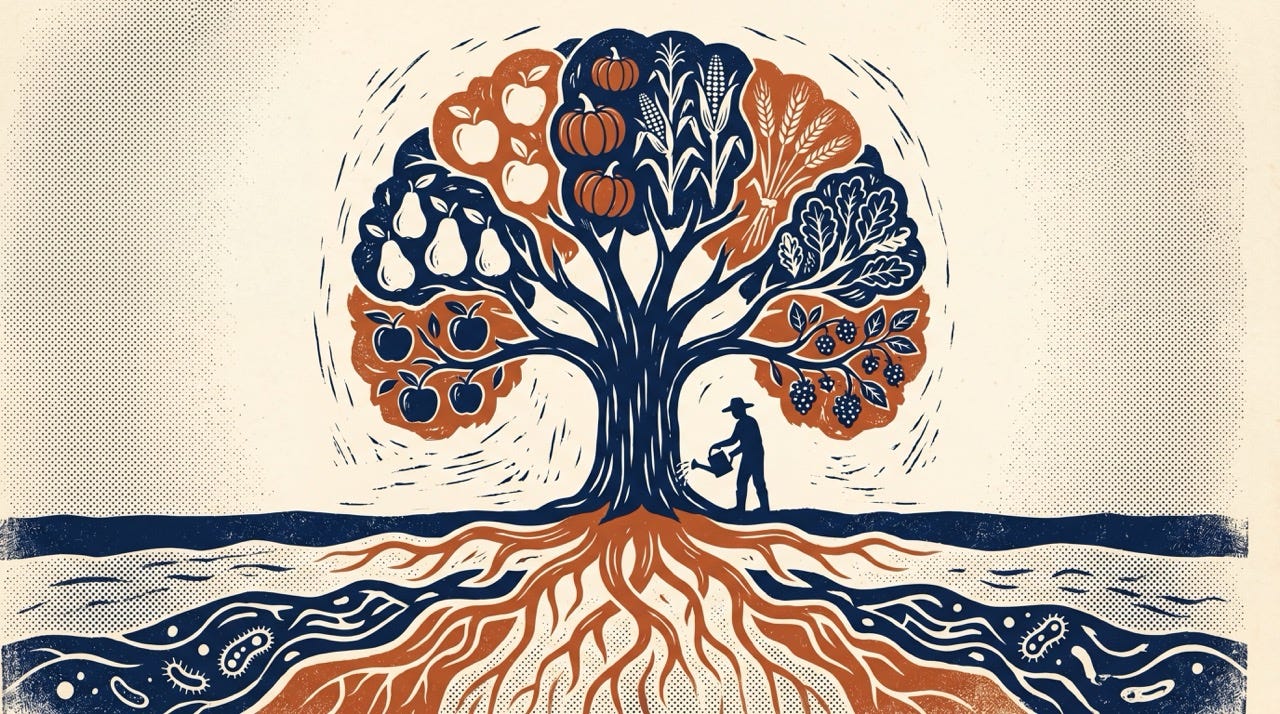
The pieces I’ve been describing don’t look novel on their own: truthful prices, closed loops, regional nodes, pleasure-led demand, antifragile soil. What’s new is treating them as one redesign instead of five siloed sustainability plays. Give the current system another hundred years without that redesign, and the picture isn’t hard to sketch.
Consolidation continues because it still pays. More fertilizer and grain moves through fewer chokepoints. Another disease hits another monocrop and we rebuild around whatever survives. Aquifers that have been draining since the 1950s finish draining. Shocks that used to hit once a decade hit annually, then seasonally. Crop insurance gets expensive, then unaffordable, then withdrawn. Diet-related disease eats a bigger share of every rich country’s healthcare budget until something gives. None of this requires a catastrophe. Each move is the rational continuation of the last one. That’s what “exactly as designed” looks like by the year 2126.
The other path is harder to describe because it hasn’t been built. Prices tell the truth about ecological cost, so soil-builders out-earn soil-miners. Regional nodes pick up share every time a central one falters. Nitrogen cycles between farm and table and back, and the Persian Gulf import bill shrinks every year. Plant breeding optimizes for flavor and soil at the same time, so what’s best for the land tastes best on the plate. More pleasure, not less. A food system that gets stronger from each shock and feeds more people, not fewer. Neither future is guaranteed. The first is the slope we’re already on; the second takes real work, most of which hasn’t started at scale.
I don’t know which pieces will matter. TNFD could become just a routine checkbox. NACs could die in regulatory purgatory. Crop insurance reform has to survive actuarial committees where caution disguises itself as rigor. Row 7 might stay a niche honeynut story. You have to accept most of that before you start placing the bets.
But the current design is failing on its own terms. Hormuz. COVID. Avian flu. The Panama Canal. The crises mostly hit the same pressure point: wherever concentration meets disruption. And they’re getting more frequent.
Taleb has another metaphor for this: the turkey parable. Feed a turkey for a thousand days and by day 999 he’s never been more sure the butcher loves him, until he gets slaughtered on day 1000. Our food system has been living that life for a while. Every year of stable abundance was more evidence the model worked, until it doesn’t.
The next food system gets built by people who think in generations. They see the gap between how food works now and how it should work, and decide that closing it is worth a career. What they’re building is larger than any single company or movement. It’s a food system that feeds more people without stripping the soil, and gets stronger from each crisis. The current design won’t get us there. I’m with the people who are building the next one.
—
Mike Lee is a food futurist and innovation strategist, author of Mise: On the Future of Food, host of The Tomorrow Today Show podcast, creator of Mise Futures, and is on Instagram at The Book of Mise.