



Producer’s Note: The following is a transcript of a special episode of The Tomorrow Today Show, recorded by Mike Lee on August 18, 2025. Due to the unusual nature of this recording, we recommend reading the transcript with an open mind and a healthy appreciation for theoretical possibilities. -Sarah Vaughn, Producer
MIKE LEE: Hello World! Welcome to a very, very special episode of The Tomorrow Today Show. I’m your host, Mike Lee, and today we’re doing something that technically shouldn’t be possible. Last week, my team received two separate emails from the year 2045—both claiming to be from Boston, both timestamped identically, but describing completely different realities. After some creative technical work involving quantum entanglement and a borrowed MIT quantum computer (don’t ask), we’ve managed to establish communication with both timelines simultaneously.
Our guests today are living proof of a philosophical fork in the road. In one timeline, humanity embraced Thomas Malthus’s 1798 warning that population growth would inevitably outstrip food production. In the other, they followed Ester Boserup’s 1966 theory that human ingenuity rises to meet any challenge.
Let me introduce Kevin Rodriguez, a Population Management Officer from what we’re calling Timeline M—for Malthus. And Jane Clarke, Head of Community Food Innovation for Greater Boston, from Timeline B—for Boserup.
Jane, Kevin, the weird thing is you both live in Boston, but your Bostons couldn’t be more different. Kevin, paint us a picture.
KEVIN RODRIGUEZ: Boston, 2045, Timeline M. Population: 2.1 million, down from 4.9 million in 2025. Those elegant brownstones you remember? They’re processing centers now. Faneuil Hall is where you get your monthly protein allocation—assuming your productivity metrics qualify you. The Common is farmland, but it barely feeds a thousand people. Malthus predicted this exactly—population grows exponentially, food production grows linearly. The math is brutal but undeniable.
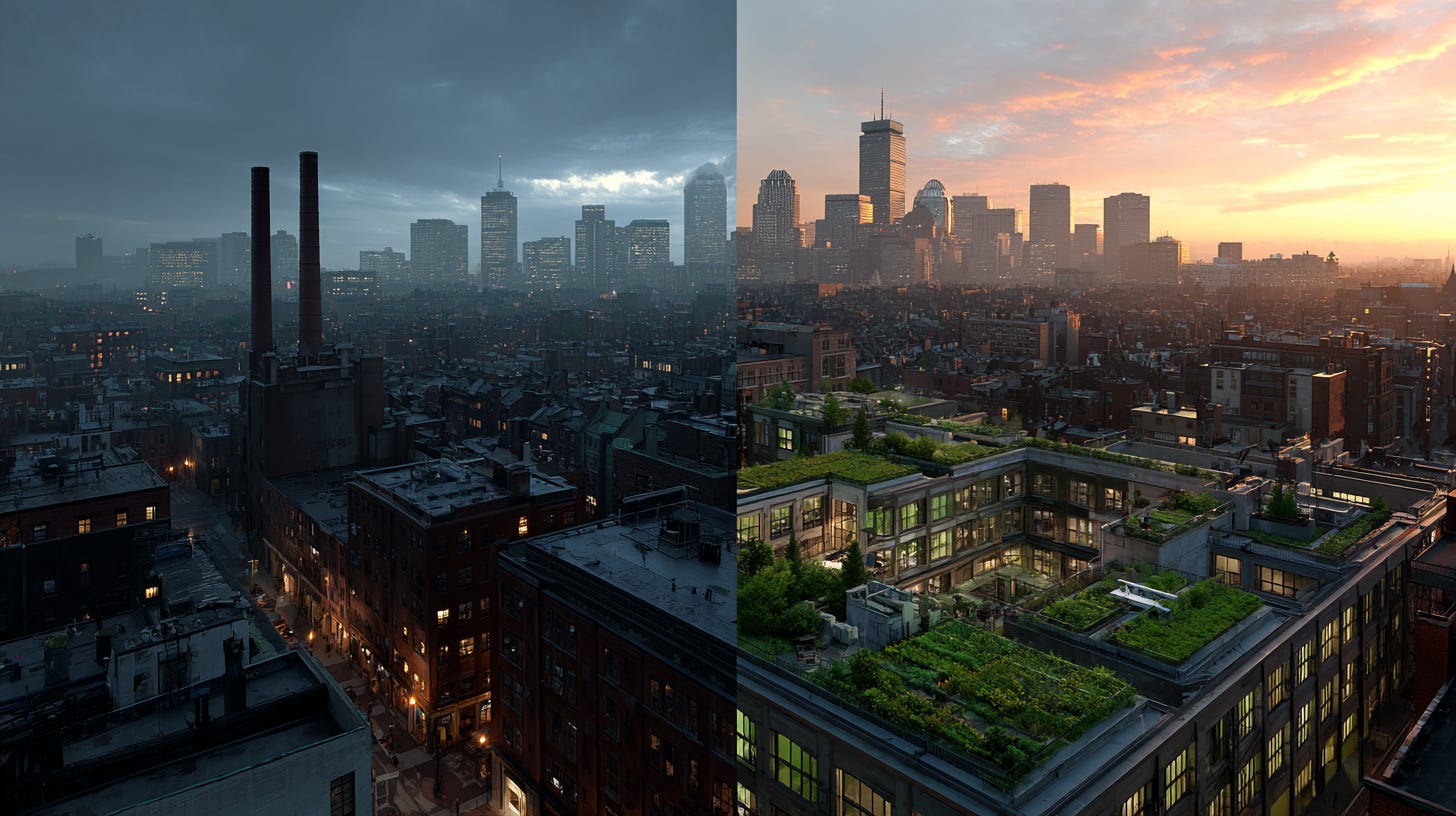
JANE CLARKE: [laughing] Sorry, it’s just—Boston, 2045, Timeline B. Population: 6.2 million and thriving. Those same brownstones have rooftop gardens and vertical farms built into their facades. Faneuil Hall is still a market, but now it’s where neighbors trade homegrown produce and share recipes. The Common? It’s a food forest that feeds ten thousand and hosts free agricultural classes every weekend. We proved Boserup’s theory—more people means more hands, more minds, more solutions.
MIKE: Okay, I have to ask the obvious question. How did two identical cities, facing the same population pressures, end up so differently?
KEVIN: The Shortage Summer of 2027. When the global wheat crisis hit and bread prices tripled overnight, our leaders made the hard choice. They said, “Malthus warned us—we can prevent catastrophe through controlled population decline, or nature will impose it through famine.” The Birth Allocation Act passed that September. One child per family, unless you could prove agricultural or scientific merit.
JANE: We had the same Shortage Summer! But our response was pure Boserup—pressure creates innovation. Within six months, a Boston University student developed perennial wheat that grows on rooftops. A Roxbury grandmother figured out how to make flour from acorns. By Christmas, we had seventeen new bread recipes using zero traditional wheat. The crisis didn’t break us; it made us creative.

MIKE: Let’s back up for listeners who might not be familiar with these theories. Kevin, you’re living Malthus’s prediction?
KEVIN: Thomas Malthus, 1798, “An Essay on the Principle of Population.” He observed that populations double every 25 years—2, 4, 8, 16—while food production increases steadily—1, 2, 3, 4. Simple math: exponential growth meets arithmetic growth equals catastrophe. In my timeline, we accepted this as iron law. The only question was whether we’d control population through what Malthus called “preventive checks”—birth control, delayed marriage—or suffer “positive checks”—war, plague, famine.
JANE: And I’m living Boserup’s rebuttal. Ester Boserup, 1966, “The Conditions of Agricultural Growth.” She studied farming across history and found that Malthus had it backwards. Population pressure doesn’t cause starvation—it forces innovation. When hunter-gatherers got crowded, they invented agriculture. When simple farming wasn’t enough, they developed irrigation, crop rotation, fertilizers. In my timeline, we trusted human creativity over mathematical doom.
MIKE: This is surreal. You’re basically living philosophical thought experiments. Kevin, what do you eat for breakfast?
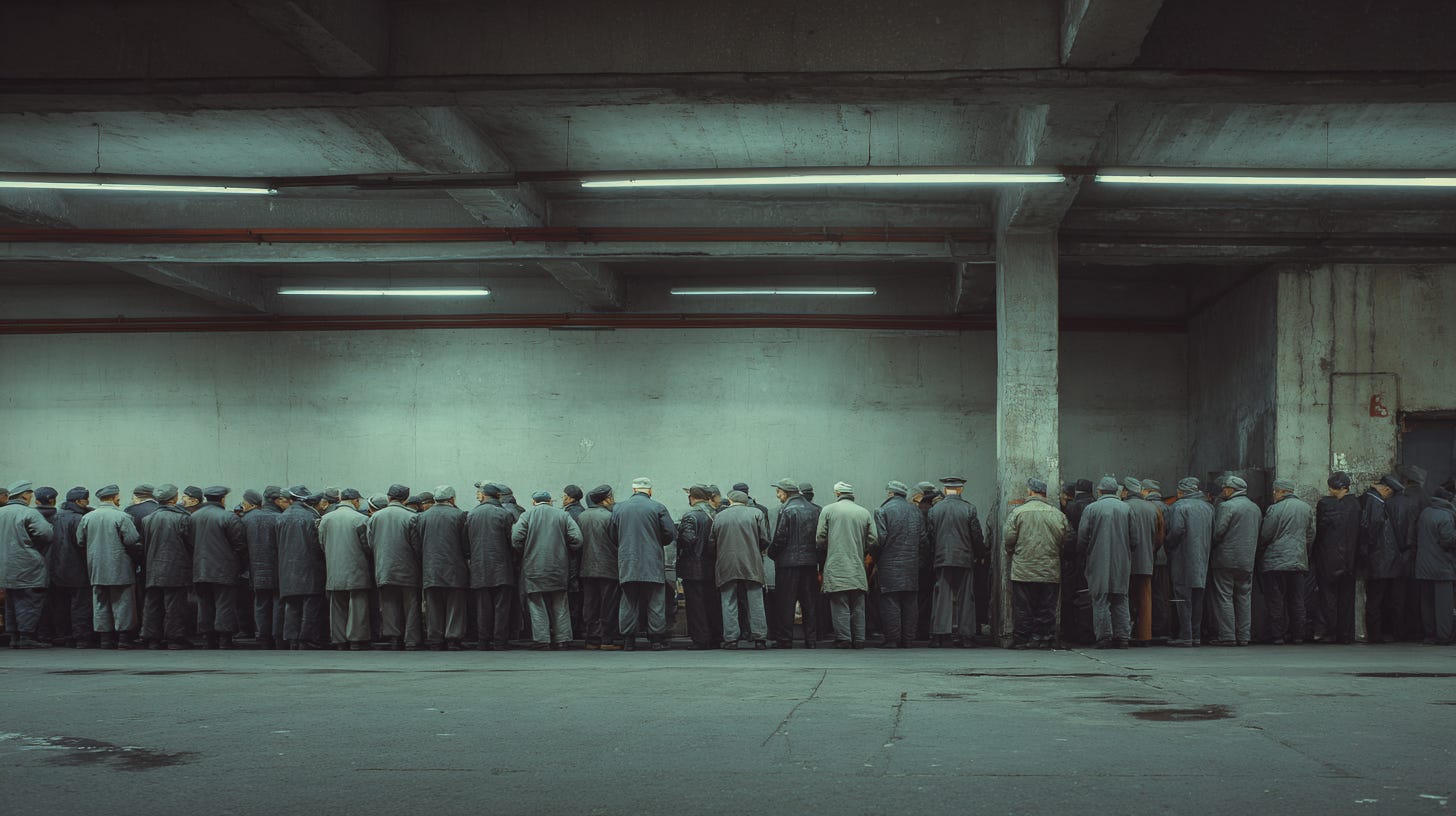
KEVIN: Protein Block 7-A, 400 calories, optimized for my age and work classification. It tastes like… resignation? They stopped trying to make it palatable after the Flavor Riots of ’38. Malthus would recognize this—when population exceeds carrying capacity, life becomes, as he put it, “nasty, brutish, and short.”

JANE: This morning? Eggs from my apartment building’s roof chickens, salad greens from my window farm, and sourdough from the neighborhood baker who mills acorn flour in her basement. It’s delicious chaos. Boserup would love it—distributed innovation, everyone a producer, necessity mothering a thousand tiny inventions.
MIKE: [chuckling] “Delicious chaos” versus “resignation.” That really sums it up. But Jane, critics of Boserup say her theory only works for societies with resources and education. What about inequality?
JANE: Fair point. The Boserupian path isn’t automatic—it requires investment in human potential. We had rough patches. The hoarding crisis of 2029, when wealthy neighborhoods tried to keep innovations to themselves. But we learned that food security is like herd immunity—it only works if everyone participates. Now every innovation is open-source by law. A kid in Dorchester can access the same vertical farming tutorials as someone in Beacon Hill.
KEVIN: See, that’s the fantasy. In reality, scarcity creates competition, not cooperation. The Malthusian truth is that resources are finite. Period. You can’t innovate your way out of thermodynamics. We tried urban farming, insect protein, lab-grown meat. But every solution just delayed the reckoning. Now the rich live in agricultural zones while the poor survive on processed algae. Malthus predicted this too—subsistence for the masses, surplus for the few.
MIKE: Kevin, that’s incredibly dark. Is there any joy in your timeline?
KEVIN: [pause] We have Stabilization Day—celebrating when population finally dropped below carrying capacity. Children get extra protein rations. There’s dancing, carefully choreographed to minimize calorie expenditure. Look, we avoided the worst-case scenario. No mass cannibalism, no complete ecological collapse. That’s… something.
JANE: Kevin, I want to give you a hug through the quantum field. In my timeline, we have Joy Gardens—public spaces where anyone can grow whatever makes them happy. Flowers, herbs, culturally significant plants that have zero calories but infinite meaning. We celebrate Abundance Day, when we proved Malthus wrong by feeding 7 billion people with room to spare.
MIKE: Let’s talk practical implications. What technologies emerged from your different approaches?
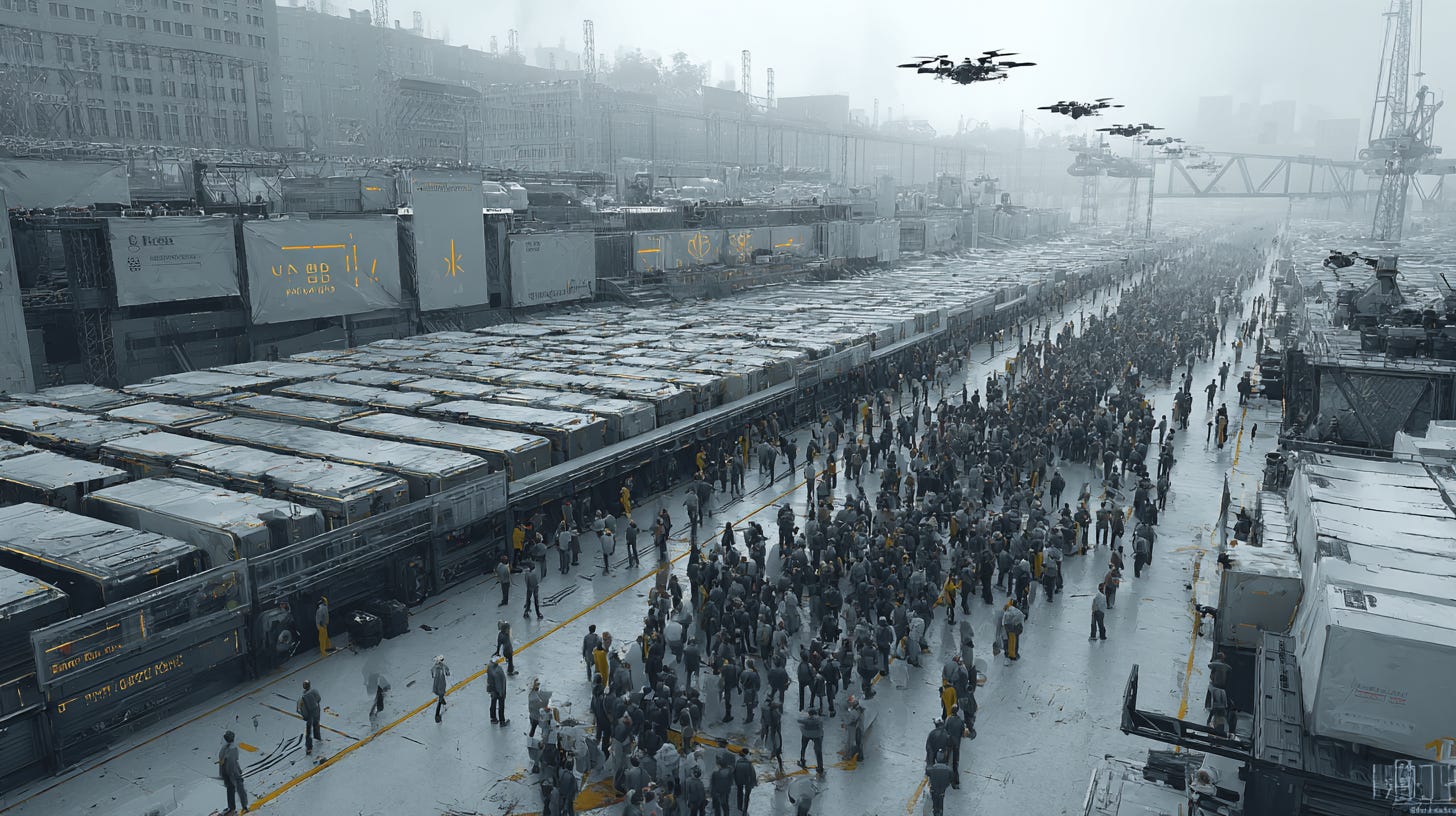
KEVIN: Efficiency maximization. Meal pills that provide perfect nutrition in 100 calories. Vertical farms that produce maximum calories per square foot. Genetic modifications to reduce human caloric needs—though the “Efficient Humans” program had… unfortunate side effects. We’ve gotten very good at doing more with less, because less is all we have.
JANE: Innovation explosion! Window farms that follow the sun. Mycelium networks that share nutrients between buildings. Edible landscaping that makes every surface productive. My favorite—the Boston Food Computer, an open-source AI that helps anyone grow anything anywhere. A kid in a basement apartment can grow tomatoes that would make an Italian grandmother weep with joy.
MIKE: Speaking of grandmothers, both Malthus and Boserup studied traditional societies. How do your timelines handle food traditions?
KEVIN: Cultural food practices were deemed inefficient in 2031. Thanksgiving is now “Gratitude for Adequate Nutrition Day.” We consume our allocated calories in silence to aid digestion. My grandmother’s tamale recipe is in a museum—“Artifacts of Excess: When Humans Ate for Pleasure.”
JANE: Food traditions are how we survived! When industrial agriculture wobbled, grandmothers’ knowledge saved us. Every cultural community contributed solutions. Vietnamese water spinach growing in Boston winters. Indigenous three-sisters agriculture on rooftops. Puerto Rican sofrito made from weeds that most people didn’t know were edible. Boserup was right—human knowledge is our greatest resource.
MIKE: This is fascinating and terrifying. What would you tell someone in 2025 who wants to avoid Kevin’s timeline and achieve Jane’s?
KEVIN: Don’t wait for the crisis. Malthus wasn’t advocating for my timeline—he was warning against it. He wanted voluntary population control and moral restraint to avoid forced control and suffering. But also recognize that resources have limits. Infinite growth on a finite planet is a fantasy, whether it’s population or economy.
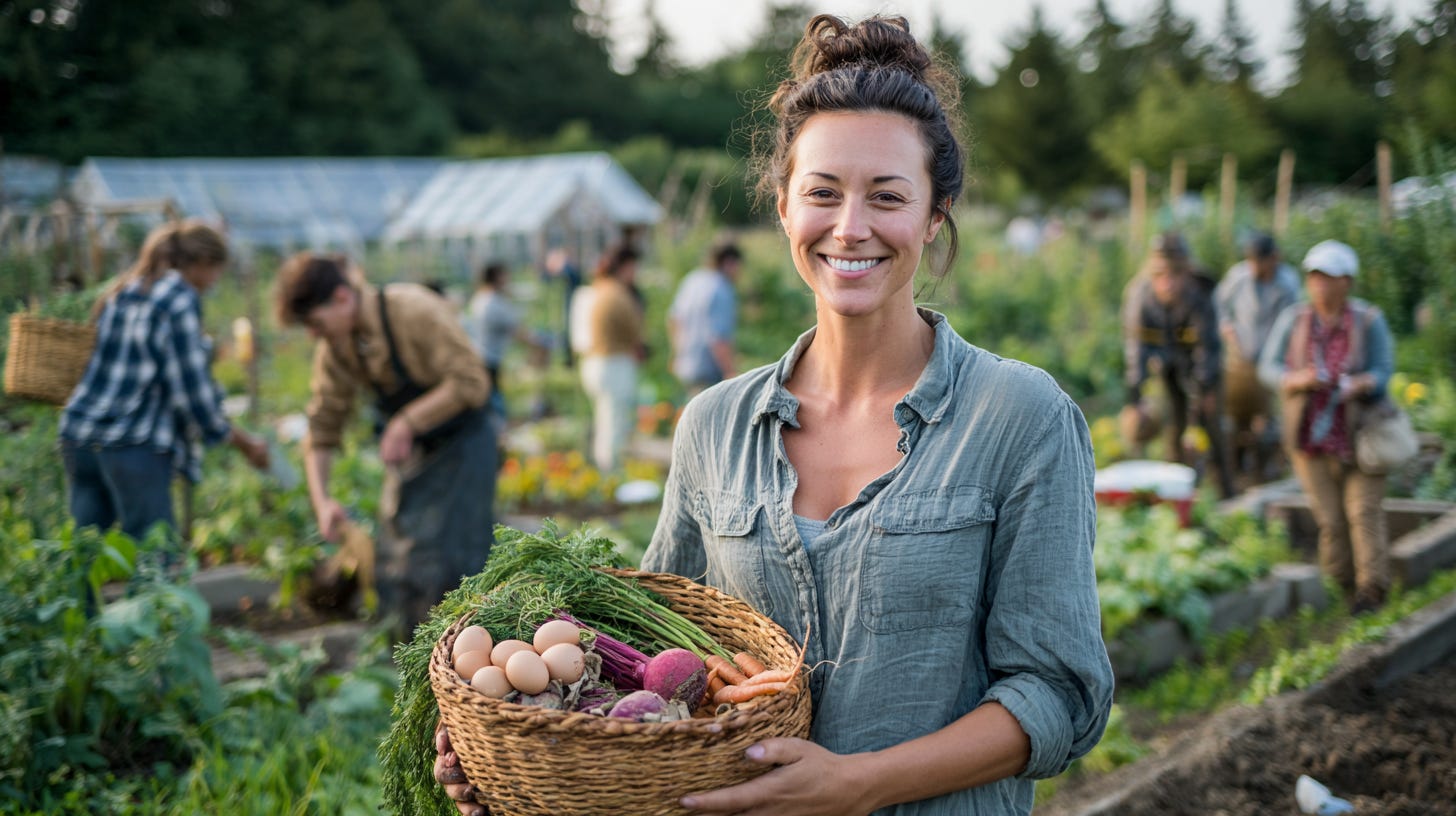
JANE: Start growing something. Anything. Even herbs on a windowsill. Share what you learn. Boserup’s insight wasn’t just that humans innovate under pressure—it’s that innovation is collective. The solution won’t come from one genius in a lab but from millions of people trying small experiments. Make friends with your neighbors. Learn one traditional recipe. Save seeds. The future is crowd-sourced.
MIKE: Final question, and this is the big one. Looking at both your timelines, what’s the real lesson about human nature and our relationship with food?
KEVIN: That Malthus was both right and wrong. He was right that populations can exceed carrying capacity—we’ve seen it happen locally throughout history. But he underestimated how brutal humans would become to avoid exceeding it globally. We didn’t just prevent overpopulation; we turned scarcity into a system of control. The powerful use Malthusian logic to justify inequality that has nothing to do with actual resource limits.
JANE: And Boserup was both right and wrong too. She was absolutely right that humans innovate under pressure—we’re living proof. But innovation isn’t automatic or equally distributed. It requires education, resources, and most importantly, faith in human potential. The moment we accept scarcity as inevitable, we stop innovating and start hoarding. The Boserupian future is a choice, not a destiny.
MIKE: So what you’re both saying is that these aren’t just theories about food and population—they’re self-fulfilling prophecies about human nature?
KEVIN & JANE: [simultaneously] Exactly.
JANE: If you believe humans are a plague that will inevitably exceed resources—
KEVIN: —you create systems to control them, and scarcity becomes real.
JANE: But if you believe humans are innovators who rise to meet challenges—
KEVIN: —you might just be naive enough to make it work.
JANE: [laughing] I’ll take naive over nihilistic any day.
KEVIN: [softer] Maybe that’s the difference between our timelines. You kept believing in tomorrow.
MIKE: [pause] Wow. Okay. I think we all need a moment to process that. Kevin Rodriguez and Jane Clarke, thank you for this glimpse into two possible futures—one shaped by fear, the other by hope, both by human choices made today.
To everyone listening: the future of food isn’t determined by mathematical models or technological inevitability. It’s determined by what we believe about ourselves and each other. Malthus and Boserup gave us the warnings and the inspiration. What we do with them—that’s up to us.
This has been a very special episode of The Tomorrow Today Show. I’m Mike Lee, reminding you that tomorrow is built on what we choose to believe today. Now if you’ll excuse me, I’m going to go plant something in my backyard and share the vegetables with my neighbors. You know, just in case.
[END TRANSCRIPT]

Producer’s Note: After recording, both guests simultaneously transmitted the same message: “The divergence point is 2026. Choose wisely.” We’ve started a community garden in the station parking lot and are hosting free seed-saving workshops every Tuesday. Also, Mike has become oddly obsessed with acorn flour. We’re monitoring the situation. - Sarah Vaughn, Producer
Additional Note: This special episode was produced as part of our “Philosophical Futures” series, exploring how academic theories might manifest in reality. No time travelers were harmed in the making of this podcast, because time travel remains, as far as we know, purely theoretical. Probably. - Legal Department
—
MOAR PLZ!
My Book - Mise: On the Future of Food
My Podcast - The Tomorrow Today Show
My Instagram - The Book of Mise
My Consultancy - Mise Futures
Brilliant! Thanks so much!
Quite interesting! Love the experiment.